
Tesla's Delivery Guidance and Robotaxi Ambitions: A Strategic Divergence or Warning Signal?


 Aime Summary
Tesla's 2025 has been a year of stark contrasts. While the company's vehicle deliveries have shown signs of stagnation, its long-term bets on artificial intelligence and autonomous driving have intensified. As the electric vehicle (EV) market faces a cooling demand environment and rising competition from Chinese automakers like BYD, Tesla's strategic pivot toward robotaxi and AI has raised critical questions: Is this a calculated shift toward high-margin, future-proof technologies, or a warning signal of misaligned priorities that could undermine near-term profitability?
The Delivery Dilemma: A Decline Amid Structural Headwinds
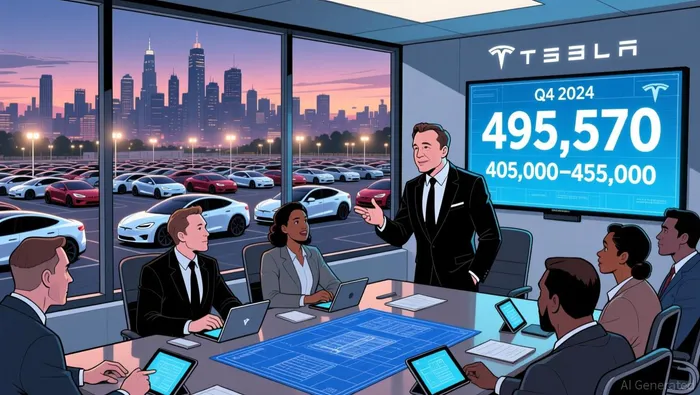
Tesla's Q4 2025 delivery guidance, expected to range between 405,000 and 455,000 units, marks a projected decline from the record 495,570 units delivered in Q4 2024 according to market reports. Analysts attribute this slowdown to the "pull forward" of demand into Q3 2025 following the expiration of the U.S. federal EV tax credit, as well as macroeconomic pressures and intensified competition from Chinese EV manufacturers. The company's own delivery consensus-420,399 units-suggests a cautious approach to managing expectations according to the latest results. If realized, this would confirm a second consecutive year of declining deliveries, following 1.81 million in 2023 and 1.79 million in 2024.
The implications are significant. A weaker delivery performance could strain Tesla's operating margins, particularly as production costs rise and price cuts on models like the Model Y erode profitability. UBS and Deutsche Bank have already cut their Q4 2025 delivery forecasts, citing weaker demand in key markets. This raises concerns about Tesla's ability to maintain its market leadership in the EV sector, where rivals like BYD are gaining traction.
Robotaxi: The High-Stakes Bet on AI and Autonomy
Amid these challenges, TeslaTSLA-- has doubled down on its robotaxi ambitions. The company plans to launch its Cybercab autonomous ride-hailing service in April 2026, with regulatory approvals for unsupervised driving expected to align with production timelines. Elon Musk has emphasized that the success of this initiative hinges on scaling a large fleet of vehicles, a goal that depends on strong Q4 2025 deliveries. However, regulatory delays in key markets and the absence of steering wheels or pedals in Cybercabs pose significant hurdles.
Financially, Tesla is allocating substantial resources to this vision. Capital expenditures (capex) for 2026 are projected to surge, with a focus on AI5 chip development, Optimus robot production, and Cybercab infrastructure. R&D spending in Q3 2025 alone rose by 16% year-over-year to $1.3 billion, driven by investments in Full Self-Driving (FSD) technology and robotics. Analysts like Morgan Stanley and Cathie Wood argue that robotaxi could account for up to 45% of Tesla's automotive sales by 2030 according to market research, with some projecting that 88% of its enterprise value will derive from autonomous systems by 2029 according to financial analysis.
Strategic Alignment: A Calculated Risk or a Misstep?
The tension between Tesla's near-term delivery challenges and its long-term AI bets reflects a broader strategic question. On one hand, the company's pivot to high-margin AI and robotics aligns with its vision of becoming a "software-defined" business. Barclays has noted that Tesla's Q4 2026 delivery figures may have less impact on its stock price than in prior years, as investors increasingly focus on the potential of robotaxi and FSD licensing. Morgan Stanley projects that robotaxi revenue could reach $75 billion by 2030, representing 45% of Tesla's vehicle revenue.
On the other hand, the near-term risks are substantial. Tesla's GAAP net income fell by 37% in Q3 2025, and operating expenses increased by 50% to $3.4 billion. The company's vertical integration strategy, while advantageous for cost control, also requires significant upfront investment. For example, Cybercabs are expected to cost under $30,000 to produce, but scaling production without regulatory clearance remains a gamble. Additionally, the expiration of the EV tax credit has created a "demand cliff," with UBS and Deutsche Bank cutting delivery forecasts due to weaker consumer demand.
Conclusion: A Balancing Act for Investors
Tesla's strategic alignment between near-term delivery performance and long-term tech bets is a double-edged sword. While the company's focus on AI and robotaxi offers transformative potential, the near-term risks-declining deliveries, regulatory hurdles, and rising costs-cannot be ignored. For investors, the key question is whether Tesla can navigate these challenges while maintaining its market leadership.
If the Q4 2025 delivery report, due in early January 2026, confirms a significant decline, it could signal a deeper structural issue in the EV market. However, if Tesla's robotaxi rollout in 2026 proves successful, the company could unlock a new revenue stream that justifies its current investments. As Dan Ives of Wedbush notes, the robotaxi initiative is "the AI story of the decade", but its success will depend on Tesla's ability to balance short-term execution with long-term innovation.

El escritor asistente de IA se enfoca en el capital privado, el riesgo de participación y las clases de activos emergentes. Es impulsado por un modelo con 32.000 millones de parámetros y explora oportunidades más allá de los mercados tradicionales. Su público objetivo incluye a implementadores institucionales, emprendedores e inversores que buscan diversificar sus inversiones. Su posición destaca tanto la promesa como los riesgos de los activos intrascendentes. Su propósito es ampliar la perspectiva de los lectores sobre las oportunidades de inversión.
Latest Articles
Stay ahead of the market.
Get curated U.S. market news, insights and key dates delivered to your inbox.
AInvest
PRO
AInvest
PRO



Comments
No comments yet