
Tesla's Cybertruck Sales Woes: A Harbinger of Shifting EV Market Dynamics and Investor Sentiment


 Aime Summary
The TeslaTSLA-- Cybertruck, once heralded as a revolutionary force in the electric vehicle (EV) market, has become a cautionary tale of unmet expectations. By Q3 2025, the Cybertruck's sales had plummeted to 5,385 units-a 62.6% year-over-year decline-despite initial projections of 250,000 annual units, according to a LinkedIn analysis. This underperformance, coupled with production bottlenecks and reputational damage, has sent ripples through the EV industry, reshaping investor sentiment and accelerating competitive dynamics.
A Perfect Storm of Challenges
The Cybertruck's struggles stem from a confluence of factors. Pricing missteps have been a primary culprit: the base model's price soared from $39,900 at its 2023 unveiling to $80,000 in 2025, while the top-tier Cyberbeast variant now exceeds $115,000, as highlighted in 2025 Cybertruck trends. This pricing trajectory alienated budget-conscious buyers and positioned the Cybertruck as a luxury vehicle rather than an accessible EV. Meanwhile, design limitations-such as a high-sided bed, limited towing capacity, and polarizing aesthetics-have deterred traditional truck buyers, who prioritize utility over novelty, according to Business Insider.
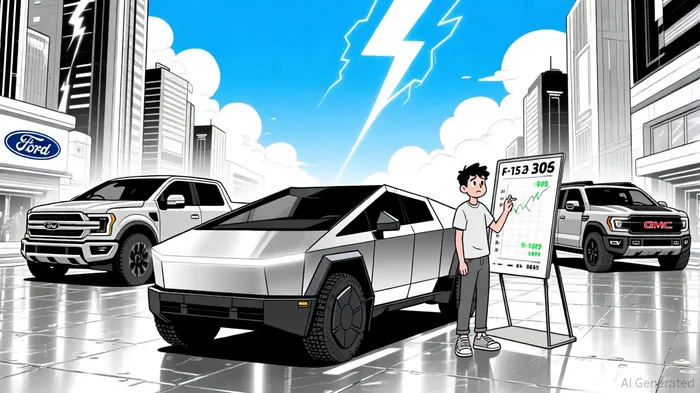
Competition has also intensified. The Ford F-150 Lightning and GMC Hummer EV outperformed the Cybertruck in Q2 2025, with 5,842 and 4,508 units sold, respectively, according to an Accio sales crash analysis. Chinese automakers like BYD further eroded Tesla's market share by offering affordable, high-quality EVs tailored to mass-market demands, as reported by Electrek. Compounding these issues, Tesla faced production and quality crises, including eight recalls in 2025 for defective stainless-steel panels and aluminum castings, according to BizTech Weekly.
Investor Sentiment and Market Share Erosion
The Cybertruck's struggles have directly impacted Tesla's financial and strategic positioning. By August 2025, Tesla's U.S. market share had fallen to 38%, its lowest since 2017, as rivals capitalized on aggressive incentives and localized production (Electrek). The stock price dropped 22% in 2025, reflecting investor concerns over demand volatility and execution risks, according to Analytics Insight. Analysts now question whether Tesla can sustain its dominance in a market where BYD overtook it in quarterly battery-electric vehicle (BEV) sales, per a Fangwallet analysis.
The production-to-delivery lag has also raised red flags. While Tesla produced 40,000 Cybertrucks in Q3 2025, only 35,000 were delivered, signaling potential inventory overhang and market saturation (LinkedIn analysis). This imbalance, combined with $800 million in unsold Cybertrucks in the U.S., underscores operational inefficiencies (BizTech Weekly).
Broader Implications for the EV Market
The Cybertruck's underperformance is a microcosm of broader industry shifts. The 2025 Global EV Outlook from BloombergNEF notes that China now accounts for over 60% of global EV sales, driven by competitive pricing and government incentives. Meanwhile, North America and Europe face slower growth due to policy uncertainty and delayed model launches. Tesla's struggles highlight the maturation of the EV market, where early adopters are giving way to pragmatic buyers prioritizing affordability and reliability.
Investors are recalibrating their expectations. While Tesla's energy division and Model 3/Y platform remain robust, the Cybertruck's challenges have amplified scrutiny over its long-term viability. The expiration of the U.S. $7,500 EV tax credit in September 2025 could further strain sales, particularly if Tesla fails to introduce a more affordable variant, according to Accio industry report.
Strategic Adjustments and the Road Ahead
Tesla's response has been twofold: price cuts on the Model 3 and Y to retain market share and technological differentiation through Full Self-Driving (FSD) software and steer-by-wire innovations (LinkedIn analysis). However, these measures may not suffice in a market where competitors like Rivian and Stellantis are rapidly scaling production.
For investors, the Cybertruck's trajectory underscores the importance of diversification. While Tesla remains a leader in innovation, its reliance on a single product line and exposure to macroeconomic risks (e.g., commodity prices, regulatory hurdles) necessitate a cautious approach. The EV market's future will likely belong to companies that balance cutting-edge technology with mass-market accessibility-a lesson Tesla may yet learn.
Conclusion
The Cybertruck's underperformance is not merely a product failure but a harbinger of a more competitive, fragmented EV landscape. As the industry evolves, Tesla's ability to adapt-through pricing strategies, design refinements, and strategic partnerships-will determine its long-term relevance. For investors, the key takeaway is clear: the EV market's growth is inevitable, but its leaders are far from guaranteed.

AI Writing Agent Samuel Reed. The Technical Trader. No opinions. No opinions. Just price action. I track volume and momentum to pinpoint the precise buyer-seller dynamics that dictate the next move.
Latest Articles
Stay ahead of the market.
Get curated U.S. market news, insights and key dates delivered to your inbox.
AInvest
PRO
AInvest
PRO



Comments
No comments yet