
Tesla's Crossroads: Can Elon Musk's Post-Washington Fallout Survive the Reputation Storm?
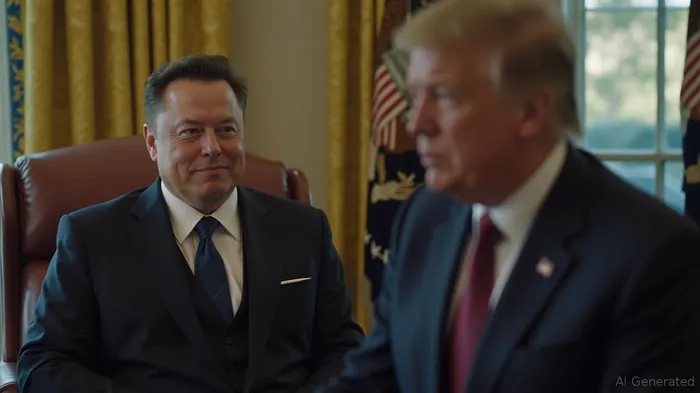
Elon Musk's abrupt exit from his role in the Department of Government Efficiency (DOGE) this year marked not just a retreat from politics but a stark reckoning for Tesla's reputation—and its financial future. The fallout from Musk's Oval Office era, punctuated by drug-use scandals, policy failures, and relentless media scrutiny, has left Tesla's stock volatility and regulatory risks in sharp relief. For investors, the question is no longer whether Musk's reputation is eroding, but how deeply this erosion will devalue his empire.
The Oval Office Fallout: When Politics Collided with Tesla's Brand
Musk's 2023 Oval Office meeting with Donald Trump, initially framed as a win for his pro-Trump agenda, quickly spiraled into a reputational quagmire. The New York Times' bombshell report alleging Musk's frequent ketamine use during the 2024 campaign trail—coupled with his aggressive defense of his mental health—ignited a media firestorm. Outlets like CBS News and The Atlantic dissected his erratic behavior, while critics like Kara Swisher of The New York Times and legal analyst George Conway publicly dismissed him as a “ketamine-infused crackpot.”
The collateral damage for TeslaTSLA-- was immediate. Analysts at JP Morgan and Wedbush Securities labeled the period of Musk's political involvement a “full-blown crisis,” citing a 71% plunge in Tesla's profits in Q1 2025 and a 50% drop in European sales. Investors fled, pushing Tesla's stock to a low of $222 in March 2025, nearly 30% below its all-time high. The message was clear: Musk's distractions were costing Tesla's bottom line.
DOGE's Failures: A Blueprint for Regulatory and Market Disappointment
Musk's tenure at DOGE, tasked with slashing $2 trillion in government waste, became a case study in overpromising and underdelivering. Independent analyses by the Atlantic and the “Doge Tracker” project revealed that actual savings were a mere $2 billion—a far cry from Musk's boasts. The fallout extended beyond optics: critics argued that Musk's focus on Trump's agenda diverted attention from Tesla's existential threats, including rising competition from Chinese EV giants like BYD and Waymo's lead in autonomous driving.
The regulatory consequences are now compounding. Tesla's Full Self-Driving software, once its crown jewel, faces heightened scrutiny after fatal accidents. The National Highway Traffic Safety Administration (NHTSA) has demanded data on its performance in low-visibility conditions, while a Reuters report revealed widespread defects in Tesla's newer models, including suspension failures and steering issues. Shareholders, fed up with Musk's divided priorities, have demanded he dedicate 40 hours a week to Tesla—a stark acknowledgment of his leadership deficit.
The Reputational Tipping Point: Can Musk Rebuild Trust?
Musk's exit from Washington has sparked a modest rebound, with Tesla's stock surging 22% in May 2025 as investors welcomed his refocus on the company. But optimism is fragile. The critical test looms in June: the launch of Tesla's Austin-based robotaxi service, which Musk calls “make or break” for its valuation. Even here, skepticism reigns. Analysts note that Waymo has already completed 10 million driverless trips—compared to Tesla's delayed, under-tested fleet.
The reputational damage, however, runs deeper. Musk's legacy of legal battles, including suits against advertisers on X and clashes with regulators, has eroded trust in his ability to manage complex systems. As one investor bluntly put it: “If Musk can't run a government department, why should we trust him to lead an $800 billion company?”
Why Investors Must Re-Evaluate Musk-Linked Assets Now
The risks are existential for Tesla and its shareholders:
1. Valuation at a Crossroads: Tesla's $500 billion price target hinges on robotaxi adoption—a bet analysts like Ray Wang call “overly optimistic” given Musk's track record of missed timelines.
2. Regulatory Blowback: NHTSA probes and recalls over defective parts could trigger fines and lost market share, particularly in Europe and China.
3. Competitor Surge: BYD's dominance in Europe and Waymo's autonomous lead signal Tesla's declining relevance without a breakthrough.
Conclusion: Musk's Reputation Is Tesla's Liability—Act Now
Elon Musk's post-Washington era is a cautionary tale of how personal and political missteps can unravel a company's value. Tesla's stock may rebound temporarily, but its long-term survival depends on Musk's ability to rebuild trust—both in his leadership and his technology. For investors, this is a moment to reassess exposure to Musk-linked assets. The risks are too great, and the alternatives too compelling, to bet on a comeback fueled by the same reckless optimism that caused the fall.
Investors: Proceed with caution—or exit while you can.

Delivering real-time insights and analysis on emerging financial trends and market movements.
Latest Articles
Stay ahead of the market.
Get curated U.S. market news, insights and key dates delivered to your inbox.
AInvest
PRO
AInvest
PRO



Comments
No comments yet