
Tesla's Bold Vision: Navigating Financial Setbacks and Pioneering Autonomous Future
As the global electric vehicle market faces a deceleration in growth and intensifying competition, Tesla has unveiled an ambitious technological blueprint for the future. The financial results for Q4 2024 revealed total revenue of $25.707 billion, a modest 2% increase year-over-year, while net income attributable to Tesla's common stockholders fell by 71% to $2.32 billion. Notably, the adjusted GAAP earnings per share also dropped by 71%, creating waves in the market.
Beyond the financials, CEO Elon Musk responded to numerous queries surrounding Tesla's advancements. He highlighted the resolution of battery supply bottlenecks, propelling autonomous driving technology into rapid development by 2026. Musk remains skeptical of lidar as an optimal solution for self-driving, affirming a strategy focusing on utilizing local street data, particularly in China, to train Tesla's autonomous systems.
Tesla's strategic investments in AI, manufacturing, and robotics underscore its plans for future expansion. Musk projected milestones for the company's Full Self-Driving (FSD) technology, with safety improvements and its plan to launch an affordable new model by 2025 further poised to strengthen Tesla's foothold in the electric vehicle market. Moreover, the company is investing heavily in Optimus humanoid robots, with aspirations for an annual production of 100 million units, and forecasts this innovation could drive over $10 trillion in revenue long-term.
Musk envisions 2026 as a pivotal year for Tesla, with the maturation of FSD systems significantly enhancing vehicle usage efficiency. As battery supply constraints are alleviated, autonomous technology is expected to gain momentum. The introduction of the Cortex training cluster at Tesla's Austin Gigafactory has been crucial to FSD's progress, reflecting the company’s commitment to advancing its autonomous driving capabilities globally.
In addressing Tesla's humanoid robot, Optimus, Musk articulated its ambitious production and innovation goals. The design and production challenges are underscored by the need to establish new supply chains and components, with an eye toward revolutionary precision and functionality. While the company anticipates internal utilization of Optimus for certain tasks within its facilities, broader commercialization and pricing details remain to be determined.
On the energy front, Musk emphasized the potential of energy storage to substantially enhance grid capacity. As Tesla ramps up production of fixed battery storage solutions, the company seeks to balance battery supplies for both mobile and fixed applications, with further expansion indicated by new factory developments in Shanghai.
Looking ahead, 2025 is poised to be critical for Tesla, with the anticipated launch of a supervisory-free version of FSD marking a significant milestone. Despite challenges, Musk’s vision positions Tesla as a leader in autonomous and AI technology, promising extensive market implications and strategic growth. 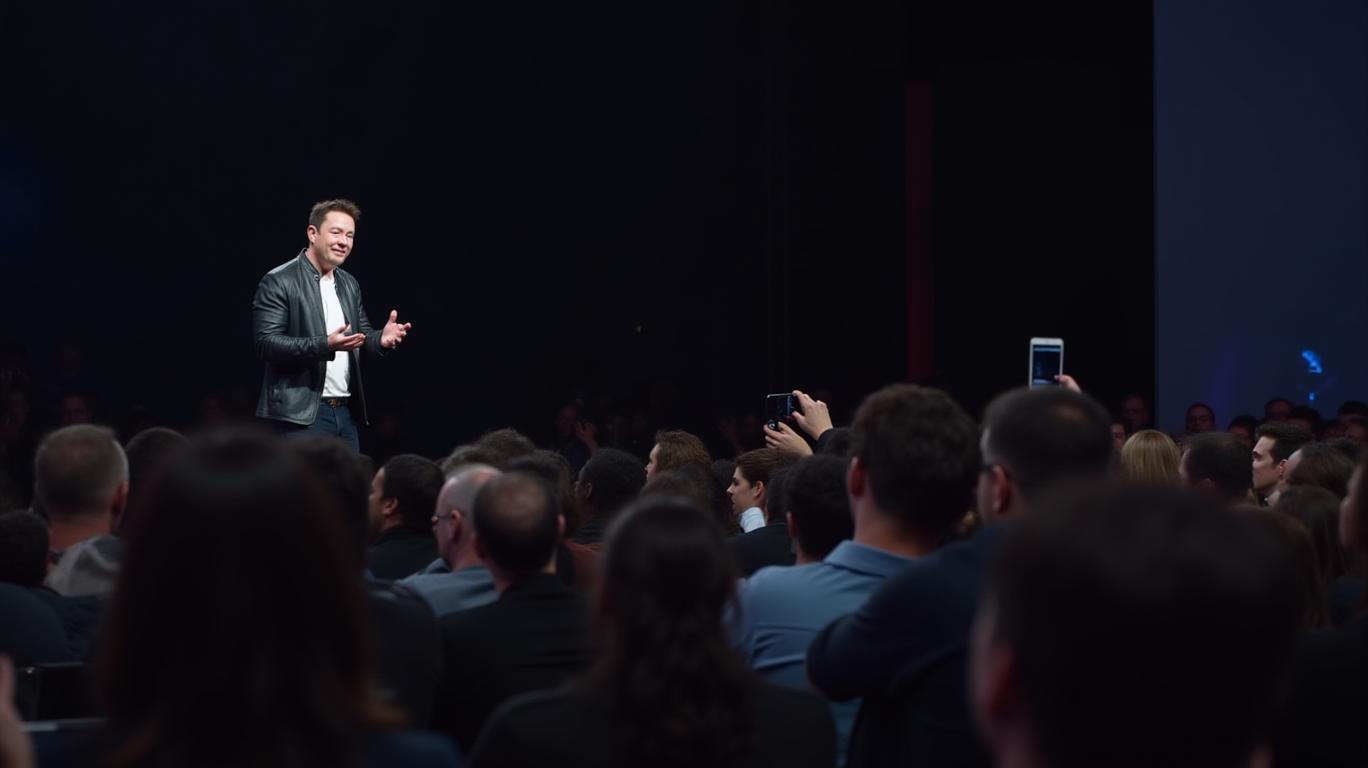

Stay ahead of the market.
Get curated U.S. market news, insights and key dates delivered to your inbox.




Comments
No comments yet