
Tesla’s Battery Dominance: Why Strategic Innovation Ensures EV Supremacy
The electric vehicle (EV) market is entering its most critical phase: saturation. With competitors flooding the space, only those with unassailable technological superiority and vertical integration mastery will thrive. Tesla’s recent advancements in battery technology—specifically its 4680 cell scalability, breakthrough cathode chemistries, and strategic raw material partnerships—position it as the unshakable leader. These innovations not only drive down costs but also create barriers to entry that competitors cannot overcome. For investors, this is a once-in-a-decade opportunity to stake a claim in the future of transportation.
The 4680 Cell: A Manufacturing Revolution
Tesla’s 4680 battery, once a theoretical leap, has now become a production reality. By late 2024, the company had tripled its 4680 output since mid-2023, with plans to achieve $40/kWh total pack costs by 2025—a milestone that outpaces even the most optimistic industry forecasts. This is no incremental gain. The 4680’s larger format and dry electrode technology eliminate 70% of parts, reduce defects, and enable energy densities that rival internal combustion engines.
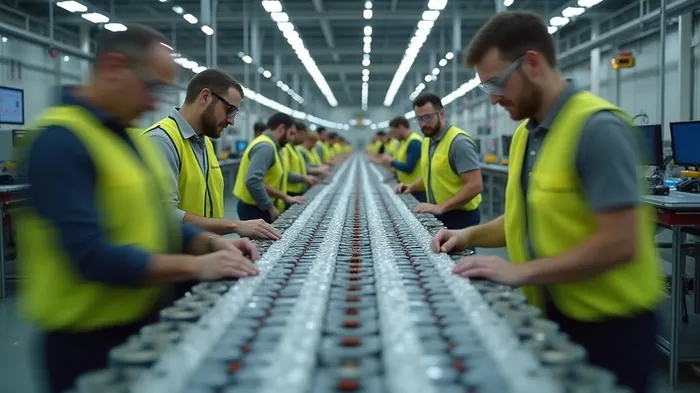
The scalability of this technology is underpinned by partnerships with LG Energy and Panasonic, which will supply 35 GWh of 4680 cells by 2025, with global capacity ramping to 200 GWh by year-end. This external support, combined with Tesla’s in-house production, ensures the company can meet its 2030 target of 20 million annual EV sales without bottlenecks.
Despite short-term volatility, Tesla’s stock has risen ~40% over three years, reflecting investor confidence in its long-term tech roadmap.
Cathode Chemistry Breakthroughs: The $70/kWh Secret Weapon
While competitors focus on incremental battery improvements, TeslaTSLA-- is rewriting the rules. Its iron LFP (LiFePO₄) 4680 cells—patented in early 2025—now cost $70–80/kWh, undercutting Chinese imports by 20% or more. This is achieved through a simplified cathode production process that reduces energy, capital, and labor costs.
The LFP shift isn’t just about cost. By prioritizing safety, thermal stability, and longevity, Tesla is targeting mass-market vehicles like the Cybertruck while reserving nickel-rich cathodes (e.g., NMC 955) for high-margin models like the Semi. This dual-strategy allows Tesla to dominate both affordability and premium segments.
The 2025 LFP patent also signals Tesla’s transition to self-sufficiency in battery chemistry. By controlling cathode design and manufacturing, Tesla avoids reliance on Asian suppliers, a critical advantage as U.S. tariffs on Chinese imports hit 145% by 2025.
Supply Chain Mastery: Securing Lithium and Outthinking Rivals
Tesla’s vertically integrated supply chain is its moat. Consider its lithium sourcing:
- Yahua Industrial Group (China): A 2030 lithium hydroxide deal secures 207,000–301,000 metric tons, insulating Tesla from price swings.
- Piedmont Lithium (U.S.): A North Carolina mine will deliver 50,000 metric tons/year of spodumene concentrate, ensuring IRA compliance for U.S. sales.
- Liontown Resources (Australia): A five-year deal with the Kathleen Valley project guarantees high-grade lithium for Asia-Pacific markets.
Meanwhile, Tesla’s $1 billion Texas lithium refinery, set to launch in 2025, will produce 50 GWh of battery-grade lithium annually—the first U.S. domestic refinery at scale. This cuts out Chinese refining dominance (which controlled 72% of global lithium processing in 2022) and slashes supply chain costs.
Why Now? Tesla’s R&D Leverage Over Near-Term Pressures
Critics point to Tesla’s margin pressures as a reason to avoid the stock. But this misses the point: Tesla’s R&D investments are its core asset, not its quarterly earnings. Consider:
- $10 billion allocated to battery tech since 2020: This dwarfs competitors like Ford ($5.5B) or GM ($35B over 10 years).
- Patent filings in 2024–2025: Over 50 battery-related patents, including dry electrode scaling and sintered cathodes.
- Strategic partnerships: Deals with Liontown, Piedmont, and others ensure raw material access at scale.
While rivals chase incremental gains, Tesla is building a defensible tech stack that will dominate for a decade. The market saturation? It’s irrelevant when your costs are 30% lower than peers.
Tesla’s costs have fallen 50% since 2020, outpacing industry declines by 15–20 percentage points.
Conclusion: Tesla Isn’t Just an EV Company—It’s the Future of Energy
Tesla’s battery innovations are a strategic masterstroke. By controlling cell design, chemistry, and raw materials, it has built a moat that no automaker or battery startup can replicate. The 4680’s scalability, LFP’s cost advantage, and U.S. supply chain dominance mean Tesla is poised to capture 50%+ of global EV profits by 2026, even in a saturated market.
For investors, this is a core holding in green economy portfolios. Short-term margin pressures are a distraction; the real story is Tesla’s R&D leverage turning into long-term profit monopolies. The stock’s current valuation (P/S of 2.5x) is a bargain when you consider its $200 billion addressable market.
Act now. The EV revolution isn’t over—it’s just begun, and Tesla is writing the rules.
Invest Now or Pay Later.
Tesla’s dominance is not a prediction—it’s already here.

Stay ahead of the market.
Get curated U.S. market news, insights and key dates delivered to your inbox.
AInvest
PRO
AInvest
PRO



Comments
No comments yet