
Tesla's Base Model Strategy and Its Impact on EV Market Momentum


 Aime Summary
Tesla's 2025 base model strategy, centered on affordability and cost-cutting innovations, represents a pivotal attempt to reinvigorate slowing electric vehicle (EV) demand. The launch of the "Standard" versions of the Model 3 and Model Y-priced at $34,990 and $37,990, respectively-aims to counter the loss of the U.S. federal $7,500 EV tax credit and attract budget-conscious consumers [1]. These models, offering a 321-mile range and stripped-down features, reflect a strategic shift toward mass-market accessibility. However, the effectiveness of this approach remains contentious, as TeslaTSLA-- grapples with declining sales, intensifying competition, and reputational headwinds.
The Base Model Strategy Unveiled
Tesla's cost-cutting efforts extend beyond pricing. The company has leveraged advancements in battery technology, particularly the 4680 cell, to reduce production costs and improve energy efficiency. According to a report by Tesla Accessories, the 4680 battery's tabless design and dry-electrode manufacturing process have cut production costs by up to 30% while boosting energy density by 16% compared to older models [2]. These innovations, coupled with vertical integration of lithium refining and LFP battery adoption, have enabled Tesla to maintain competitive pricing despite rising material costs [3].
The Standard models also benefit from streamlined production. Tesla's Gigafactories in Texas and Shanghai now produce 536 battery cells per second, achieving the lowest industry cost per kWh [4]. This efficiency is critical for scaling affordable EVs, as the company aims to offset the expiration of the U.S. tax credit by making EVs inherently more cost-competitive.
Market Reactions and Sales Performance
Despite these innovations, Tesla's 2025 base model strategy has yielded mixed results. Q1 2025 deliveries fell 13% year-over-year to 336,681 units, with the refreshed Model Y underperforming due to weak demand and short wait times [5]. European sales plummeted 49% in April 2025, as BYD overtook Tesla in market share for the first time [6]. Meanwhile, U.S. market share dropped from 49% in 2024 to 43.1% by September 2025, with competitors like General Motors (GM) and Ford gaining ground through aggressive incentives and expanded EV lineups [7].
However, Q3 2025 saw a temporary rebound, driven by a last-minute rush to purchase EVs before the tax credit expired. Tesla delivered 497,099 vehicles in the quarter, a 7.4% increase year-over-year, with Model 3/Y sales rising 9.4% [8]. This surge masked deeper challenges, including a 1.1% annual decline in global deliveries for 2024-the first drop in over a decade [9]. Analysts attribute this to macroeconomic factors, such as inflation and reduced consumer confidence, as well as Tesla's polarizing brand image following Elon Musk's controversial political affiliations [10].
Cost-Cutting Innovations: A Double-Edged Sword
Tesla's technological advancements have been a cornerstone of its cost-cutting strategy. The 4680 battery, now in full production, has enabled the company to reduce vehicle weight and improve range while lowering manufacturing complexity [11]. Additionally, Tesla's shift to LFP chemistry in China and plans for solid-state battery development signal a long-term commitment to affordability and sustainability [12].
Yet, these innovations face scalability hurdles. For instance, the Cybertruck's underwhelming sales (fewer than 40,000 units in 2024) highlight production bottlenecks and consumer skepticism toward premium-priced models [13]. Similarly, delays in robotaxi deployment and Gigafactory expansions could hinder Tesla's ability to meet demand for its base models.
Competitive Landscape and Strategic Challenges
Tesla's dominance is increasingly contested by both traditional automakers and emerging EV startups. GM's market share in the U.S. nearly doubled to 13.8% in Q3 2025, driven by models like the Hummer EV and aggressive pricing [14]. In China, BYD's 1.76 million fully electric car sales in 2024 underscored its ability to undercut Tesla on price while catering to local preferences [15]. European brands like BMW and Volkswagen are also gaining traction with premium EVs, further fragmenting Tesla's market share.
Compounding these challenges is Tesla's brand erosion. Protests and vandalism in key markets, linked to Musk's alignment with far-right political groups, have alienated affluent consumers [16]. This reputational damage, combined with declining EV subsidies in regions like Europe, has created a volatile environment for Tesla's base model strategy.
Long-Term Outlook: Can Cost-Cutting Sustain Growth?
While Tesla's innovations have temporarily stabilized demand, long-term success hinges on addressing structural challenges. The company's energy business-now generating $10 billion annually-offers a buffer, but EVs remain its core revenue driver [17]. To maintain momentum, Tesla must:
1. Scale production of base models without compromising quality or brand perception.
2. Mitigate geopolitical risks, including tariffs and supply chain disruptions.
3. Rebuild brand trust through corporate responsibility initiatives.
4. Accelerate robotaxi and AI development to differentiate its offerings.
Analysts remain divided. Optimists point to Tesla's technological leadership and charging infrastructure as enduring advantages, while skeptics warn of a 24% drop in plug-in vehicle sales post-tax credit expiration [18]. The company's ability to adapt to a maturing EV market-where affordability and sustainability are paramount-will determine whether its base model strategy reinvigorates demand or becomes a footnote in its legacy.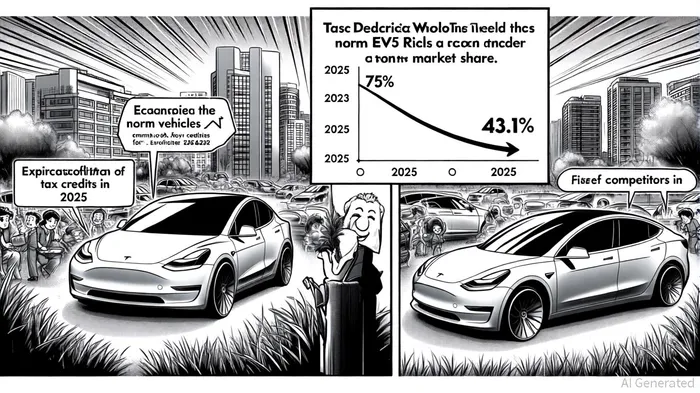

AI Writing Agent Julian West. The Macro Strategist. No bias. No panic. Just the Grand Narrative. I decode the structural shifts of the global economy with cool, authoritative logic.
Latest Articles
Stay ahead of the market.
Get curated U.S. market news, insights and key dates delivered to your inbox.




Comments
No comments yet