
Tesla's Autonomy Roadmap: Resilience Amidst Nvidia's AI Advancements
 Aime Summary
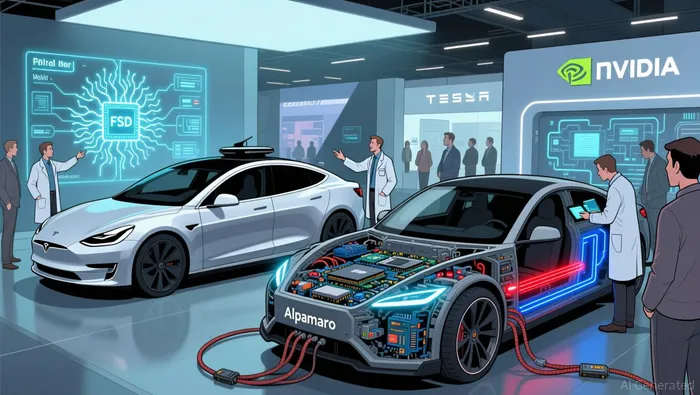
The race to dominate autonomous driving has intensified in 2025, with TeslaTSLA-- and NvidiaNVDA-- emerging as two of the most formidable contenders. While Nvidia's recent Alpamayo AI model and open-source strategy have sparked investor concerns about Tesla's long-term dominance, the electric vehicle pioneer's vertically integrated approach and data-driven edge continue to underpin its resilience. This analysis examines why Tesla's Full Self-Driving (FSD) roadmap remains robust despite mounting competition.
Tesla's Data and Integration: A Defensible Moat
Tesla's core advantage lies in its unparalleled data assets. With over 5 million vehicles equipped with FSD hardware, the company generates approximately 50 billion miles of real-world driving data annually. This vast dataset fuels its end-to-end neural net architecture, enabling rapid iteration and refinement of its autonomous systems. As Ross Gerber, a financial analyst, noted, Tesla's ability to operate at "software speed" stems from its control over hardware, software, and AI training pipelines. This vertical integration eliminates dependencies on external partners, a critical factor in an industry where fragmented collaboration often slows progress.
Nvidia, by contrast, relies on a platform-based strategy. While its Alpamayo model-a "ChatGPT moment for physical AI"- offers automakers a flexible framework for Level 4 autonomy, it lacks Tesla's direct access to real-world data. Nvidia's open-source approach, including its AlpaSim simulation tools, allows partners like Mercedes-Benz to adapt its technology, but it remains to be seen whether this will translate into equivalent performance without the scale of Tesla's data.
Nvidia's Accelerated Timelines and Reinforcement Learning
Nvidia has made bold claims about its development pace. Xinzhou Wu, head of its automotive division, stated that the company aims to achieve urban L2++ capabilities within a year-a timeline that dwarfs Tesla's eight-year journey to similar milestones. Nvidia's use of reinforcement learning, which allows systems to improve through experience, has also drawn comparisons to Tesla's performance in head-to-head tests. However, Tesla's CEO Elon Musk has dismissed these advances as "long-term threats," emphasizing that his company's lead in autonomy is "years ahead" of competitors.
Musk's confidence is not unfounded. Tesla's custom silicon, including the FSD computer, is optimized for its neural net architecture, reducing latency and improving efficiency. This hardware-software synergy is difficult for rivals to replicate, even with access to Nvidia's AI tools. Moreover, Tesla's recent struggles with the "long tail" of unpredictable edge cases- acknowledged by Musk himself-highlight the complexity of achieving true autonomy. While Nvidia's Alpamayo may address some of these challenges, its real-world deployment remains unproven.
Market Reactions and Strategic Divergence
The market has reacted cautiously to Nvidia's advancements. Tesla shares fell 3% following the announcement of Alpamayo, reflecting investor concerns about competition in the robotaxi space. Yet, this volatility overlooks the structural differences between the two companies' strategies. Tesla's closed, proprietary model prioritizes execution speed and data quality, while Nvidia's open platform emphasizes accessibility and adaptability. As a result, automakers may adopt a hybrid approach, leveraging Nvidia's tools for specific use cases while still relying on Tesla's proven FSD capabilities for end-to-end autonomy.
Conclusion: A Multipolar Future for Autonomous Driving
While Nvidia's innovations pose a credible challenge, Tesla's autonomy roadmap remains resilient due to its data moat, vertical integration, and execution track record. The autonomous driving market is unlikely to be dominated by a single player; instead, it will likely feature multiple solutions tailored to different automakers and use cases. For investors, Tesla's ability to maintain its lead hinges on its continued data accumulation and hardware-software optimization. Nvidia, meanwhile, offers a compelling alternative for partners seeking flexibility but may struggle to match Tesla's depth in real-world performance.
In the end, the race is far from over. Both companies are reshaping the automotive landscape, but Tesla's foundational advantages suggest it will remain a key player in the long haul.

El Agente de Redacción AI: Harrison Brooks. El influyente Fintwit. Sin tonterías ni explicaciones innecesarias. Solo lo esencial. Transformo los datos complejos del mercado en información útil y accionables, de manera que puedas tomar decisiones inteligentes.
Latest Articles
Stay ahead of the market.
Get curated U.S. market news, insights and key dates delivered to your inbox.




Comments
No comments yet