
Tesla’s Autonomous Driving Revolution: A Catalyst for EV Dominance and Investor Opportunity
In the rapidly evolving electric vehicle (EV) market, Tesla’s latest advancements in AI-driven autonomous driving are positioning the company not just as an EV leader but as a pioneer in redefining mobility itself. With its upcoming Robotaxi service launch in Austin, Texas, TeslaTSLA-- is poised to leverage its proprietary Full Self-Driving (FSD) technology to carve out a dominant position in the autonomous transportation sector. This article explores how Tesla’s innovations create a sustainable competitive advantage, their impact on market dynamics, and why investors should act now to capitalize on this transformative shift.
The Quantum Leap: Tesla’s Camera-Based FSD and the Robotaxi Play
Tesla’s decision to rely solely on a camera-based system for FSD—a stark contrast to competitors like Waymo, which use lidar—has been both controversial and strategic. While lidar offers superior 3D environmental mapping, Tesla’s approach prioritizes scalability and cost efficiency, eliminating the need for expensive sensors. This system, now refined through billions of miles of real-world data, is the backbone of its Robotaxi service, set to launch in June 2025.
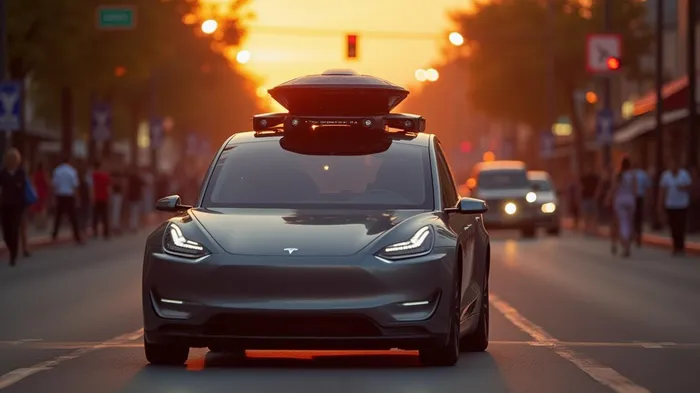
The Robotaxi initiative represents Tesla’s first fully autonomous ride-hailing service, eliminating human drivers entirely. By leveraging its proprietary neural network architecture and real-time machine learning, Tesla aims to reduce operational costs by up to 40% compared to traditional ride-sharing models. This not only creates a compelling price advantage but also opens a new revenue stream—recurring software subscriptions—that could rival its hardware sales within five years.
Competitive Edge: Why Tesla’s Strategy is Unmatched
Tesla’s lead in autonomous driving is underpinned by three key advantages:
- Data Dominance: With over 2 million FSD-enabled vehicles on the road, Tesla’s fleet generates a petabyte-scale data trove that refines its AI models daily. This “software flywheel” ensures its systems improve exponentially faster than competitors reliant on smaller test fleets.
- Regulatory Agility: Tesla’s early wins in Norway (where it secured exemptions for public FSD testing) and the U.S. (where federal regulations now favor AV innovation) give it a head start in deploying autonomous services. By contrast, rivals like Cruise and Waymo face fragmented state-level approvals.
- Vertical Integration: From designing its Dojo supercomputers to manufacturing FSD hardware, Tesla’s control over every layer of its tech stack allows rapid iteration and cost optimization.
Competitors like BYD and Waymo are scrambling to catch up, but Tesla’s first-mover advantage in autonomous ride-hailing could lock in customer loyalty and market share for decades.
Market Impact: Redefining the EV Landscape
Tesla’s FSD advancements are already reshaping investor sentiment. In early May 遑, its stock surged 5% on Robotaxi launch optimism, outperforming broader EV indices. However, the full financial impact is still to come:
- Revenue Diversification: The Robotaxi service could generate $10 billion annually by 2027, turning Tesla’s vehicles into profit-generating assets.
- Margin Expansion: Autonomous services reduce reliance on volatile hardware sales, boosting margins as software revenue scales.
- Global Market Penetration: With plans to expand FSD to Europe by late 2025 and China, Tesla is targeting a $1.5 trillion global mobility market.
Risks and Considerations
While Tesla’s vision is bold, execution risks remain:
- Regulatory Hurdles: States like California may impose stricter safety standards, delaying nationwide rollout.
- Safety Perception: Past FSD incidents and NHTSA scrutiny require flawless performance in Austin to rebuild trust.
- Tariffs and Costs: Proposed U.S. tariffs on imported EVs could pressure Tesla to ramp up North American production, adding capital demands.
Investment Strategy: Act Now Before the Rally
The strategic entry point for investors is clear:
- Buy Tesla (TSLA) on dips below $220/share, targeting a $300+ price target by end-2025 as Robotaxi revenues materialize.
- Hedge with options: Use call options to capitalize on upside while limiting risk.
- Monitor Catalysts: Track the Austin launch (June 2025) and FSD’s Article 39 approval in Europe for further momentum.
Conclusion: Tesla is Writing the Future of Mobility
Tesla’s autonomous driving innovations are not incremental—they’re transformative. By monetizing its software edge and capitalizing on regulatory tailwinds, Tesla is primed to dominate both the EV and autonomous mobility markets. For investors, the window to buy into this revolution is narrowing. With a stock at $220/share, now is the time to act before the world fully recognizes Tesla’s $1 trillion potential.
JR Research advises investors to view Tesla not just as an automaker but as a software-driven mobility giant—and bet on its ability to redefine the industry.

Stay ahead of the market.
Get curated U.S. market news, insights and key dates delivered to your inbox.
AInvest
PRO
AInvest
PRO



Comments
No comments yet