
Tesla's Autonomous Ambition: Can the Stock Sustain Its Volatile Surge?
The launch of Tesla's autonomous robotaxis in Austin, Texas, on June 22, 2025, marked a pivotal moment for the company's vision of a driverless future. Within 24 hours, Tesla's stock surged 9%, adding $85 billion to its market cap and reigniting debates about the sustainability of its growth trajectory. While the immediate market reaction celebrated the milestone, the road ahead is fraught with challenges—from regulatory hurdles to competition and the high cost of innovation. Can Tesla's stock maintain its momentum, or is this volatility a sign of overexuberance?
The Optimistic Case: Autonomous Tech as a Growth Engine
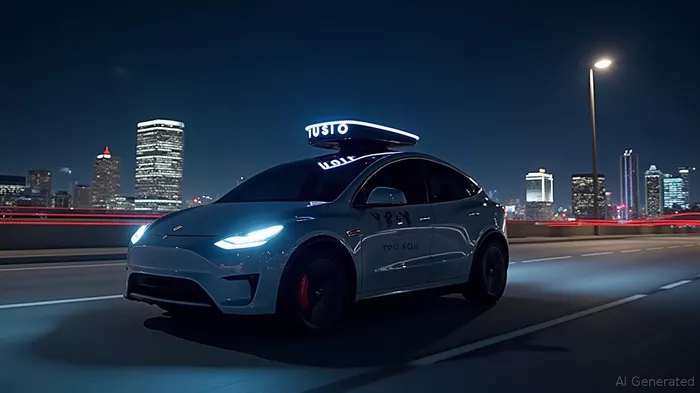
The robotaxi launch was more than a product rollout—it was a proof-of-concept for Tesla's decade-long bet on full autonomy. The service, which charges a flat $4.20 per ride, uses Tesla's proprietary Full Self-Driving (FSD) software and camera-based vision system, bypassing the lidar sensors favored by rivals like Waymo. Early riders reported seamless navigation through Austin's streets, with the system handling complex intersections and traffic patterns.
For investors, this success signals a tangible step toward Tesla's vision of “robotaxi-as-a-service,” which analysts project could add over $1 trillion to its enterprise value by 2029. The logic is clear: autonomous vehicles could revolutionize transportation, turning Tesla's electric vehicles into revenue-generating assets that operate 24/7. A single Model Y, for example, could generate $50,000 annually in rideshare revenue, far exceeding the $40,000 average purchase price.
The chart would show Tesla's sharp rise on June 23, followed by a dip on June 24, contrasting with Alphabet's more stable trajectory.
Risks Lurking in the Rearview Mirror
While the launch was a technical triumph, the path to profitability remains littered with obstacles.
Regulatory Headwinds: Texas lawmakers are already pushing to restrict autonomous vehicles, requiring state permits by September 2025. Meanwhile, California's new safety guidelines, including mandatory human monitors, could slow expansion plans. The National Highway Traffic Safety Administration (NHTSA) is also investigating Tesla's FSD system after reports of traffic violations during testing.
Fierce Competition: Waymo, which already operates 100+ autonomous vehicles in Austin, has a head start in building partnerships with ride-hailing platforms. Cruise, backed by General Motors, is also scaling rapidly, leveraging its broader automotive ecosystem.
Safety and Trust: Tesla's FSD system has been linked to accidents, raising questions about reliability. While the Austin trial includes safety monitors, fully autonomous vehicles will need flawless performance to win public trust—a hurdle even Waymo and Cruise have yet to fully overcome.
Financial Strain: Tesla's net income fell 52% in 2024 due to heavy R&D spending on autonomy and Gigafactories. Scaling robotaxis to hundreds of thousands of vehicles will require further investment, risking short-term profitability.
Data Tells the Story: Volatility and Valuation
The stock's performance since the launch underscores investor indecision. On June 23, 2025, Tesla's stock spiked to $357.54—a 9% surge—but closed at $348.68. The next day, it retreated to $340.47, reflecting skepticism about execution risks.
The chart would highlight Tesla's PE ratio of 183.05, far exceeding the automotive industry average of ~20, signaling overvaluation concerns.
Analysts are divided. Bulls cite the long-term potential of autonomous software as a recurring revenue stream, akin to Apple's app store. Bears argue the stock's valuation already discounts perfection, leaving little room for error.
Investment Considerations: A Delicate Balance
Investors face a critical question: Is Tesla's robotaxi initiative a transformative growth lever or a costly distraction? Here's how to navigate the uncertainty:
- Buy if: You believe TeslaTSLA-- can scale autonomy safely and outcompete rivals. The $4.20 flat fee could disrupt ride-hailing economics, and Tesla's direct-to-consumer model avoids traditional taxi intermediaries.
- Hold if: You're satisfied with current gains but wary of execution risks. Tesla's stock is up 9% post-launch but still down 12% year-to-date, reflecting broader concerns about its core EV business.
- Sell if: You prioritize stability over high-risk, high-reward plays. Regulatory setbacks or safety issues could trigger a sharp correction.
Final Analysis: A Volatile Road Ahead
Tesla's robotaxi launch is undeniably a milestone, but the stock's trajectory hinges on translating technical prowess into scalable, profitable services. While the $1 trillion valuation target by 2029 is ambitious, it's not impossible—provided Tesla can navigate regulatory minefields, outpace competitors, and maintain investor patience.
For now, the stock's volatility reflects this tension between optimism and doubt. Investors should monitor key metrics: the pace of robotaxi expansion, regulatory approvals, and Tesla's ability to monetize software updates. A cautiously optimistic stance is warranted, but this is a stock for long-term believers willing to endure short-term turbulence.
The chart would show software/robotaxi revenue overtaking EV sales by 2029, assuming aggressive growth.
In the end, Tesla's success will be measured not just in stock price swings, but in whether it can redefine transportation—and make money doing it.

Stay ahead of the market.
Get curated U.S. market news, insights and key dates delivered to your inbox.




Comments
No comments yet