
Tesla's Annual Revenue Fell for the First Time, but Aggressive Commitment to Optimus and Robotaxi Remains
 Aime Summary
Tesla reported its fourth-quarter results after the market close. Despite beating expectations on both revenue and earnings, full-year revenue declined year over year for the first time in the company's history. Against this backdrop, Elon Musk is pushing TeslaTSLA-- to pivot aggressively toward autonomous driving and humanoid robots to build new growth engines.
Earnings Results:
Revenue: $24.9 billion, down 3% year over year, but slightly above the $24.8 billion consensus; automotive revenue was $17.7 billion, down 11% year over year.
Net income: $1.76 billion, down 16% year over year, translating to EPS of $0.50 versus expectations of $0.45.
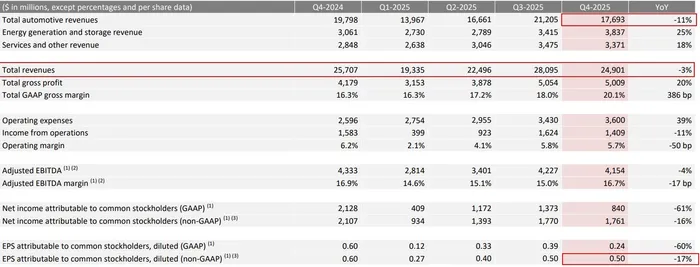
Notably, automotive gross margin jumped to 20.4%, up 3.3 percentage points from the previous quarter and the highest level since April 2022. This suggests Tesla has regained some pricing power and improved profitability despite persistent competitive pressure.
Tesla said the Q4 revenue decline was mainly driven by lower vehicle deliveries and reduced carbon credit revenue. These headwinds were partially offset by growth in energy storage, services, higher average selling prices, and Full Self-Driving (FSD) subscription revenue.
Previously, the company reported Q4 deliveries of 418,000 vehicles, down 16% year over year, with full-year deliveries down 8.6%. Model 3 and Model Y accounted for 97% of deliveries, while Model S/X and other models made up less than 3%.
This backdrop has prompted Musk to reallocate capacity toward what he views as Tesla's future growth engines. On Wednesday's earnings call, he said the company would shut down the Model S/X production lines at its Fremont factory and convert the facility to produce the upcoming Optimus humanoid robot. "We're really moving into a future that is based on autonomy," Musk said.
Such ambitions require massive capital investment. CFO Vaibhav Taneja said Tesla expects capital expenditures of about $20 billion this year, compared with $8.5 billion in 2025—an increase of 134% year over year—primarily directed toward robotics and autonomous driving.
On execution, Tesla said its third-generation Optimus humanoid robot, designed for mass production, will be unveiled in the first quarter of this year. It will feature major upgrades from version 2.5, including a new hand design, with applications ranging from factory work to childcare. The first production line is expected to begin operation before the end of 2026, with public sales starting next year. Tesla's long-term target is an annual production capacity of 1 million robots. While Musk previously predicted Tesla would produce 5,000 robots in 2025—a goal that was not met—the overall strategic direction remains unchanged.
Meanwhile, Tesla is accelerating its autonomous driving push, including its Robotaxi business. Company executives said last week that human safety supervisors have been removed from some vehicles in its Austin fleet, enabling fully autonomous passenger testing. Tesla plans to expand Robotaxi services to seven additional U.S. markets in the first half of this year, including Dallas, Houston, Phoenix, Miami, Orlando, Tampa, and Las Vegas.
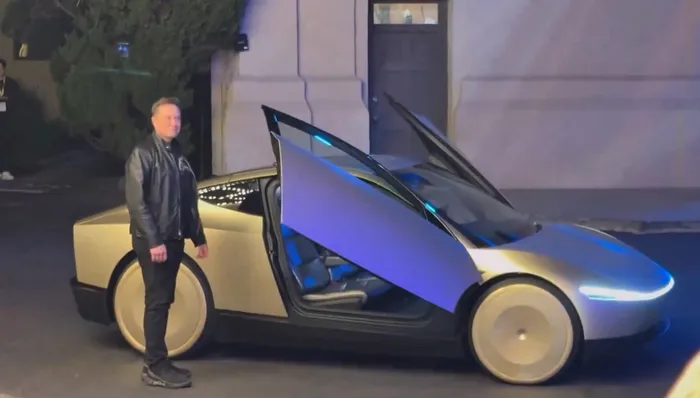
Tesla also said it is making tooling preparations for the upcoming Cybercab, a two-seat vehicle purpose-built for autonomous driving, with no steering wheel or pedals.
In addition, Tesla disclosed that on January 16 it reached an agreement to invest about $2 billion in Elon Musk's AI startup xAI. Earlier this month, the ChatGPT rival announced a $20 billion funding round, with Nvidia and Cisco among the participants.
Tesla said its investment in xAI and the cooperation between the two companies are intended to enhance its ability to build products and services that bring AI into the physical world.
Overall, Tesla's valuation is no longer tightly anchored to vehicle deliveries. Instead, it increasingly reflects market expectations for humanoid robots, autonomous driving, and deeper integration with AI—key factors reshaping the company's valuation framework. That said, these long-term bets come with substantial uncertainty, both in execution and ultimate market size. Still, given Musk's track record and risk appetite, the upside of this wager may yet be significantly underestimated.

Crypto market researcher and content strategist with 3 years of experience in digital asset analysis and market commentary. Skilled at transforming complex blockchain data and trading signals into clear, actionable insights for investors. Experienced in covering Bitcoin, Ethereum, and emerging ecosystems including DeFi, Layer2, and AI-related projects. Passionate about bridging professional market research with accessible storytelling to empower readers and investors in the fast-evolving crypto landscape.
Latest Articles
Stay ahead of the market.
Get curated U.S. market news, insights and key dates delivered to your inbox.
AInvest
PRO
AInvest
PRO



Comments
No comments yet