
Tesla's AI Revolution and Musk's X Synergy: A Catalyst for EV and Tech Dominance
The tech and automotive landscapes are undergoing a seismic shift, driven by Elon Musk's dual ambitions: to redefine transportation with electric vehicles (EVs) and to harness artificial intelligence (AI) as a transformative force. Tesla's recent AI Day 2025 and the strategic integration of X (formerly Twitter) into Musk's AI ecosystem underscore a bold vision—one that could solidify Tesla's leadership in the EV sector while unlocking new revenue streams in AI-driven mobility. For investors, this convergence presents a compelling case for long-term allocation to AI-enabled EV companies, despite near-term execution risks.
Tesla's AI Day 2025: From Autonomous Delivery to Optimus's Evolution
Tesla's milestone first fully autonomous delivery of a Model Y from its Austin factory to a customer's doorstep marked a turning point. The vehicle navigated highways and urban streets without human intervention, powered by the FSD v13.2.9 software, which leverages a 48-neural network architecture trained on 70,000 GPU hours of data. This achievement, while imperfect (e.g., reported lane deviations and braking anomalies), signals progress toward Musk's goal of a robotaxi network offering rides at $0.05–0.10 per mile—a cost that could disrupt traditional transportation and logistics.
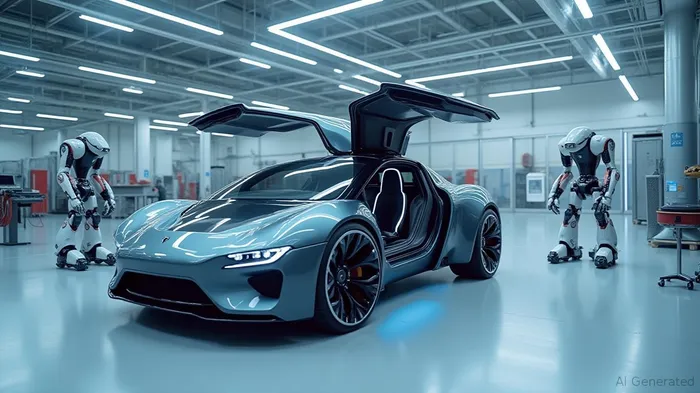
The Cybercab, Tesla's steering-wheel-free autonomous vehicle, is poised to be the backbone of this network. With a 300-mile range, wireless charging, and a 20.5-inch touchscreen for passenger entertainment, it embodies Tesla's vision of a seamless, AI-driven mobility future. Meanwhile, Optimus, the humanoid robot, is advancing toward mass production, with thousands expected in factories by late 2025. Its integration with Tesla's EVs—sharing hardware and software—could reduce manufacturing costs and accelerate adoption of automation across industries.
The X-AI-Tesla Synergy: Data, Compute, and Disruption
The strategic value of Musk's ownership of X becomes clearer when viewed through the lens of AI development. X's social media data—a treasure trove of real-time human behavior patterns—can be cross-trained with Tesla's vehicle sensor data to refine AI models. For instance, X's user interactions could help FSD better predict pedestrian movements or traffic patterns.
Equally critical is xAI's Memphis supercomputer, a $1 billion investment housing up to one million GPUs. This infrastructure could cut Tesla's AI training costs by 90%, enabling faster iteration of FSD and Optimus algorithms. However, this ambition isn't without risks: the project faces local opposition over energy consumption and environmental concerns, while antitrust regulators may scrutinize Musk's consolidation of AI and automotive power.
Valuation and Competitive Landscape: Tesla's Edge vs. the Hurdles
Tesla's market cap of ~$500 billion remains a testament to its brand equity and first-mover advantage, but its valuation is under pressure. The stock has declined ~30% since early 2024 due to declining sales (Q1 deliveries fell 7% YoY) and execution missteps, such as delayed Cybercab production and safety incidents in its Austin robotaxi pilot. Competitors like Waymo (Alphabet) and Chinese EV firms (e.g., Xiaomi) are gaining ground, leveraging LiDAR and lower price points.
Yet Tesla's moats remain formidable:
- Data dominance: 7+ million vehicles on the road provide a constant stream of real-world driving data.
- Vertical integration: From Dojo chips to Optimus robots, TeslaTSLA-- controls its AI stack, avoiding reliance on third-party suppliers.
- Brand loyalty: Despite Tesla's flaws, its EVs command premium pricing, and the robotaxi vision resonates with tech-forward consumers.
Investment Thesis: Long-Term Opportunities Outweigh Near-Term Risks
For investors, Tesla represents a high-risk, high-reward bet on Musk's vision. While short-term volatility persists, the long-term case is compelling:
1. Robotaxi monetization: A 2030 target of 1 million Tesla robotaxis could generate $15–20 billion annually in revenue, assuming conservative utilization rates.
2. Optimus's industrial applications: Robotics could open new markets in manufacturing, logistics, and consumer services, leveraging Tesla's existing supply chain.
3. AI software as a service: FSD subscriptions ($99/month) and enterprise sales of autonomous driving systems could diversify revenue streams.
Risk Considerations:
- Regulatory pushback on autonomous driving and data usage could delay commercialization.
- Execution risks: Tesla's history of missing production targets (e.g., Cybertruck, FSD timelines) remains a concern.
- Market saturation: EV adoption in mature markets like the U.S. is slowing, pressuring Tesla to expand in Asia.
Portfolio Strategy:
- Hold Tesla: For investors with a 5–10-year horizon, Tesla's valuation multiples (P/E ~50x) are justified by its AI and EV leadership.
- Diversify with AI partners: Companies like NVIDIANVDA-- (GPU provider for autonomous systems) or Alphabet (Waymo) offer complementary exposure.
- Monitor xAI-Tesla integration: Shareholder approval of a potential merger could unlock synergies but requires scrutiny of governance risks.
In conclusion, Musk's dual play of EVs and AI is a high-stakes gamble with massive upside. While near-term challenges are real, Tesla's technological edge and Musk's relentless innovation make it a core holding for portfolios betting on the future of mobility and AI. For the patient investor, the road ahead—paved with autonomous cars and thinking robots—may yet lead to Tesla's promised land.

Stay ahead of the market.
Get curated U.S. market news, insights and key dates delivered to your inbox.




Comments
No comments yet