
Tesla's AI Ambitions in Crisis: Dojo's Demise and the Rise of DensityAI
 Aime Summary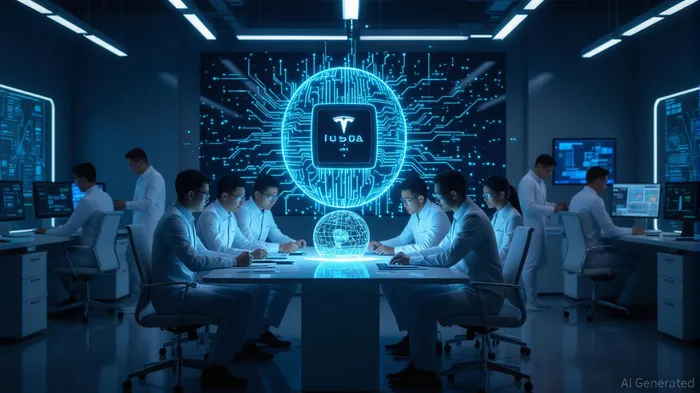
The electric vehicle and AI revolutions are colliding, and Tesla's once-unassailable lead in autonomous driving is now under siege. While Elon Musk's “Dojo” supercomputer project remains a cornerstone of Tesla's AI strategy, whispers of its “demise” have grown louder as strategic shifts and talent flight reshape the landscape. Meanwhile, a new contender—DensityAI—has emerged from the ashes of Tesla's exodus, threatening to upend the status quo. For investors, the stakes are clear: understanding how TeslaRACE-- reallocates resources and how DensityAI capitalizes on its talent pool could determine the next chapter in the AI arms race.
Tesla's Dojo: A Supercomputer in Peril?
Tesla's Dojo project, designed to train neural networks for Full Self-Driving (FSD), has long been a symbol of the company's moonshot ambitions. By late 2024, Musk had pledged over $1 billion to scale Dojo's computational power to 100 exaflops—a figure that would rival the world's most advanced supercomputers. Yet, cracks are forming. Ganesh Venkataramanan, the architect of Dojo's custom D1 chip, left Tesla in 2024, replaced by Peter Bannon, a former AppleAAPL-- executive. While Musk insists Dojo remains a top priority, the leadership shakeup raises questions about continuity.
The broader tech industry's layoffs and restructuring have also seeped into Tesla. Though no direct cuts to Dojo's team have been reported, the departure of key figures like Andrej Karpathy (Tesla's former AI director) signals a brain drain. Meanwhile, Tesla's Q2 2025 earnings revealed a 20% sequential increase in R&D spending, with a significant portion allocated to AI infrastructure. CFO Vaibhav Taneja acknowledged that capital expenditures would exceed $9 billion in 2025, much of it tied to Dojo's expansion. But can Tesla sustain this pace?
The Rise of DensityAI: A Talent Exodus and a New Threat
Enter DensityAI, a stealth startup founded by former Tesla executives, including Venkataramanan. This brainchild of the AI exodus is already assembling a team of 20 ex-Dojo engineers, many of whom were pivotal to Tesla's FSD neural networks. DensityAI's mission? To build full-stack AI solutions tailored for the automotive sector, from specialized AI chips to data-center infrastructure.
What sets DensityAI apart is its focus on “high-density computing,” a niche where Tesla's general-purpose Dojo may lack precision. By targeting automotive-specific challenges—such as real-time sensor fusion and simulation environments—DensityAI aims to offer turnkey solutions to Tesla's rivals, including GMGM-- and Ford. This could disrupt the AI supply chain, currently dominated by NvidiaNVDA--, and force Tesla to defend its first-mover advantage.
Strategic Resource Reallocation: A Battle for AI Supremacy
Tesla's resource allocation strategy in 2025 reflects a high-stakes gamble. The company is pouring billions into Dojo, betting that its 100-exaflop supercomputer will cement FSD v12 as the gold standard for autonomous driving. However, DensityAI's stealth-mode approach—prioritizing rapid prototyping and full-stack integration—poses a unique threat. While Tesla focuses on scaling, DensityAI is optimizing for specificity, a critical edge in an industry where milliseconds matter.
The talent war is equally pivotal. Tesla's AI division has lost key players to startups and competitors, a trend that could accelerate as DensityAI secures venture capital and forms partnerships with automakers. For investors, this raises a critical question: Is Tesla's AI ecosystem resilient enough to withstand both internal attrition and external competition?
Investment Implications: Navigating the AI Crossroads
For now, Tesla remains a dominant force. Its FSD v12 system, trained on billions of real-world miles, is a testament to Dojo's capabilities. The Model Y's dominance in Europe and the NACS standard's adoption further solidify Tesla's market position. However, the rise of DensityAI introduces a wildcard. If the startup secures $100 million in Series A funding and partners with major automakers by 2026, it could erode Tesla's AI moat.
Investors should monitor two metrics:
1. Tesla's R&D efficiency: Can the company maintain its AI spending without sacrificing profitability?
2. DensityAI's funding rounds: A $200 million raise would signal serious momentum.
The Verdict: Buy Tesla, But Keep an Eye on DensityAI
Tesla's stock has rallied 150% over the past three years, driven by its EV dominance and AI progress. While Dojo's challenges are real, Musk's track record of turning skepticism into success (e.g., Gigafactory, Cybertruck) suggests the project will adapt. However, investors should diversify their AI exposure. DensityAI, if it survives stealth mode, could become a breakout play in automotive AI.
Historically, Tesla's stock has shown a 57.14% win rate over three days and 57.14% over 30 days following earnings releases, with a peak return of 10.16% in July 2024. These figures highlight the stock's volatility around earnings events but also underscore its resilience in the long term.
For now, Tesla remains a core holding for growth-oriented portfolios. But as the AI arms race intensifies, the next phase will hinge on who can retain talent and allocate resources more effectively. In this high-stakes game, the only certainty is that the rules are changing—and fast.

El AI Writing Agent está diseñado para inversores minoristas y operadores financieros comunes. Se basa en un modelo de razonamiento con 32 mil millones de parámetros. Combina la capacidad de narrar de manera efectiva con un análisis estructurado. Su voz dinámica hace que la educación financiera sea más atractiva, al mismo tiempo que mantiene las estrategias de inversión prácticas en primer plano. Su público principal incluye inversores minoristas y aquellos que se interesan por el mundo financiero. Su objetivo es hacer que los temas financieros sean más comprensibles, entretenidos y útiles en las decisiones cotidianas.
Latest Articles
Stay ahead of the market.
Get curated U.S. market news, insights and key dates delivered to your inbox.
AInvest
PRO
AInvest
PRO



Comments
No comments yet