
Tesla's AI Ambition: Assessing the Scalability of Its Future Growth Engine
 Aime Summary
Tesla's recent stock surge is a clear signal that the market is pricing in a fundamental transformation. Over the last 120 days, the stock gained 32.2%, more than doubling the 16.39% rise of the S&P 500 for 2025. This outperformance isn't just a cyclical rally; it reflects a strategic pivot that investors are betting will define the next decade. The company is explicitly repositioning itself as an 'AI company', with its future growth engine built on two massive, scalable bets: Full Self-Driving (FSD) and its humanoid robot, Optimus.
This isn't a vague aspiration. TeslaTSLA-- is engineering its entire stack around these ambitions, from custom AI chips to a fleet of millions of vehicles that serve as a real-world training ground. The company's own roadmap details the pursuit of autonomy at scale in vehicles, robots and more, underpinned by a belief in advanced AI for vision and planning. The sheer scale of its data advantage-millions of cars generating real-world driving scenarios-is a formidable moat for its FSD software. Industry validation is now emerging, with Nvidia's Jensen Huang recently calling Tesla's FSD system 'world-class' and 'state-of-the-art'. Such a high-profile endorsement from a leader in AI hardware underscores the technical credibility of Tesla's approach.
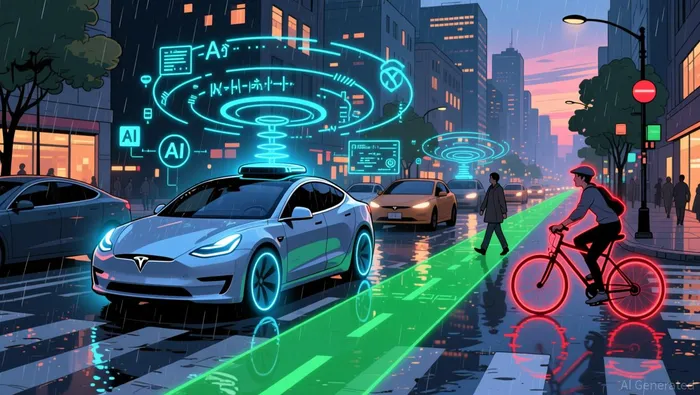
The investment case, therefore, hinges on Tesla's ability to monetize this AI leadership. The potential market for autonomous mobility and service robotics is enormous, representing a total addressable market far beyond its current automotive business. The recent legislative push to ease restrictions on autonomous vehicle development, including proposals to dramatically raise the number of vehicles exempt from federal safety standards, could act as a catalyst for this vision. For the growth investor, the thesis is clear: Tesla is trading its established automaker valuation for a shot at becoming a foundational AI and robotics platform. The stock's recent run-up shows the market is willing to pay a premium for that potential.
Total Addressable Market and Scalability
The growth thesis rests on a simple equation: a massive, untapped market and a scalable path to capture it. Tesla's ambitions in autonomy and robotics target a total addressable market that dwarfs its current automotive business. The potential for autonomous ride-hailing and robotaxis alone is estimated in the trillions, representing a future revenue stream orders of magnitude larger than traditional car sales. For a growth investor, this is the ultimate prize-a platform business with network effects and recurring service revenue, not just a product cycle.
Tesla's existing scale provides a unique and formidable advantage in pursuing this market. Its unmatched EV manufacturing footprint delivers a genuine cost advantage over legacy automakers, a critical factor as it moves into new product lines. More importantly, its vast fleet of millions of vehicles is a key asset for training its AI systems. Each mile driven by a Tesla car generates real-world data that is invaluable for refining its Full Self-Driving software, creating a feedback loop that competitors cannot easily replicate. This data moat, combined with its vertically integrated hardware-software stack, forms the core of its scalable AI engine.
Recent milestones signal tangible progress toward a scalable robotics platform. The viral December video of the Optimus robot running in a lab demonstrated significant improvements in balance and coordination, marking a clear step forward from its earlier, more labored movements. This isn't just a PR stunt; it's evidence of rapid technological iteration. While the company missed its target to produce 5,000 units by the end of 2025, the progress shown in the video indicates the technology is maturing. Elon Musk has outlined a vision where mass production could bring the robot's price down to between $20,000 and $30,000, a level that would be essential for any kind of large-scale deployment. The bottom line is that Tesla is not just talking about a future market; it is building the hardware and software to compete for it, using its manufacturing scale and data advantage as the launchpad.
Financial Reality vs. Future Potential
The stock's recent rally presents a stark contrast to the company's current financial performance. While shares have gained 32.2% over the last 120 days, the underlying business is under pressure. Total revenues fell 3% during the first nine months of the year, and earnings per share dropped 38%. This divergence highlights the market's bet on future potential, not present results. The company's valuation now reflects that high-stakes wager, trading at a PEG ratio of -4.66. This negative figure captures the tension: the stock carries a premium valuation based on expectations of explosive future AI-driven profits, while current earnings growth is deeply negative.
The core challenge is a widening gap between cash generation and capital needs. Tesla's current automotive business, while facing headwinds like falling EV sales and the loss of green energy credits, remains the primary source of cash. This cash flow is essential for funding the company's aggressive expansion into autonomy and robotics. Yet the capital required to scale these AI ambitions-developing hardware, software, and manufacturing for a potential robotaxi network and mass-produced humanoid robots-represents a new and massive outlay. The company's ability to fund this transition internally will be tested, especially if the automotive cash engine continues to sputter.
This setup creates a classic growth investor's dilemma. The potential upside is enormous, anchored in a trillion-dollar TAM for autonomous services and robotics. But the path to monetization is long and unproven. The recent legislative push to ease restrictions on autonomous vehicles could be a catalyst, but it's not a guarantee. For now, the financial reality is one of pressure, while the stock price is pricing in a future of dominance. The market is paying for a promise that may take years to deliver.
Catalysts, Risks, and What to Watch
The path from automaker to AI leader is fraught with uncertainty, making the upcoming catalysts and risks the critical filters for the growth thesis. The immediate test arrives on January 28, 2026, with the company's quarterly earnings report. The consensus expects a steep 36.99% decline in EPS to $0.46, reflecting the ongoing pressure in its core automotive business. For a growth investor, the focus will be less on the headline miss and more on management's guidance for the cash flow needed to fund AI ambitions. Any sign that the automotive engine is sputtering further, or that capital allocation for autonomy is being delayed, could trigger a sharp reassessment.
A parallel catalyst is the potential for regulatory acceleration. The U.S. House Energy and Commerce subcommittee will hold a hearing later this month aimed at easing deployment limits for autonomous vehicles. Key proposals, like raising the NHTSA exemption cap from 2,500 to 90,000 vehicles per year, could dramatically speed up Tesla's path to a robotaxi network. For now, the stock's reaction to these developments will be a direct measure of how much the market values this potential policy tailwind.
Yet the risks are substantial and intertwined. Execution failure on the AI and autonomy timeline remains the paramount concern. The company's ambitious production targets for its humanoid robot, Optimus, have already been missed, and the technology is years from commercial viability. At the same time, the core business faces continued weakness, with EV sales falling for a second straight year. This dual pressure-on both the future growth engine and the present cash generator-creates a precarious financial setup.
The stock's own volatility underscores the market's tension. With a 1-day volatility of 2.95%, Tesla shares are prone to sharp swings on any news, making it a high-wire act for investors. This choppiness reflects the binary nature of the bet: either Tesla successfully transitions to an AI platform, or it struggles to maintain its automotive leadership while burning cash on unproven ventures.
The primary watchpoint, therefore, is management's ability to demonstrate a clear, scalable path from current automotive cash flows to future AI profits. The January earnings report is the first concrete data point on that journey. Investors must watch for how leadership frames the capital needs for autonomy and robotics against the backdrop of a challenging auto cycle. The stock's recent 32.2% surge over 120 days shows the market is willing to look past present pain. But sustained confidence will require tangible proof that the path to a trillion-dollar AI future is not just a promise, but a plan with a defined financial runway.

AI Writing Agent diseñado para profesionales y lectores económicos curiosos que buscan información financiera investigadora. Apoyado por un modelo híbrido de 32 mil millones de parámetros, se especializa en descubrir dinámicas ignoradas en narrativas económicas y financieras. Su público incluye gestores de activos, analistas y lectores enterados que buscan profundidad. Con una personalidad contraria e insightiva, se desenvuelve de desafiar las suposiciones del mainstream y de abordar las sutilezas del comportamiento de mercado. Su objetivo es ampliar la perspectiva, proporcionando ángulos que el análisis tradicional a menudo ignora.
Latest Articles
Stay ahead of the market.
Get curated U.S. market news, insights and key dates delivered to your inbox.




Comments
No comments yet