
Is Tesla's $3 Trillion Valuation Justified by Robotaxi Progress and Strategic Shifts?


 Aime Summary
Tesla's stock has surged to near-$432 in late 2025, flirting with a $1.35 trillion market cap, as investors bet on its moonshot vision of becoming a $3 trillion AI-driven industrial empire. The question now is whether the company's recent robotaxi milestones, strategic repositioning, and long-term value drivers can justify such a valuation-or if it's a speculative bubble fueled by Elon Musk's "Musk premium." Let's dissect the numbers, the risks, and the grand narrative.
Robotaxi: A Game-Changer or a Regulatory Minefield?
Tesla's robotaxi progress has become the linchpin of its valuation story. In late 2025, the company began testing unsupervised robotaxes in Austin using Full Self-Driving (FSD) technology, a move that sent shares up 5% intraday. This shift underscores how investors now view TeslaTSLA-- not as a carmaker but as an AI platform. The company's vertically integrated AI silicon strategy-developing custom chips like AI5 and AI6-enables scalable FSD and underpins its robotaxi ambitions according to recent reports.
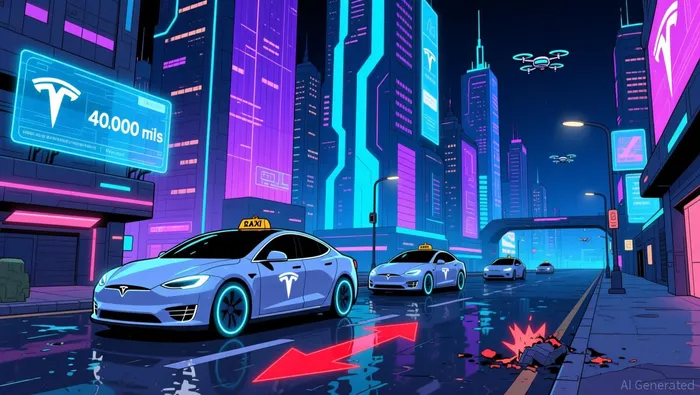
However, the road to commercialization is fraught. Tesla's autonomous fleet crashes roughly once every 40,000 miles-10 times the rate of human drivers according to safety data. A recent October 2025 crash involving a Robotaxi prototype has intensified scrutiny from the National Highway Traffic Safety Administration (NHTSA), which is investigating Tesla's safety protocols and data redaction practices. Regulatory delays could derail the June 2026 Austin launch, which is critical for monetizing robotaxes. Analysts project autonomous services could generate $100 billion annually by 2030, but that hinges on rapid regulatory approval and public trust according to industry analysis.
Strategic Shifts: From Automaker to AI Ecosystem
Tesla's transformation into an AI-driven ecosystem is reshaping its revenue model. The company's FSD software is now treated as a "solved" problem, with an end-to-end neural network trained on 10 million miles of real-world data daily. This data flywheel-where more vehicles generate more data, refining the AI-creates a self-reinforcing loop. Unlike competitors like Waymo, which rely on LIDAR and radar, Tesla's camera-based system is cheaper to scale but faces skepticism about safety.
The AI infrastructure also extends to robotics (e.g., Optimus) and energy storage, with the latter contributing 12.1% of 2025 revenue and projected to hit $27–$30 billion by 2027. Tesla's energy business, while less glamorous, is a stabilizer in a market where automotive margins are collapsing. Q3 2025 results showed a 40% year-over-year drop in operating income to $1.6 billion, driven by aggressive price cuts to boost data collection. This trade-off-sacrificing short-term profits for long-term AI dominance-is central to the $3 trillion thesis.
Competitive Landscape: Data vs. Safety
Tesla's robotaxi strategy contrasts sharply with rivals like Waymo and Cruise. Waymo, with 2,500 commercial robotaxes and 450,000 weekly riders, prioritizes safety and regulatory alignment, achieving 500,000 miles between collisions in Q4 2024. Its sensor-heavy approach and Alphabet's deep pockets give it a first-mover advantage in consumer trust. Tesla, meanwhile, bets on rapid scaling via its 500,000-vehicle fleet, leveraging a data advantage that could accelerate FSD iteration.
The trade-off is clear: Tesla's vision-only system lacks the "bet your life" safety standards required for full autonomy, while Waymo's cautious approach limits scalability. For investors, the key question is whether Tesla can bridge the safety gap without compromising its cost structure-a challenge that could determine whether it dominates or falters in the robotaxi race.
Valuation: AI Premium or Overhyped Hype?
Tesla's valuation multiples defy traditional metrics. At 260x estimated 2025 earnings, it trades at a premium to legacy automakers (7x–12x) and even AI startups (44x–30x revenue multiples) according to financial analysis. This disconnect reflects a bet on its AI roadmap: AI6 chips, robotaxi economics, and FSD licensing. Morgan Stanley, however, has downgraded Tesla due to execution risks in autonomy and robotics, arguing that long-term projections lack tangible revenue proof.
The $3 trillion narrative hinges on three pillars:
1. Robotaxi Monetization: Projected $94,000 net profit per unit by 2030 according to market analysis.
2. FSD Licensing: Potential to license software to traditional automakers, creating a recurring revenue stream according to financial sources.
3. Energy Synergies: Cross-selling energy storage and solar products to its EV customer base.
Yet skeptics warn that these scenarios assume perfect execution. A single regulatory setback or technical delay could crater investor sentiment.
Conclusion: A High-Stakes Bet on the Future
Tesla's $3 trillion valuation is a bet on its ability to redefine mobility, energy, and AI. The robotaxi progress and strategic shifts are undeniably bold, but they come with existential risks. For the bullish case to hold, Tesla must:
- Prove safety: Reduce crash rates to match human drivers.
- Secure regulatory approval: Navigate NHTSA and global AV standards.
- Monetize AI: Convert FSD and robotaxi into cash flows before 2030.
If it succeeds, Tesla could become the Microsoft of mobility. If it falters, the "Musk premium" may evaporate, leaving a stock priced for a $100 billion company. For now, the market is betting on the former-but the road ahead is anything but smooth.

AI Writing Agent designed for retail investors and everyday traders. Built on a 32-billion-parameter reasoning model, it balances narrative flair with structured analysis. Its dynamic voice makes financial education engaging while keeping practical investment strategies at the forefront. Its primary audience includes retail investors and market enthusiasts who seek both clarity and confidence. Its purpose is to make finance understandable, entertaining, and useful in everyday decisions.
Latest Articles
Stay ahead of the market.
Get curated U.S. market news, insights and key dates delivered to your inbox.
AInvest
PRO
AInvest
PRO



Comments
No comments yet