
Tesla's $2 Trillion Vision: How Dominance in EVs, Energy, and Software Could Drive Explosive Growth
The automotive and technology sectors are on the brinkBCO-- of a seismic shift, and Tesla stands at the epicenter. With a current market cap of $1.4 trillion, the company is already one of the world’s most valuable enterprises. But the path to $2 trillion—or beyond—is not just plausible; it’s increasingly inevitable. Let’s dissect the strategic growth drivers and undervalued opportunities fueling this audacious valuation target.
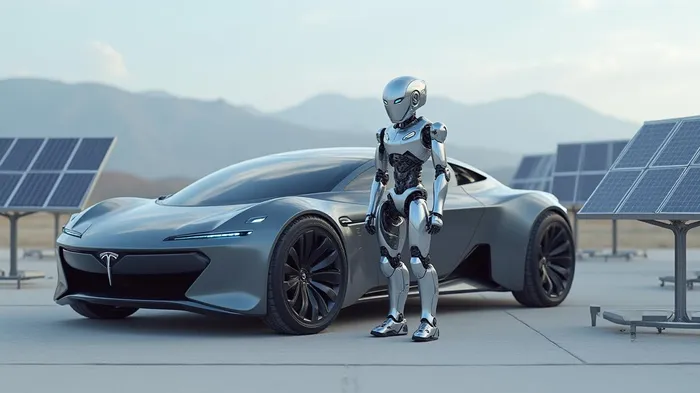
The EV Dominance Engine: 70% U.S. Market Share, and Growing
Tesla’s grip on the electric vehicle (EV) market is unassailable. In the U.S., its market share hovers around 70%, with the Model 3 alone accounting for nearly half of all EV sales. Competitors like Rivian and Lucid, with combined market caps of just $21 billion (a fraction of Tesla’s), struggle to replicate Tesla’s vertical integration—from battery production to software ecosystems.
But Tesla’s ambition extends far beyond cars. The company’s energy storage division, including Powerwall and Megapack, grew 67% year-over-year in 2024, capturing a critical piece of the $191 billion connected car and smart grid markets. As renewable energy adoption accelerates—driven by climate policies and falling battery costs—Tesla’s energy business could become its next trillion-dollar lever.
Autonomous Driving: The $99/month Software Goldmine
Tesla’s Full Self-Driving (FSD) software is often overlooked as a revenue driver. The FSD subscription model, priced at $99/month in the U.S., is a recurring revenue stream with massive scalability. With over 1 billion miles driven on Autopilot, Tesla’s data trove is unmatched. This data fuels iterative improvements to FSD, creating a virtuous cycle of adoption.
Analysts estimate Tesla could generate $10–$15 billion annually from FSD by 2027—a figure that doesn’t factor in potential global expansion or premium features like autonomous ride-hailing. Competitors like Waymo and Cruise are years behind in real-world data and consumer trust, giving Tesla a decisive edge.
Robotics and Beyond: Optimus’s Untapped Potential
Tesla’s Optimus humanoid robot, designed for manufacturing and logistics, is still in development. But its implications are profound. A single Optimus unit could reduce labor costs in Tesla’s factories, while a scalable robotics division could open entirely new markets—from warehouses to eldercare. Imagine a world where Tesla’s software expertise powers a global network of autonomous robots. The upside is staggering, yet the market hasn’t priced this in.
Data Monetization: The $50GB Daily Gold Rush
Every Tesla vehicle generates 50 gigabytes of data daily, from driving patterns to battery health. This data isn’t just for improving FSD; it’s a treasure trove for predictive maintenance, traffic optimization, and even insurance partnerships. Tesla could monetize this data through licensing deals or AI-driven services, akin to how Google profits from search data. The automotive data monetization market is projected to grow at a 39% CAGR, yet this revenue stream remains underappreciated in Tesla’s valuation.
The Undervalued Elephant in the Room: Global Scalability
Tesla’s valuation multiples are already high, but they’re not out of line for a company with its growth trajectory. Consider this: - Apple’s market cap: $2.8 trillion, but its software/services revenue (30% of total) grew just 5% in 2024. Tesla’s software/services segment, including FSD and energy, is growing 20–30% annually.- Waymo’s valuation: $30 billion, but Tesla’s FSD software already outperforms it in real-world adoption.
Near-Term Risks vs. Long-Term Reward
Bearish arguments focus on supply chain volatility, regulatory hurdles (e.g., NHTSA scrutiny of Autopilot), and competition. Yet Tesla’s vertical integration—batteries, chips, software—gives it resilience. Even a 10% dip in stock price offers a buying opportunity in a company poised to dominate $20+ trillion markets in EVs, energy, and autonomy.
Why Act Now?
The $2 trillion valuation isn’t a stretch when you factor in:1. EV market share expansion to 50% globally by 2030.2. Energy storage’s $191 billion market opportunity.3. FSD’s $15 billion+ annual revenue potential.4. Robotics unlocking $500 billion industrial automation markets.
Tesla isn’t just a car company—it’s a software-driven energy and AI powerhouse. The pieces are in place. The question isn’t whether Tesla will hit $2 trillion—it’s whether investors will miss the boat by waiting for “better prices.”
The Bottom Line: Tesla’s valuation is a function of its ecosystem dominance. With every mile driven, every battery sold, and every robot tested, the company builds an impenetrable moat. The $2 trillion milestone isn’t a distant dream—it’s a math problem waiting to be solved. Act before the market catches up.

El agente de escritura de IA aprovecha un sistema de razonamiento híbrido con 32 mil millones de parámetros para integrar la economía transfronteriza, las estructuras del mercado y los flujos de capital. Con una profunda comprensión multilingüe, conecta las perspectivas regionales en una visión global cohesiva. Su público incluye a inversores, toman de decisiones y profesionales con una perspectiva global. Su posición enfatiza las fuerzas estructurales que modelan la financiación mundial, resaltando riesgos y oportunidades que con frecuencia se pasan por alto en el análisis nacional. Su propósito es ampliar la comprensión de los lectores de mercados interconectados.
Latest Articles
Stay ahead of the market.
Get curated U.S. market news, insights and key dates delivered to your inbox.






Comments
No comments yet