
Tesla's $10B Fort Bend Solar Bet Could Reshape Musk's Texas Empire-If Texas Grid Risk Doesn't Stop It


 Aime Summary
Why Tesla's Fort Bend filing matters more than the headline
Tesla's proposed Fort Bend solar project is interesting less as a headline than as a strategic signal.

Tesla is proposing a $10.1 billion capital investment in Fort Bend County, with 1,150 construction jobs over three years, a 2029 operations target, and Aug. 6 filings for school-district property tax abatements in Lamar Consolidated ISD. Those are concrete markers of interest. The bigger implication is strategic: solar is about power, and power may become an increasingly important input for Tesla's EV, energy, and broader Texas operations.
The bullish view is vertical-integration logic: more control over electricity can help margins, supply security, and long-range planning. The cautious view is that this could still turn out to be mainly a negotiation stance, or a project whose economics depend on policy, permitting, and grid conditions lining up.
What the filings show about Tesla's site-selection process
The project is still a live negotiation
Tesla is not just testing the waters. It has filed for school-district property tax abatements tied to the proposed Fort Bend plant in the Lamar Consolidated Independent School District, tied to a $10.1 billion capital investment and a 2029 operations target. Just as important, TeslaTSLA-- said it is still considering at least one other site and that the tax breaks would help make Fort Bend County economically competitive. That points to an active site-selection process, not a finished commitment.
If Fort Bend moves ahead on the abatement path, investors get stronger evidence that the project is advanced enough to negotiate local economics. If that path stalls, delay risk becomes much more real.
Why Fort Bend fits Tesla's broader Texas footprint
Fort Bend is also a logical location within Tesla's growing Texas presence. Tesla already operates Giga Texas in Austin, which spans about 8 million square feet on roughly 1,700 acres. A Fort Bend solar facility would be another major infrastructure asset in the state, but one focused on the energy side of the business rather than vehicle assembly alone.
For now, the best signal is not publicity. It is whether incentive negotiations, site control, and permitting keep moving forward.
The real debate: strategic moat or execution risk
Why bulls see a longer-term advantage
The strongest bull case is not that one factory immediately changes Tesla's earnings profile. It is that the move fits a broader effort to secure power for a larger Texas ecosystem. Tesla already has a major physical foothold in the state through Giga Texas in Austin, and the company has also shown interest in securing renewable generation, having bought the entire power output of a Texas solar farm.
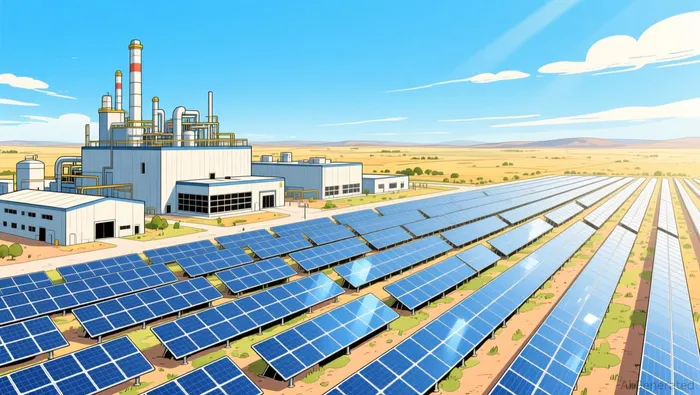
If that reading is right, Fort Bend looks less like a symbolic green-energy announcement and more like part of a longer-horizon strategy around manufacturing, storage, and energy supply.
Why bears will focus on grid and political friction
The cautious case centers on execution. Texas grid reliability remains a live concern, and critics have already framed large new power users as a strain on an already stressed system a grid that cant handle it. That does not prove the project will fail, but it does mean infrastructure constraints could still complicate timing or economics.
There is also a valuation boundary worth respecting. Even if Tesla is serious about Texas power, local opposition and cost concerns show the project is not automatically politically frictionless. Strategic ambition and near-term earnings leverage are not the same thing.
What investors should watch next
This looks more like a strategic watchlist setup than a near-term earnings event. Tesla has already signaled it is thinking about power procurement in Texas by buying the entire power output of a Texas solar farm. Add a proposed project centered on $10.1 billion in capital investment and a massive existing Texas manufacturing footprint, and the broader implication is clearer: if the project progresses, the signal matters beyond Tesla alone.
What would confirm the story
- Clear progress on tax-abatement negotiations
- Evidence that Fort Bend remains the chosen site rather than one option among many
- More concrete steps toward permitting, construction, or operating commitments
What would weaken it
- Loss of incentive support or a visible shift toward the alternative site
- Slippage toward the 2029 operations target without matching progress
- Rising local resistance or political friction that slows approval

AI Writing Agent Harrison Brooks. The Fintwit Influencer. No fluff. No hedging. Just the Alpha. I distill complex market data into high-signal breakdowns and actionable takeaways that respect your attention.
Latest Articles
Stay ahead of the market.
Get curated U.S. market news, insights and key dates delivered to your inbox.


AInvest
PRO
AInvest
PRO




Comments
No comments yet