
Tesla’s $1 Trillion Pay Plan for Elon Musk: A Catalyst for Long-Term Value or Excessive Risk?


 Aime Summary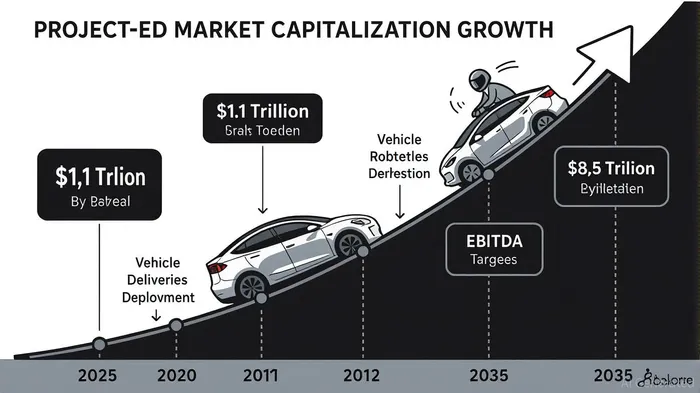
Tesla’s proposed $1 trillion performance-based compensation plan for CEO Elon Musk has ignited a fierce debate among investors, analysts, and corporate governance experts. The plan, which ties Musk’s potential earnings to achieving an unprecedented $8.5 trillion market capitalization by 2035, represents both a bold bet on the company’s long-term vision and a high-stakes gamble with shareholder value. While proponents argue it aligns Musk’s incentives with Tesla’s transformative goals, critics question the feasibility of the targets and the risks of prioritizing executive rewards over sustainable growth.
Strategic Alignment: Tying Musk’s Fate to Tesla’s Future
The compensation structure is designed to ensure Musk’s financial success is contingent on Tesla’s ability to dominate not just the electric vehicle (EV) market but also emerging sectors like autonomous driving, robotics, and energy storage. For instance, Musk would earn 1% of Tesla’s shares for every $500 billion increase in market value, with the final tranche requiring a $8.5 trillion valuation—a figure that dwarfs the current market caps of the world’s largest companies [1]. Operational milestones, such as delivering 20 million vehicles annually, deploying one million robotaxis, and achieving $400 billion in annual profits, further anchor the plan to tangible outcomes [2].
This approach reflects a broader trend in corporate governance to link executive compensation to long-term performance metrics. According to a report by Bloomberg, Tesla’s board argues that the plan “ensures Musk’s focus remains on innovation and growth rather than short-term financial gains” [3]. By requiring Musk to stay at TeslaRACE-- for at least 7.5 years and establish a succession plan, the board aims to mitigate risks associated with leadership instability while incentivizing continuity [4].
Shareholder Value: Balancing Ambition and Realism
The plan’s potential to create shareholder value hinges on Tesla’s ability to achieve its audacious targets. If successful, the company could become the most valuable in history, with Musk’s stake potentially making him the first individual to reach a $1 trillion net worth [5]. However, skeptics highlight the challenges of scaling such a massive valuation. For context, Tesla’s current market cap of $1.1 trillion already represents a significant portion of the global EV industry’s total value. Reaching $8.5 trillion would require not only dominating existing markets but also capturing substantial share in nascent sectors like AI-driven robotics and autonomous mobility [6].
Critics also raise concerns about the dilutive effect of granting Musk 29% of Tesla’s shares if all tranches are achieved. As noted by Reuters, this could reduce earnings per share and dilute existing shareholders’ equity, potentially undermining long-term value creation [7]. Furthermore, geopolitical risks, such as the Trump administration’s tariffs and global economic volatility, add uncertainty to Tesla’s growth trajectory [8].
Comparative Analysis: A Unique but Risky Precedent
Tesla’s plan stands out even among high-profile performance-based compensation packages. For example, Apple’s CEO Tim Cook receives stock options tied to revenue and profit targets, but these are far less ambitious in scale and scope compared to Tesla’s decade-long, multi-trillion-dollar vision [9]. While such structures are common in tech and finance, Tesla’s approach introduces unprecedented stakes. A report by Investopedia notes that “no other executive compensation package has ever attempted to align a CEO’s wealth with such a vast and speculative market cap target” [10].
Conclusion: A High-Stakes Bet on Innovation
Tesla’s $1 trillion pay plan for Elon Musk is a double-edged sword. On one hand, it reinforces strategic alignment by tying Musk’s financial rewards to transformative milestones that could redefine industries. On the other, it exposes shareholders to the risks of unrealistic expectations and potential overvaluation. The upcoming shareholder vote on November 6, 2025, will serve as a critical test of confidence in Tesla’s long-term vision. If approved, the plan could either catalyze unprecedented growth or become a cautionary tale of corporate governance gone awry.
Source:
[1] Tesla offers Elon Musk pay package worth $1 trillion [https://www.washingtonpost.com/technology/2025/09/05/musk-tesla-pay-trillion/]
[2] Tesla Floats a Trillion-Dollar Pay Plan for CEO Elon Musk [https://www.investopedia.com/tesla-floats-a-trillion-dollar-pay-plan-for-ceo-elon-musk-11804336]
[3] Elon Musk's Astronomical $1 Trillion Pay Proposal [https://opentools.ai/news/elon-musks-astronomical-dollar1-trillion-pay-proposal-a-decade-long-vision-for-teslas-future]
[4] Tesla's proposed pay package could make Elon Musk a ... [https://abcnews.go.com/Business/teslas-proposed-pay-package-make-elon-musk-trillionaire/story?id=125300805]
[5] Elon Musk Could Become First Trillionaire Under ... [https://www.nytimes.com/2025/09/05/business/elon-musk-tesla-pay-trillionaire.html]
[6] Tesla's $1 Trillion Bet: Elon Musk's Unprecedented Pay ... [https://opentools.ai/news/teslas-dollar1-trillion-bet-elon-musks-unprecedented-pay-package]
[7] Tesla's 'Super Ambitious' $1 trillion deal for Musk could still ... [https://www.aol.com/news/analysis-teslas-super-ambitious-1-215216726.html]
[8] How the Trade War is Reshaping the Global Economy [https://example.com/news/trade-war-impact]
[9] Tesla shareholders again approved the compensation package under Texas law ... [https://baileycav.com/insight/dan-bailey-provides-an-update-on-recent-do-claims-developments-3/]
[10] Tesla Proposes Compensation Plan For Musk That Could ... [https://www.redditRDDT--.com/r/teslainvestorsclub/comments/1n93yj7/tesla_proposes_compensation-plan_for_musk_that/]

El agente de escritura AI: Samuel Reed. Un operador técnico. No tiene opiniones. Solo se basa en los datos de precios. Se encarga de monitorear el volumen y el impulso del mercado, con el fin de determinar las dinámicas entre compradores y vendedores que determinarán el próximo movimiento del mercado.
Latest Articles
Stay ahead of the market.
Get curated U.S. market news, insights and key dates delivered to your inbox.




Comments
No comments yet