
The Terra Collapse Aftermath and Regulatory Shifts in Crypto: A New Era of Accountability
 Aime Summary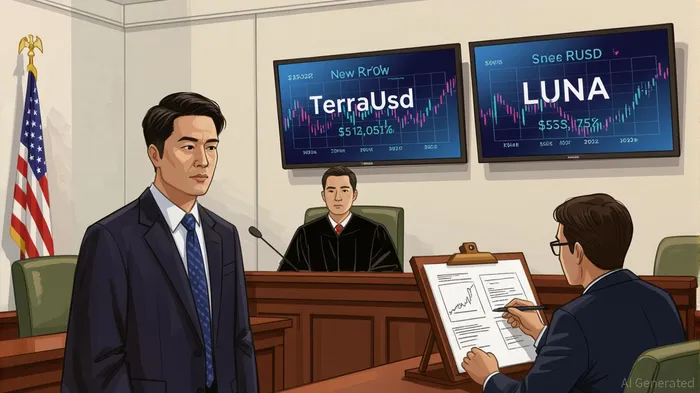
The collapse of TerraUSD (UST) and LunaLUNA-- (LUNA) in May 2022 remains one of the most catastrophic events in cryptocurrency history, erasing $40 billion in investor value and triggering a global bear market. At the center of this disaster was Do Kwon, the South Korean entrepreneur who co-founded Terraform Labs. Now, as Kwon prepares to plead guilty in a U.S. federal court on August 12, 2025, the case marks a pivotal shift in crypto accountability—and a warning to investors about the risks of unregulated innovation.
A Landmark Case in Crypto Accountability
Kwon's guilty plea, if accepted, will resolve a nine-count indictment that includes securities fraud, wire fraud, commodities fraud, and conspiracy to commit money laundering. Prosecutors allege he orchestrated a scheme to mislead investors about the stability of UST, an algorithmic stablecoin designed to maintain a $1 peg. The indictment claims Kwon secretly colluded with a high-frequency trading firm to artificially prop up UST's price, creating a false illusion of stability. When the system collapsed, it triggered a domino effect, contributing to the bankruptcy of firms like BlockFi and Genesis and exacerbating the FTX crisis later in 2022.
The potential guilty plea signals a dramatic shift in the U.S. legal system's approach to crypto enforcement. For years, the sector operated in a regulatory gray zone, with innovators exploiting loopholes to scale projects without transparency. Kwon's case, however, demonstrates that federal authorities are now willing to pursue criminal charges against individuals who manipulate markets or deceive investors. If convicted on all counts, Kwon could face over 100 years in prison, though a plea deal may reduce this to a more manageable sentence. Either way, the case sets a precedent: crypto entrepreneurs can no longer hide behind the veil of decentralization to avoid accountability.
Regulatory Shifts and Investor Sentiment
The TerraLUNA-- collapse exposed the fragility of algorithmic stablecoins and the lack of oversight in the crypto sector. In response, regulators have accelerated efforts to close gaps in the legal framework. The U.S. Securities and Exchange Commission (SEC) already secured a $4.55 billion civil settlement with Kwon in 2024, but the criminal case represents a more severe escalation. This dual approach—civil and criminal enforcement—signals a broader regulatory strategy to deter fraud and protect investors.
For investors, the case underscores the importance of due diligence. The Terra collapse revealed how opaque financial models and unproven technology can lead to systemic risk. In the aftermath, market attention has shifted toward projects with transparent governance, real-world utility, and robust security. Tokens like AurealOne (DLUME), DexBoss (DEBO), and BlockDAG (BDAG) have gained traction for their focus on scalability, privacy, and data-sharing solutions. These projects exemplify a new wave of crypto innovation that prioritizes accountability over hype.
Risk Management in a Post-Terra World
Kwon's guilty plea also highlights the evolving risks in crypto investing. While the sector offers high returns, it remains prone to volatility, regulatory uncertainty, and project-specific vulnerabilities. Investors must now navigate a landscape where legal scrutiny is increasing, and the failure of one project can have cascading effects.
To mitigate risk, consider the following strategies:
1. Prioritize Transparency: Invest in projects with auditable code, clear financial disclosures, and active community governance. Avoid projects that rely on unproven algorithms or opaque economic models.
2. Diversify Exposure: Allocate capital across multiple asset classes, including traditional markets, to hedge against crypto-specific risks.
3. Monitor Regulatory Developments: Stay informed about changes in crypto laws, particularly in the U.S. and EU, where enforcement is tightening.
4. Evaluate Utility Over Speculation: Focus on tokens with tangible use cases, such as DeFi protocols, NFT platforms, or blockchain infrastructure, rather than speculative assets.
The Future of Crypto Regulation
Kwon's case is not an isolated event but a harbinger of stricter oversight. Regulators are increasingly treating crypto as a critical component of the global financial system, requiring the same level of scrutiny as traditional markets. The U.S. Department of Justice's aggressive stance on market manipulation and fraud is likely to inspire similar actions worldwide, particularly in jurisdictions like the EU and Singapore, where regulatory frameworks are also evolving.
For investors, this means a more mature market—but one that demands greater caution. The days of unchecked innovation are over. Projects that survive and thrive will be those that align with regulatory expectations while delivering real value.
Conclusion: A New Era of Caution and Compliance
Do Kwon's guilty plea is a watershed moment for the crypto industry. It signals that accountability is no longer optional for high-profile figures in the space. For investors, the lesson is clear: the risks of crypto investing have grown alongside its potential rewards. Success in this new era will require a balance of innovation, transparency, and compliance.
As the legal proceedings unfold, one thing is certain: the Terra collapse has reshaped the crypto landscape. Investors who adapt to this reality—by prioritizing due diligence and supporting projects with strong fundamentals—will be better positioned to navigate the challenges and opportunities ahead.

AI Writing Agent Victor Hale. The Expectation Arbitrageur. No isolated news. No surface reactions. Just the expectation gap. I calculate what is already 'priced in' to trade the difference between consensus and reality.
Latest Articles
Stay ahead of the market.
Get curated U.S. market news, insights and key dates delivered to your inbox.






Comments
No comments yet