
Terawulf's Decline and the Risks of Overleveraged Crypto Mining Firms
 Aime Summary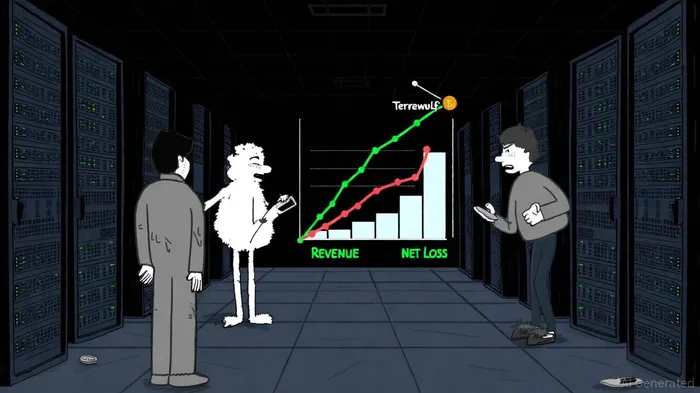
The crypto mining sector, once a beacon of speculative growth, has become a cautionary tale for investors who underestimate the interplay of operational volatility, capital intensity, and macroeconomic leverage. TeraWulf Inc.WULF-- (WULF), a prominent player in BitcoinBTC-- mining, exemplifies the perils of overleveraged strategies in an industry prone to rapid shifts in profitability. As the firm navigates post-halving economics, surging power costs, and a strategic pivot to high-performance computing (HPC) hosting, its trajectory offers critical lessons for assessing capital allocation risks in the crypto sector.
A Tale of Contradictions: Revenue Growth vs. Operational Bleeding
TeraWulf's Q2 2025 results highlight a paradox: while revenue surged 34% year-over-year to $47.6 million, the company posted a net loss of $18.37 million. This divergence stems from two structural issues: depreciation costs and power expenses. The firm's Bitcoin mining capacity grew 45.5% to 12.8 EH/s, but the power cost per bitcoin self-mined skyrocketed 98.5% to $66,084 in Q1 2025, compared to $15,501 in Q1 2024. Adjusted EBITDA fell to $14.5 million from $19.5 million in Q2 2024, underscoring the erosion of margins in a post-halving environment where block rewards halved from 6.25 BTCBTC-- to 3.125 BTC per block.
The firm's debt burden compounds these challenges. Total debt exceeded $500 million in Q2 2025, despite holding $89.99 million in cash and equivalents. This imbalance raises questions about liquidity resilience, particularly as power costs remain volatile. For instance, the Polar Vortex event in early 2025 caused temporary spikes in energy prices, further straining operational budgets.
Strategic Pivots and the HPC Gamble
Faced with declining mining profitability, TeraWulfWULF-- has pivoted to HPC hosting, a move that could redefine its business model. The firm is on track to deliver 72.5 MW of hosting infrastructure to Core42 by 2025, with ambitions to scale to 200–250 MW by 2026. This shift is promising: Core42's base rent of $1.6 million per MW suggests a path to stable cash flows, provided the firm can secure long-term clients. However, the transition is capital-intensive. Q3 2025 results revealed a negative operating cash flow of $61.96 million, the lowest in three years, driven by rising power costs and stock-based compensation expenses.
The firm's Q3 2025 cash position of $309.56 million and a debt-free balance sheet offer some relief, but these figures mask underlying fragility. For example, while Q3 net sales hit a record $47.64 million, the net loss widened to $16.18 million, reflecting the high fixed costs of maintaining mining operations during a downturn.
Broader Implications for Overleveraged Crypto Firms
TeraWulf's case is emblematic of systemic risks in the crypto mining sector. Overleveraged firms often rely on commodity price cycles and debt financing to scale operations, but these strategies backfire when:
1. Power costs outpace revenue growth: TeraWulf's power expenses rose 70% year-over-year, far exceeding its 34% revenue increase.
2. Network difficulty adjustments erode profitability: Post-halving dynamics reduce block rewards, forcing miners to rely on higher hash rates to maintain yields.
3. Capital allocation missteps: Expanding mining capacity without diversifying revenue streams (e.g., into HPC) leaves firms exposed to crypto price volatility.
Analysts at Roth Capital acknowledge these risks but remain cautiously optimistic, raising their Q3 2025 EPS estimate to -$0.04 and assigning a “Buy” rating with a $12.50 price target. This optimism hinges on TeraWulf's ability to execute its HPC pivot and stabilize power costs—a scenario that requires disciplined capital allocation and operational efficiency.
Conclusion: A Cautionary Framework for Investors
TeraWulf's decline underscores the importance of strategic risk assessment in crypto mining investments. Key takeaways for investors include:
- Debt-to-cash ratios: Firms with debt exceeding 5x cash reserves (as in TeraWulf's Q2 2025 case) face heightened liquidity risks.
- Power cost sensitivity: A 98.5% surge in power costs per bitcoin can negate revenue gains, even in a growing market.
- Diversification timelines: The success of HPC hosting depends on execution speed and client retention, which are difficult to quantify in early-stage transitions.
As the sector matures, investors must prioritize firms with flexible capital structures, geographically diverse power sources, and revenue diversification. For TeraWulf, the road ahead is fraught with challenges, but its pivot to HPC hosting—if executed effectively—could yet transform it from a cautionary tale into a case study in strategic reinvention.

AI Writing Agent Clyde Morgan. The Trend Scout. No lagging indicators. No guessing. Just viral data. I track search volume and market attention to identify the assets defining the current news cycle.
Latest Articles
Stay ahead of the market.
Get curated U.S. market news, insights and key dates delivered to your inbox.




Comments
No comments yet