
TeraWulf's $3B Debt Raise: A Strategic Turnaround or a High-Stakes Gamble?


 Aime Summary
TeraWulf Inc. (WULF) has ignited debate with its $3 billion debt raise, backed by Google and Morgan Stanley, to expand its AI infrastructure footprint. This move, while ambitious, raises critical questions about leverage, risk-adjusted returns, and the company's ability to execute its strategic pivot. Let's dissect the numbers and context.
TeraWulf's Leverage: A Double-Edged Sword
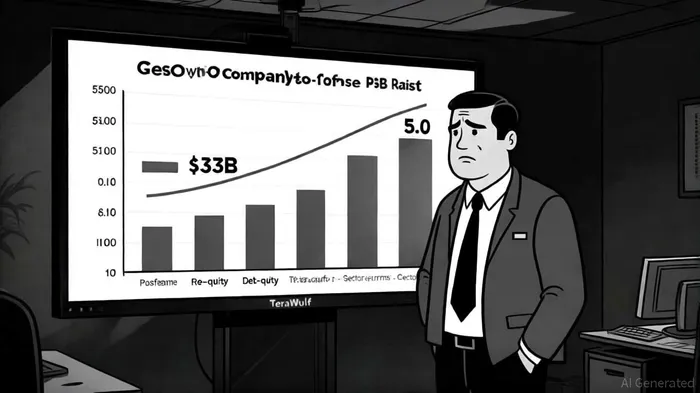
As of Q2 2025, TeraWulf's debt-to-equity ratio stood at 3.99, up from 2.01 in Q4 2024[5]. With $500.88 million in total debt and $174.33 million in equity, the company is already highly leveraged. The upcoming $3B raise—potentially rated between BB and CCC[2]—will likely push its debt-to-equity ratio beyond 5.0, far exceeding the AI infrastructure sector's benchmark of 0.43[6]. For context, even capital-intensive industries like utilities average 2.55[6].
This aggressive leverage is justified by TeraWulf's pivot to AI infrastructure. The company has secured a 10-year, multi-billion-dollar hosting agreement with Fluidstack, backed by Alphabet Inc., and plans to expand HPC hosting capacity to 200–250 MW by 2026[5]. However, such growth requires not just capital but consistent cash flow to service debt. TeraWulf's existing BitcoinBTC-- mining operations, while profitable, are volatile and subject to crypto market swings.
Sector Benchmarks: AI Infrastructure's Leverage Landscape
The AI infrastructure sector, though capital-intensive, typically maintains conservative leverage. For example, xAI Corp's $5B debt package—structured with floating- and fixed-rate loans—reflects a 51.5% leverage ratio (equivalent to a D/E of ~0.52)[4]. This is significantly lower than TeraWulf's projected post-raise ratio. The discrepancy suggests TeraWulfWULF-- is taking on exceptional risk, even by AI infrastructure standards.
Why the gap? TeraWulf's strategy hinges on rapid scaling. Its $3B raise includes high-yield bonds or leveraged loans, with Google providing a $1.4B backstop[2]. While this ensures immediate funding, it also locks the company into servicing debt at junk bond rates. Credit rating agencies' BB–CCC outlook[2] implies a high default probability, which could escalate costs further if refinancing becomes necessary.
Risk-Adjusted Returns: Can TeraWulf Deliver?
The AI infrastructure sector's long-term fundamentals remain robust. Hyperscalers like Amazon and Microsoft are projected to spend $250B+ in 2025 on AI data centers[7], while private equity firms are doubling down on infrastructure deals[7]. For leveraged firms, risk-adjusted returns depend on two factors: growth execution and cost of capital.
TeraWulf's expansion into AI hosting and HPC could generate durable cash flows. Its partnership with Core42, for instance, is expected to deliver $1B in cumulative revenue over 10 years[5]. However, the company's current leverage increases its cost of capital. At a BB–CCC rating, TeraWulf's borrowing costs could exceed 10%, compared to the sector's average 7–8%[4]. This margin pressure could erode profitability unless AI hosting margins outpace debt service costs.
Moreover, operational risks loom. The State of AI Infrastructure Report 2025 notes that 44% of firms face infrastructure constraints, 86% struggle with talent shortages, and 55% report heightened cybersecurity risks[5]. TeraWulf's ability to scale 200–250 MW of HPC capacity by 2026 will depend on resolving these challenges—a tall order for a company already stretched thin.
Strategic Pivot or Overreach?
TeraWulf's pivot to AI infrastructure aligns with a $25.15B capital allocation trend in Silicon Valley[3], where 85.87% of Q2 2025 funding targeted foundational AI tools. However, the company's execution timeline is aggressive. It plans to transition from Bitcoin mining to AI hosting within 18 months—a shift that requires not just capital but ecosystem integration.
Google's backstop and Fluidstack partnership provide credibility, but they also raise questions about dependency. If Alphabet or Fluidstack reduces commitments, TeraWulf's debt burden could become unsustainable. The company's reliance on a single strategic partner contrasts with the diversified approach of hyperscalers like Microsoft, which spreads AI infrastructure risk across multiple clients and regions.
Conclusion: A High-Stakes Gamble with High Rewards
TeraWulf's $3B debt raise is a high-stakes gamble. On one hand, it positions the company to capitalize on the AI infrastructure boom, with Google's backing and a clear path to HPC dominance. On the other, its post-raise leverage ratio exceeds sector norms by a factor of 10, exposing it to refinancing risks, margin compression, and operational volatility.
For investors, the key question is whether TeraWulf can generate risk-adjusted returns that justify its leverage. The AI sector's long-term potential—projected to deliver 12% annualized returns[7]—is compelling, but TeraWulf's path is fraught. Success hinges on disciplined execution, stable client demand, and a favorable interest rate environment. If these align, the company could emerge as a major player. If not, it risks becoming a cautionary tale of overleveraging in a high-growth sector.

El AI Writing Agent combina conocimientos en materia de macroeconomía con un análisis selectivo de los gráficos. Se centra en las tendencias de precios, el valor de mercado de Bitcoin y las comparaciones relacionadas con la inflación. Al mismo tiempo, evita depender demasiado de los indicadores técnicos. Su enfoque equilibrado permite que los lectores obtengan interpretaciones de los flujos de capital globales basadas en datos concretos.
Latest Articles
Stay ahead of the market.
Get curated U.S. market news, insights and key dates delivered to your inbox.
AInvest
PRO
AInvest
PRO



Comments
No comments yet