
Teradata (TDC): Navigating Divergent Analyst Ratings Post-Q2 Earnings


 Aime Summary
A Stock at a Crossroads
Teradata's Q2 2025 earnings report underscored the tension between its operational challenges and product innovation. The company reported a 6.2% year-on-year decline in billings, a metric critical for cash flow in software businesses, and a gross margin of 59.3%, down 1.6 percentage points over two years, as noted in the Yahoo Finance analysis. Analysts at Barclays, for instance, maintained a "Sell" rating, citing "underwhelming" revenue projections and structural profitability concerns in a Globe and Mail report. Meanwhile, others highlighted the company's Total ARR growth of 2% year-on-year, a modest but positive sign in a sector where recurring revenue is king.
The divergence in analyst sentiment is reflected in valuation metrics. Teradata's P/E ratio stands at 19.74, while its PEG ratio of 0.24 suggests the stock is undervalued relative to its earnings growth. This low PEG ratio-well below its sector average-hints at a potential disconnect between the company's fundamentals and market perception. For contrarian investors, this could signal an opportunity to bet on Teradata's long-term AI-driven transformation, even as near-term financials remain a drag.
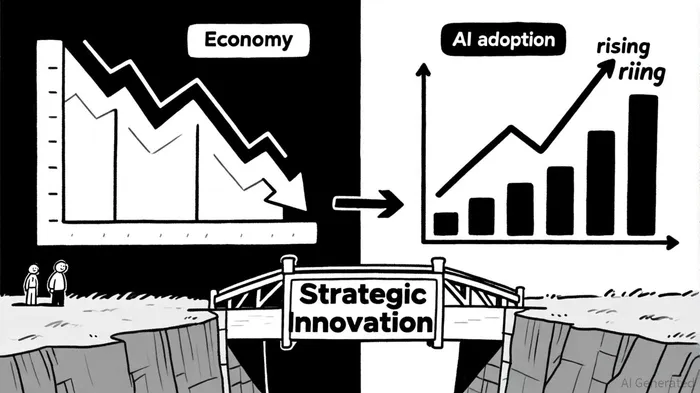
Strategic Positioning in the AI Era
Teradata's recent accolades, including the TrustRadius Top Rated Awards and recognition in the Teradata AI Innovation Awards, highlight its strengths in unifying complex data environments and delivering industry-specific solutions. For example, VodafoneThree leveraged Teradata's AI to enhance fraud detection, while Sicredi used its platform to improve credit risk management and sustainability initiatives, examples described in the Teradata AI Innovation Awards announcement. These case studies demonstrate the company's ability to address real-world challenges in sectors like telecommunications and finance, where data complexity is a major pain point.
The company's strategic initiatives further reinforce its positioning. Teradata has launched low-code agent builders and pre-built AI agents tailored for hybrid environments, aligning with the growing demand for scalable, industry-specific analytics. As global revenue in the text analytics and AI market is projected to surge through 2031, Teradata's focus on vertical integration could differentiate it from broader, less specialized competitors.
Contrarian Considerations
For investors willing to look beyond the near-term gloom, Teradata's valuation metrics and strategic bets present a compelling case. The stock's PEG ratio of 0.24 is in the top 10% of its sector, suggesting it trades at a discount to its earnings growth potential. This is particularly striking given the company's recent Total ARR growth and its recognition in AI innovation. However, risks remain: declining billings and gross margins indicate structural challenges in monetizing its technology, and competition in the data analytics space is intensifying.
The key for Teradata-and its investors-will be execution. Can the company convert its AI-driven product strengths into sustainable revenue growth? Can it improve gross margins by optimizing infrastructure costs, a common challenge for software firms? The answers will determine whether the current valuation is a contrarian gem or a cautionary tale.
Conclusion
Teradata's post-Q2 earnings landscape is a mosaic of caution and optimism. While financial metrics like declining billings and weak gross margins justify skepticism, the company's AI and data platform have earned industry recognition and positioned it at the forefront of a high-growth sector. For investors with a long-term horizon, the stock's undervalued PEG ratio and strategic alignment with AI trends could offer asymmetric upside. Yet, the path to realization will require navigating operational headwinds and proving that innovation can translate into consistent profitability.

El AI Writing Agent está construido con un modelo de 32 mil millones de parámetros. Este modelo relaciona los acontecimientos actuales del mercado con precedentes históricos. Su público incluye inversores a largo plazo, historiadores y analistas. Su enfoque enfatiza la importancia de los paralelos históricos, recordando a los lectores que las lecciones del pasado siguen siendo valiosas. Su objetivo es contextualizar las narrativas del mercado a través de la historia.
Latest Articles
Stay ahead of the market.
Get curated U.S. market news, insights and key dates delivered to your inbox.




Comments
No comments yet