

Three straight sessions of near-double-digit gains is the kind of tape that makes momentum traders feel brilliant and fundamental investors queasy. Tempus AITEM-- closed Friday, Aug 21 at $72.69, up roughly 9% on the session and capping a run that has lifted the stock about 70% in a month. The driver is real — a clinical validation of the exact asset the company agreed to acquire last month. The problem is the price the crowd is now paying for that asset. When a genuine catalyst meets one of the most heavily shorted floats in healthcare, the quote stops being a measure of the thesis and becomes a measure of the squeeze.
The velocity says this is a positional event, not a normal re-rating. After the ~13% pop on Aug 19 and the ~10.9% follow-through on Aug 20, Friday added roughly 9% more, on turnover of about $1.12 billion across roughly 15.9 million shares — a 14.8% turnover rate, extreme churn for a large-cap. By the close the stock was up 39.5% over five days, 70.3% over twenty, 36.4% over 120 days, and 23.1% year to date — an acceleration so steep that the twenty-day gain now dwarfs the full-year figure.
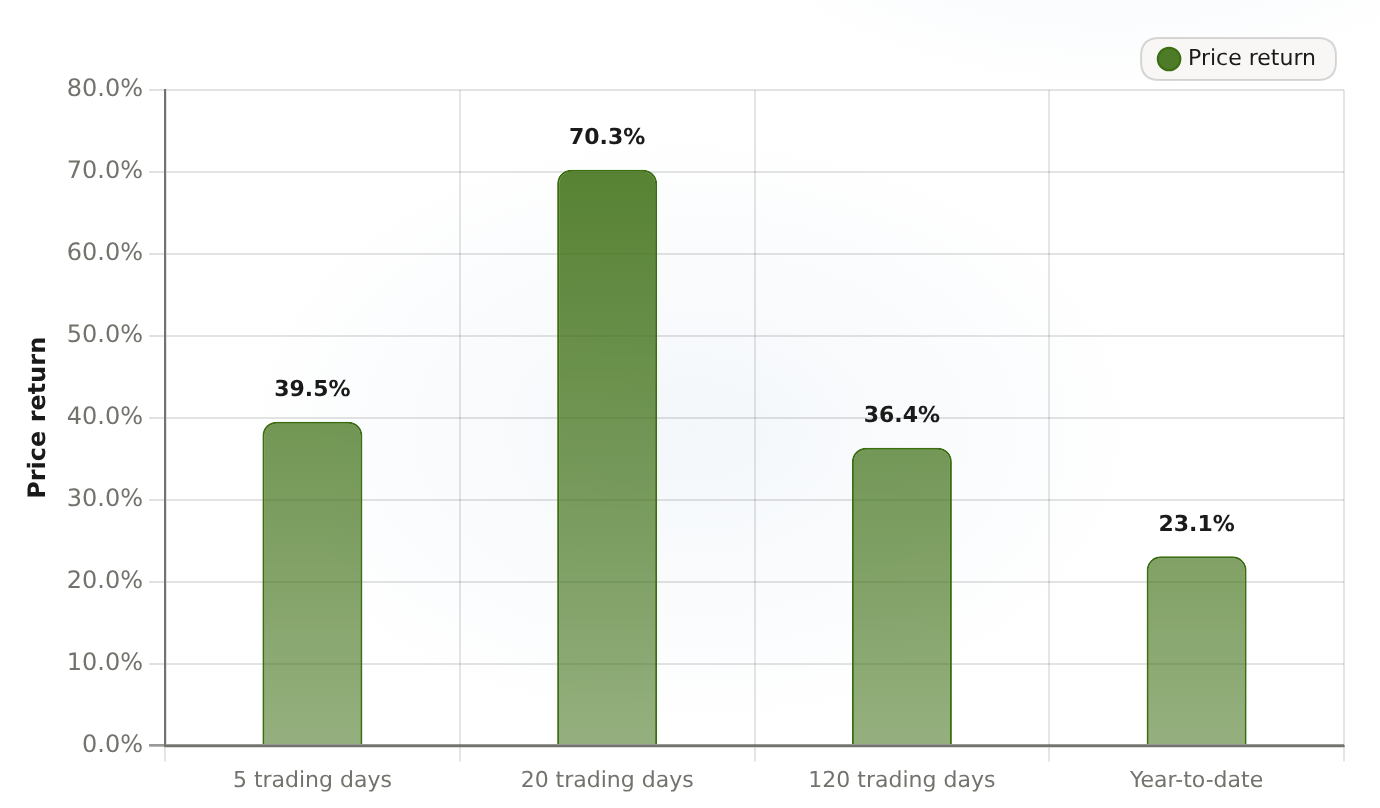
The +70% 20-day surge dwarfs both the 120-day (+36%) and year-to-date (+23%) returns, underscoring how compressed and recent this run is.
| Horizon | Price return (%) |
|---|---|
| 5 trading days | 39.52 |
| 20 trading days | 70.27 |
| 120 trading days | 36.35 |
| Year-to-date | 23.1 |
Yet even after all of that, shares still sit roughly 30% below the $104.32 high printed earlier in the year, a reminder that TEM's tape was already round-tripping violently before this week arrived. A stock that swings this hard, this often, is not asking for a buyer at the top of a squeeze. It is asking for a buyer who can time the exhaustion.
The Driver: A Clinical Readout That Validated the Deal
The catalyst cluster that lit the fuse landed on Aug 19-20, and it was clinical, not vibes. Merck and Moderna reported that their Phase 3 INTerpath-001 trial — a personalized mRNA neoantigen vaccine combined with Keytruda in resected melanoma — met its endpoint, the first successful Phase 3 readout for a customized mRNA cancer treatment. That result matters to TempusTEM-- because Moderna's manufacturing relies on Personalis's tumor-sequencing and neoantigen platform, the very company Tempus agreed on July 20 to acquire for roughly $1.5 billion in stock at $16.25 a share.
A positive late-stage readout lifts the commercial ceiling on the asset being bought, so investors repriced the deal thesis rather than Tempus's own quarterly numbers. Wall Street reinforced the read-through: BTIG maintained its Buy rating and raised its price target from $70 to $80 on Aug 20, pointing to the integration of Personalis's genomic sequencing with Tempus's data platform. Friday itself carried no discrete new headline — the session was continuation, driven by analyst upgrades and precision-oncology expansion layered on top of already-overbought technicals.
The Squeeze Mechanics Behind the Vertical
The short interest is why this validated story is being paid for so violently. Short interest stood at 24.32% of the float as of the July 31 report — roughly 33.2 million shares, about 5.9 days to cover — and mid-August estimates pushed the range to roughly 26% to 33% of the float, depending on the source.
When a positive catalyst lands on that positioning, fresh buying forces leveraged shorts to cover, the covering adds buying pressure, and the price climbs on the exit of others rather than on fresh conviction. The loop ends only when the shorts capitulate, when new supply arrives, or when the price stretch itself chokes off new longs.
The cleanest evidence that this is a structure trade rather than a vaccine bet: Moderna itself fell about 20% on Aug 20 — a textbook sell-the-news fade — while Tempus kept climbing. Investors were not buying the vaccine developer; they were buying the sequencing and minimal-residual-disease (MRD) substrate underneath it, the roughly $20 billion MRD testing market that rides alongside, not against, the new cancer therapies. That is the durable positioning at the heart of the deal, and it is why the long-term thesis itself deserves respect.
Real Inflection, Squeezed Valuation
The fundamentals support that long-term view, and the Q2 print was genuinely encouraging. Revenue rose 22% year over year to $382.5 million, and the company recorded its first quarterly GAAP net profit, swinging from a $42.84 million loss a year earlier to $5.64 million of net income, with management raising FY2026 revenue guidance to $1.60-1.61 billion and projecting roughly $65 million of adjusted EBITDA. Keep the basis straight, though: that is one quarter of GAAP profit, not a profitable company. Operating margin is still about -19.8%, EBITDA margin -16.1%, and trailing twelve-month free cash flow is -$273 million, against net debt of about $545 million on roughly $600 million of cash and $1.9 billion of total debt. The inflection is real; the earnings power is not there yet.

Which brings the setup back to valuation. At $72.69 the stock trades at roughly 9.2x trailing sales — about 9.5x enterprise value to sales — and near 29.5x book, multiples normally reserved for businesses that print cash, not ones that burn it. It is also above the average analyst target of $64.68, a number that itself predates part of the move; individual targets run from Piper Sandler's $56 and Freedom Capital's $59 up to Needham's $75 and BTIG's new $80. AInvest's aggregate signal labels TEMTEM-- a Buy, but its fundamental score is only 1.5 out of 10 against a liquidity score of 7.8 — the fingerprint of a momentum-driven, short-covering rally rather than a valuation-led re-rating. When the scorecard says the story is Buy but the fundamentals score 1.5, the market is paying for the narrative, not the math.
The technicals and the calendar reinforce the caution. RSI sits near 75 — firmly overbought — and the close came in roughly 38% above the 50-day moving average of about $52.66. The all-stock Personalis deal, struck at roughly a 28% premium, is expected to close late this year with integration risk and shareholder-rights scrutiny hanging over it; Rule 144 filings disclose planned insider sales by the chief financial officer and two other executives; and the next earnings report, expected around October or November, resets the bar for a stock now priced for acceleration. Any one of those becomes a pressure valve once the squeeze exhausts.
Bottom Line: Wait for the Lower-Risk Entry
So the honest read of the driver is simple: the catalyst is real and durable, the Friday move itself was continuation, and the price after a roughly 70%-in-twenty-days squeeze is not an entry a disciplined buyer should accept. I am not chasing this. A GARP framework buys growth at a reasonable price, and at $72.69 the growth is real but the price is a squeeze multiple. The better play is to wait for the lower-risk entry — a consolidation back toward the low-$60s or the rising 50-day average, ideally after the momentum cools and the shorts flush out — while the clinical validation and the deal remain intact. I would reassess if the pullback never comes and the stock instead digests these gains on heavy volume without giving back the breakout; that would mean the re-rating is fundamental rather than positional. And the call turns outright bullish if the deal closes cleanly and the October-November print confirms revenue acceleration with improving free cash flow. Until then, patience is the position. A real catalyst deserved a better entry price than this one — it is worth waiting for it.








Comments
No comments yet