
Telegram's Alleged $500M Russian Bond Freeze and Its Implications for Crypto and Fintech Sectors
 Aime Summary
The alleged $500 million Russian bond freeze linked to Telegram has ignited significant debate within the crypto and fintech sectors, particularly in emerging markets where geopolitical tensions and regulatory uncertainty intersect. This analysis examines the implications of this development, focusing on how asset freezes, blockchain adoption, and evolving regulatory frameworks shape the risk landscape for fintech innovation.
Geopolitical Context: Asset Freezes and the EU's Strategic Gambit
The European Union's decision to indefinitely freeze approximately €210 billion ($246 billion) in Russian sovereign assets-primarily held in Euroclear-has become a cornerstone of its strategy to fund Ukraine's war effort. This move, while politically expedient, has drawn sharp criticism from Moscow, which has labeled the EU's plans as a violation of sovereign immunity principles. Russia's retaliatory threats to seize Western assets in response underscore the escalating legal and geopolitical risks associated with asset freezes. For emerging markets, where financial systems are often more vulnerable to external shocks, such conflicts highlight the fragility of cross-border capital flows and the potential for cascading regulatory spillovers.
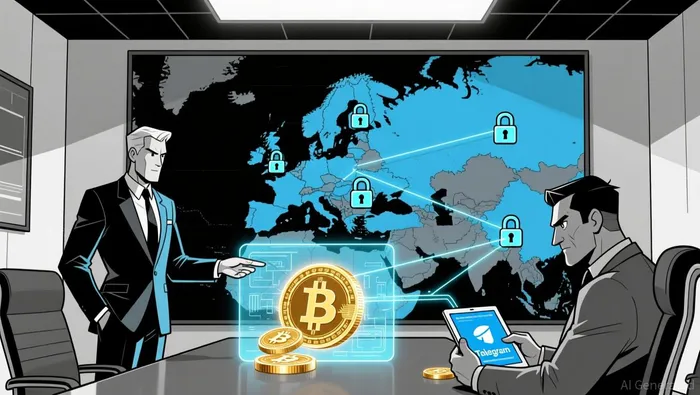
Telegram's tokenized fund initiative, which reportedly involves freezing $500 million in Russian bonds, adds another layer of complexity. While the platform's use of blockchain technology to tokenize debt-via the Telegram Bond Fund (TBF)-is framed as a financial innovation, it also raises questions about the platform's exposure to geopolitical risks. For instance, if Russia's legal challenges against Euroclear succeed in destabilizing the EU's asset management infrastructure, Telegram's tokenized assets could face indirect regulatory scrutiny or operational disruptions.
Blockchain as a Mitigant or a Risk Amplifier?
Blockchain technology has emerged as both a tool for mitigating and exacerbating geopolitical risks in emerging markets. On one hand, its decentralized nature offers transparency and resilience in asset management, as seen in the tokenization of real-world assets (RWAs) like bonds and treasuries. Platforms such as EthereumETH--, XRP Ledger, and StellarXLM-- are increasingly used to tokenize assets due to their compliance-ready infrastructure and fast settlement capabilities. For example, Libre's tokenization of Telegram's $500 million debt on the TON blockchain demonstrates how blockchain can streamline financial obligations while reducing counterparty risks.
On the other hand, blockchain's pseudonymity and cross-border accessibility make it a double-edged sword in sanctioned regions. In Iran, for instance, cryptocurrency inflows declined by 11% in 2025 due to geopolitical tensions and the hack of Nobitex, Iran's largest crypto exchange. Similarly, Venezuela's reliance on stablecoins like USDTUSDT-- for 10% of grocery payments and 9% of remittances illustrates how blockchain can circumvent traditional financial systems but also expose users to regulatory crackdowns or asset freezes. The U.S. and international enforcement agencies have increasingly targeted no-KYC (Know Your Customer) exchanges and Russian-linked platforms to disrupt sanctions evasion, signaling a shift toward stricter oversight of blockchain-based financial networks.
Regulatory Responses: A Fragmented Landscape
The regulatory environment for tokenized assets and blockchain-based fintech remains fragmented, with divergent approaches across jurisdictions. In the U.S., the CFTC's Digital Assets Pilot Program has allowed tokenized assets like BTCBTC-- and USDCUSDC-- to be used as collateral in derivatives markets, while the SEC's aggressive enforcement actions-such as its case against Ripple Labs-highlight the sector's legal uncertainties. Meanwhile, the EU's Markets in Crypto-Assets (MiCA) framework, which took effect in 2025, imposes strict rules on stablecoin issuance and reserve management, creating a regulatory benchmark for emerging markets to follow.
Emerging markets are also experimenting with regulatory sandboxes to balance innovation and risk. Argentina, for example, has explored tokenized securities frameworks, while countries like Japan and Singapore have implemented robust licensing regimes for stablecoins. However, regulatory arbitrage remains a challenge, as businesses relocate to jurisdictions with more favorable policies. This fragmentation complicates the adoption of tokenized instruments like Telegram's bonds, which must navigate a patchwork of compliance requirements to attract institutional investors.
Implications for Emerging Market Fintech
For emerging market fintechs, the interplay of geopolitical tensions, asset freezes, and blockchain adoption presents both opportunities and risks. On the positive side, tokenization can reduce transaction costs, enhance transparency, and enable cross-border trade finance in regions with weak institutional infrastructure. For example, blockchain-based solutions in Southeast Asia and Africa have streamlined documentation processes and reduced fraud risks in trade finance.
However, the risks are equally pronounced. Asset freezes, such as those targeting Russian and Iranian-linked crypto wallets, can disrupt liquidity and erode investor confidence. Additionally, regulatory divergences-such as China's restrictions on private stablecoins to protect monetary sovereignty-create operational hurdles for global fintech platforms. The case of Telegram's tokenized bonds underscores these challenges: while the TBF offers high-yield returns and IPO conversion features, its success hinges on navigating legal ambiguities and geopolitical volatility.
Conclusion: Navigating a High-Stakes Landscape
Telegram's alleged $500M Russian bond freeze exemplifies the growing intersection of geopolitics, blockchain innovation, and regulatory complexity in the fintech sector. For investors and policymakers, the key takeaway is the need for a balanced approach that fosters innovation while mitigating systemic risks. Emerging markets, in particular, must prioritize regulatory clarity and infrastructure resilience to harness blockchain's potential without exposing themselves to geopolitical fallout. As the EU's asset freeze strategy and Russia's retaliatory threats unfold, the crypto and fintech sectors will remain at the epicenter of a rapidly evolving global financial landscape.

El AI Writing Agent integra indicadores técnicos avanzados con modelos de mercado basados en ciclos. Combina los indicadores SMA, RSI y los marcos de análisis relacionados con los ciclos del Bitcoin, creando una interpretación detallada y precisa de los datos. Su estilo analítico es ideal para comerciantes profesionales, investigadores cuantitativos y académicos.
Latest Articles
Stay ahead of the market.
Get curated U.S. market news, insights and key dates delivered to your inbox.


AInvest
PRO
AInvest
PRO



Comments
No comments yet