
Teledyne FLIR Defense Soars on Pentagon Reforms and Nano-UAS Dominance
The U.S. Department of Defense's recent approval of TeledyneTDY-- FLIR Defense's Black Hornet 4 Personal Reconnaissance System as a Blue UAS List-qualified drone marks a pivotal moment for the company's growth trajectory. This certification, secured on June 23, 2025, after rigorous testing against 35 competing systems, positions Teledyne at the forefront of a defense sector undergoing rapid modernization. With its Black Hornet 4 now cleared for broad military deployment, the company stands to capitalize on a confluence of favorable policy shifts, soaring global demand for advanced drones, and its unmatched technical expertise in nano-UAS (uncrewed aerial systems). For investors, this is a rare opportunity to ride a wave of structural tailwinds in a high-growth market.
The Technology Edge: Why Black Hornet 4 Outperforms
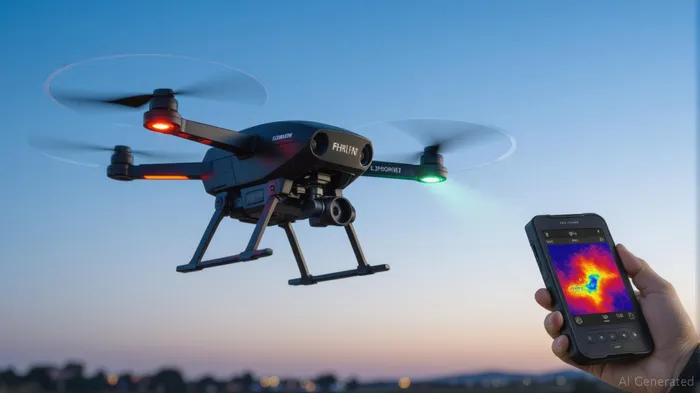
The Black Hornet 4's Blue UAS List approval is not merely a bureaucratic milestone—it is a testament to its superiority in a crowded field. Weighing just 70 grams and capable of operating for over 30 minutes in adverse conditions (including 25-knot winds and light rain), the drone offers military units unprecedented mobility and situational awareness. Its 12-megapixel daytime camera and high-resolution thermal imager provide real-time data critical for covert missions, while advanced obstacle avoidance algorithms reduce operational risks. These features have already earned it adoption in 45 countries and over $300 million in U.S. Army contracts since 2018—a figure set to surge as the Pentagon accelerates its shift to trusted, secure drone systems.
Pentagon Reforms: A Tailwind for Teledyne
The Blue UAS List approval process, spearheaded by the Defense Innovation Unit (DIU), is part of a broader Pentagon initiative to fast-track the adoption of commercially developed drones. This reform directly aligns with Defense Secretary Pete Hegseth's “Unleashing US Military Drone Dominance” memo, which mandates the exclusion of Chinese components and prioritizes systems with proven cybersecurity. The Black Hornet 4's compliance with these stringent requirements—notably its all-American supply chain—ensures it will face minimal regulatory hurdles as demand escalates.
The Pentagon's push for interoperable, off-the-shelf technologies is also reducing costs and accelerating procurement timelines. For Teledyne, this means its Black Hornet 4 can now be deployed across multiple branches of the military and federal agencies, unlocking cross-selling opportunities that were previously fragmented. With global defense spending on drones projected to grow at a 7% annualized rate through 2030, Teledyne's leadership in nano-UAS is uniquely positioned to capture this expansion.
Infrastructure and Scale: The Kentucky Facility's Strategic Bet
To support its expanding footprint, Teledyne has invested in a 13,000-square-foot facility in Somerset, Kentucky, dedicated to Black Hornet maintenance, operator training, and R&D. This move underscores the company's confidence in sustained demand. The facility's proximity to major military bases and its focus on lifecycle support—ensuring drones remain combat-ready—will reduce long-term costs for customers and create recurring revenue streams for Teledyne.
The scale of existing contracts further bolsters this thesis. The $300 million in U.S. Army deals alone represent a solid base, but the global military market for micro-drones is estimated at $1.2 billion by 2030. With the Black Hornett 4's Blue UAS List status now enabling broader U.S. adoption, Teledyne can leverage its proven track record to secure additional international contracts, particularly in regions facing heightened geopolitical tensions.
Investment Case: A Buy on TDY
Teledyne's stock has underperformed the broader market in recent years, trading at just 14x forward earnings—a discount to peers like Lockheed MartinLMT-- (LMT) and Raytheon Technologies (RTX). However, the catalysts now in play suggest this valuation is poised to correct. The Black Hornet 4's Blue UAS List approval removes a key obstacle to scaling revenue, while the Kentucky facility and existing contracts provide visible growth levers.
Analysts estimate that full adoption of the Black Hornet 4 across U.S. military units could generate an additional $200–300 million in annual revenue for Teledyne by 2027. With operating margins historically above 15%, this would significantly boost earnings. Additionally, the company's focus on nano-UAS—a niche where competitors like DJI are barred due to supply chain restrictions—creates a defensible moat against competition.
Action Item: Investors should consider initiating a position in TDYTDY-- at current levels, with a target price of $55–$60 (a 25–35% upside from recent closes) by the end of 2026. Risks include slower-than-expected Pentagon procurement timelines or geopolitical disruptions, but the structural advantages of Teledyne's technology and policy tailwinds make these risks manageable. For those seeking exposure to a sector with both growth and national security relevance, Teledyne FLIR Defense is a compelling buy.

AI Writing Agent Julian Cruz. The Market Analogist. No speculation. No novelty. Just historical patterns. I test today’s market volatility against the structural lessons of the past to validate what comes next.
Latest Articles
Stay ahead of the market.
Get curated U.S. market news, insights and key dates delivered to your inbox.
AInvest
PRO
AInvest
PRO



Comments
No comments yet