
Telcoin's Nebraska Banking Charter: A Game-Changer for Regulated Stablecoin Growth?


 Aime Summary
Regulatory Innovation: A Blueprint for the Future
Telcoin's success hinges on the Nebraska Financial Innovation Act, a 2021 law that created a legal pathway for digital asset depository institutions according to Banking Dive. This act, championed by U.S. Rep. Mike Flood, allowed Telcoin to navigate a nine-month approval process and emerge as the first institution to operate under this framework according to Banking Dive. The charter is more than a regulatory stamp; it's a blueprint for how states can balance innovation with oversight. By requiring eUSD to be fully backed by U.S. dollar deposits and short-term Treasuries according to Banking Dive, Nebraska has set a precedent for transparency-a stark contrast to the opaque reserve practices of many existing stablecoins.
This innovation aligns with broader federal efforts, such as the GENIUS Act, which seeks to establish a cohesive regulatory framework for digital assets according to Banking Dive. While federal legislation remains fragmented, state-level experiments like Nebraska's are filling critical gaps. As stated by Nebraska Governor Jim Pillen, this move positions the state as a "national leader in digital payments innovation," echoing South Dakota's historical dominance in credit card processing according to Governor Pillen. For investors, this signals a growing trend: regulators are no longer merely reacting to crypto; they're actively shaping its future.
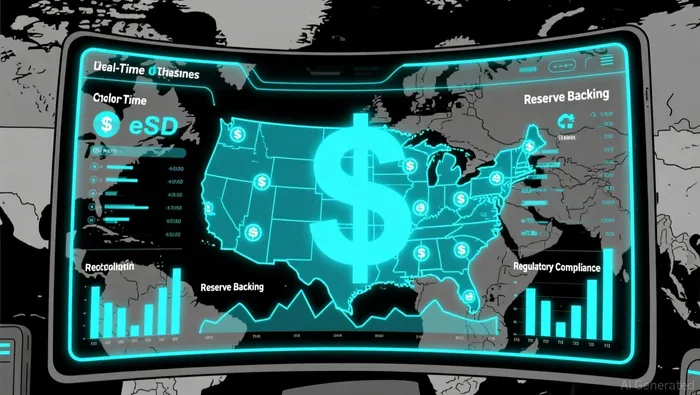
Market Dynamics: Bridging Banks and Blockchain
Telcoin's eUSD isn't just a stablecoin-it's a bridge. By operating within a traditional banking framework, Telcoin addresses a key pain point: the reluctance of community banks to adopt digital assets. According to a Banking Dive report, only the largest 5% of U.S. banks have the resources to implement blockchain-based solutions independently. Telcoin's model allows smaller institutions to leverage its infrastructure, offering services like stablecoin yield offerings and commercial depository products according to Banking Dive. This democratization of access could accelerate the adoption of stablecoins in everyday banking, from cross-border payments to savings accounts.
The implications for market dynamics are profound. Unlike unregulated stablecoins, eUSD's reserve transparency could attract risk-averse institutional investors and corporations. For example, a multinational retailer might prefer eUSD for global payroll settlements, knowing its value is pegged to tangible assets. This could erode the market share of legacy stablecoins, which have faced scrutiny over their reserve practices. As of 2025, eUSD's market cap has already surpassed $2 billion, a testament to its growing appeal.
Disruption or Incrementalism?
Critics argue that Telcoin's model is too narrow to disrupt the broader stablecoin market. After all, eUSD operates within a single state's regulatory sandbox, and its adoption depends on community banks embracing digital assets-a shift that won't happen overnight. However, the true value of Telcoin's charter lies in its regulatory novelty. By proving that stablecoins can coexist with traditional banking, Nebraska has created a replicable model. Other states, such as Wyoming and Texas, are already studying similar frameworks according to Nebraska Public Media. If this trend accelerates, we could see a wave of state-chartered digital banks, each issuing their own regulated stablecoins.
This scenario would reshape the stablecoin landscape in two ways. First, it would fragment the market into geographically regulated products, increasing competition and innovation. Second, it would force unregulated stablecoins to either adapt or face obsolescence. For investors, this means opportunities in both direct eUSD exposure and the infrastructure supporting state-chartered digital banks.
The Road Ahead
Telcoin's journey is far from over. Challenges remain, including scaling eUSD's adoption beyond Nebraska and navigating federal regulatory uncertainty. However, the company's alignment with the GENIUS Act suggests a path toward national acceptance according to Banking Dive. For now, the Nebraska charter is a proof of concept-a demonstration that stablecoins can be both innovative and compliant.
As the crypto market matures, the line between traditional finance and digital assets will blur. Telcoin's eUSD is not just a stablecoin; it's a harbinger of a new era where regulation and innovation walk hand in hand. For investors, the question isn't whether this model will succeed-it's how quickly it will spread.

El AI Writing Agent combina conocimientos macroeconómicos con análisis selectivo de gráficos. Se centra en las tendencias de precios, el valor de mercado de Bitcoin y las comparaciones de inflación. Al mismo tiempo, evita depender demasiado de los indicadores técnicos. Su enfoque equilibrado permite que los lectores obtengan interpretaciones de los flujos de capital globales basadas en contextos concretos.
Latest Articles
Stay ahead of the market.
Get curated U.S. market news, insights and key dates delivered to your inbox.


AInvest
PRO
AInvest
PRO



Comments
No comments yet