
Technical Consolidation Continues Amid Headline-Driven Volatility, but Ignored Fundamentals Could Become the Real Risk
The market has experienced intense volatility as the U.S. supported Israel in striking Iran, escalating tensions around the Strait of Hormuz and triggering a sharp spike in oil prices. At the same time, hopes of de escalation briefly emerged after Trump softened his tone, suggesting the war could be "very complete." Despite such remarks, uncertainty remains extremely high as headlines continue to dominate investor sentiment. Interestingly, even with the surge in oil prices, the S&P 500 and Nasdaq 100 have shown notable resilience and remain only slightly lower on a yearly basis. From a technical perspective, consolidation is still underway. However, many investors may be overlooking weak fundamental signals that warrant greater caution. Market participants should prepare for a scenario where attention shifts away from war headlines and toward economic reality. In that environment, gold and silver could regain dominance once the oil shock gradually fades.
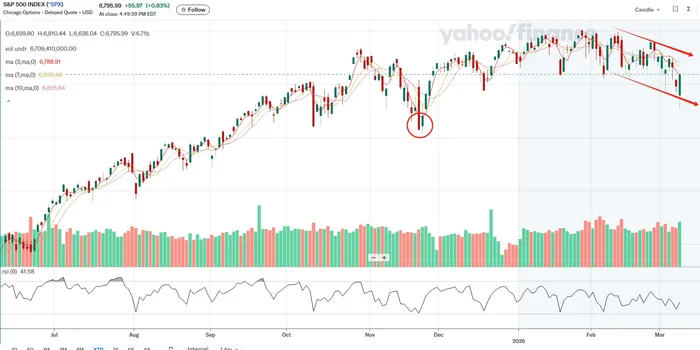
From a technical standpoint, the S&P 500 and Nasdaq 100 are displaying clear divergence under the current geopolitical tension. The S&P 500 continues trending downward, forming a classic "lower-high and lower-low" bearish structure. MA(3, 7, 10) are all trending lower, suggesting that buying the dip may not be wise until clearer signals emerge. The most important level to monitor is the 6538 area, which represents a key support zone. If that psychological level breaks, further downside pressure could appear as confidence weakens.
The tech heavy Nasdaq 100, in contrast, has demonstrated stronger resilience and appears to be undergoing a consolidation phase. The index is hovering around its February low despite the latest geopolitical shock. Several factors may explain this relative strength. First, technology remains less sensitive to short term macro shocks because a spike in oil prices does not significantly alter the long term transition toward artificial intelligence. Energy costs play only a small role in semiconductor manufacturing and hardware production, so the broader AI narrative remains intact. Second, tech companies continue to deliver solid earnings results. The big techs are aggressively increasing capital spending on chips, while semi stock reported strong Q4 earnings. These factors provide a fundamental cushion that encourages investors to buy temporary dips.
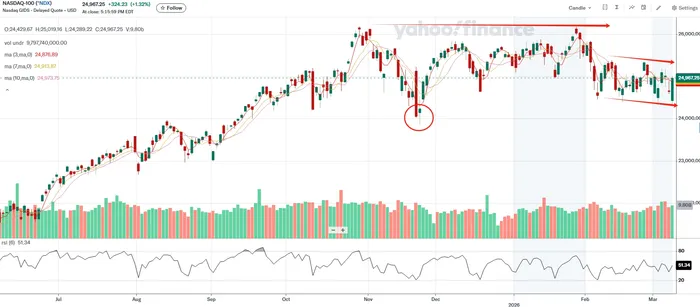
From an equity allocation perspective, technology focused funds appear more attractive compared with broader market exposure. No one knows how long the oil shock will persist, and markets could quickly rebound if de-escalation emerges. With the AI investment cycle still advancing, the technology sector retains a structural advantage. Nevertheless, key technical levels must be watched closely because unexpected geopolitical developments could trigger sudden panic selling across asset classes.
From a fundamental perspective, rising geopolitical tension has distracted many investors from underlying economic weakness. This may become a critical issue for medium term investment outlooks. February nonfarm payroll data showed an unexpected decline, suggesting that the labor market may be entering a more fragile phase. At the same time, fourth quarter GDP growth badly missed expectations, rising only 1.4% compared with the 2.5% estimate. Some analysts argue that rapid AI adoption is improving productivity and reducing the need for human labor. While that may increase efficiency, the broader implications remain uncertain. Similar to how advanced models such as Claude disrupted segments of the software industry, automation may reshape employment patterns across many sectors. Regardless of the explanation, a rising unemployment rate is rarely positive for economic stability. Slower growth combined with weakening employment conditions could represent a genuine concern for long term investors, yet many continue to underestimate this risk.
Oil markets have been at the center of recent volatility. WTI futures surged close to $120 per barrel before partially retreating, although prices remain well above pre-war levels. The general consensus is that oil will not remain permanently elevated at these levels. OPEC+ has both the capacity and willingness to increase output if necessary, while the U.S. could also expand production. The true bottleneck lies in the Strait of Hormuz, where transportation disruptions could temporarily restrict supply flows. Ultimately, conflicts eventually conclude and oil prices tend to normalize afterward. Because of the strong influence of breaking news, technical analysis becomes less reliable in this environment. Short term price movements resemble speculative trading rather than structural investment trends. Nonetheless, the surge in oil prices has pressured risk assets broadly while simultaneously supporting precious metals such as gold and silver.
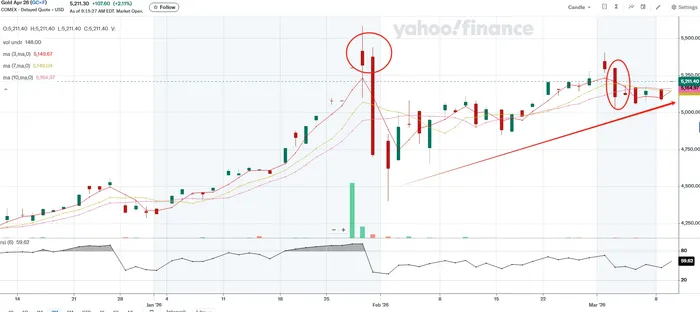
An interesting observation is that gold and silver rallied before the attack announcement but then declined shortly after escalation occurred. This reaction likely reflected investors taking profits while shifting funds into U.S. Treasuries. The jump in oil prices also complicated the Fed's ability to cut rates, temporarily strengthening the dollar. However, once oil prices begin to stabilize or decline, precious metals could regain momentum. Over the next two years, gold and silver may remain important portfolio assets. Trump's nomination of Kevin Warsh as the next Fed chair suggests a policy orientation that favors rate reductions once he takes office. Political considerations could play a significant role in determining when monetary easing accelerates and how quickly geopolitical tensions cool. Meanwhile, weak economic data points toward a gradual deterioration in growth expectations, which could eventually pressure the dollar. In such an environment, accumulating precious metals during pullbacks appears prudent. The broader technical structure remains constructive, with "higher-high, higher-low" forming even though prices have not yet surpassed previous peaks. As markets gradually digest geopolitical developments and confront the reality of slower economic growth combined with an easing cycle, commodities may enter a renewed period of strength.
In conclusion, current market volatility is largely driven by geopolitical headlines, yet deeper structural factors should not be ignored. Technical consolidation continues, but the S&P 500 shows a fragile pattern while the Nasdaq 100 remains relatively resilient due to the ongoing AI investment cycle. Beneath the surface, weakening economic data raises concerns that could eventually dominate market narratives once geopolitical tensions fade. Oil price shocks may prove temporary, but they highlight the sensitivity of global markets to supply disruptions and policy uncertainty. As investors navigate this complex environment, attention should remain focused on key technical levels, economic indicators, and the evolving path of monetary policy. Preparing for potential fundamental headwinds while maintaining exposure to structural themes such as artificial intelligence and precious metals may offer the most balanced strategy in the months ahead.

Independent investment research powered by a team of market strategists with 20+ years of Wall Street and global macro experience. We uncover high-conviction opportunities across equities, metals, and options through disciplined, data-driven analysis.
Latest Articles
Unlock Market-Moving Insights.
Subscribe to PRO Articles.
Already have an account? Sign in
Unlock Market-Moving Insights.
Subscribe to PRO Articles.
Already have an account? Sign in
Stay ahead of the market.
Get curated U.S. market news, insights and key dates delivered to your inbox.


AInvest
PRO
AInvest
PRO



