
Tech Titans Get a Lift as Salesforce Faces AI Test


Stocks opened mixed Wednesday as investors weighed fresh signals of a cooling labor market against a regulatory reprieve for Big Tech and heightened scrutiny over whether artificial intelligence can deliver on Wall Street’s expectations.
The Dow Jones Industrial Average slipped 0.16% at the open, while the S&P 500 rose 0.37% and the Nasdaq Composite gained 0.8%, buoyed by megacap technology stocks. Small caps lagged, with the Russell 2000 down 0.22%, reflecting persistent caution toward cyclical sectors.
Beyond technology, commodity markets painted a more cautious picture. Crude oil futures fell 1.9% to $64.37 a barrel, reflecting concerns about weakening demand amid slowing job growth. Gold futures climbed 0.73% to $3,618 an ounce, underscoring safe-haven demand as investors position defensively.
After The Bell!
Salesforce’s AI Crucible
After the close, SalesforceCRM-- will deliver results that many analysts say matter less for their numerical beats than for the strategy narrative around artificial intelligence.
“Numbers don’t matter as much as maybe they once did,” said Angelo Zino, senior analyst at CFRA. “More importantly is going to be the AI strategy they articulate. If Salesforce can show momentum in its agentic AI platform, that’s going to help the story.”
Salesforce has posted consistent revenue and earnings-per-share beats, but investors remain focused on whether AI consumption models can scale. Currently, AI-driven sales contribute only a low single-digit percentage of total revenue, with meaningful contributions expected no earlier than 2026 or 2027.
Chief Executive Marc Benioff’s $8 billion purchase of InformaticaINFA-- is intended to strengthen Salesforce’s grip on enterprise data pipelines—an essential ingredient for training AI systems. The acquisition raises execution risks, however, with promises of margin accretion yet to be proven.
Zino echoed a warning popularized by NVIDIA’s Jensen Huang: “Software ate the world, but AI is going to eat software.” For Salesforce and other SaaS players, the challenge is to demonstrate that new AI services such as Agentforce can offset pressure on subscription growth.
Google and Apple Score in Court
Shares of AlphabetGOOGL-- and AppleAAPL-- found support after a federal judge declined to impose the harshest remedies in a long-running Justice Department antitrust case.
Judge Amit Mehta ruled Alphabet won't be forced to divest Chrome or Android, nor present choice screens on its products. The company is barred from exclusive contracts but can continue non-exclusive arrangements, including payments to Apple to preload GoogleGOOGL-- search on iPhones.
For Google, the decision avoids what analysts had feared could be existential remedies. Wedbush raised its price target on Alphabet to $245, calling the outcome “broadly favorable” and noting it removes lingering regulatory overhang. CFRA was more bullish, lifting its target to $270 and arguing that the ruling reflects recognition of AI as a new competitive threat.
For Apple, the survival of its lucrative search revenue stream—worth roughly $20 billion annually—is a “monster win,” analysts said. The ruling also paves the way for deeper collaboration between Apple and Google on generative AI products, including Google’s Gemini.
Labor Market Clouds
Labor-market indicators continue to soften. Torsten Sløk, chief economist at Apollo Global Management, noted that consumer sentiment about job prospects—a reliable leading indicator—suggests payrolls could undershoot Friday’s consensus estimate of 90,000. Rising unemployment expectations among small businesses further point to risks ahead.
The divergence between Big Tech resilience and cyclical weakness highlights the tension in today’s markets: AI-driven optimism versus mounting evidence of a slowdown.
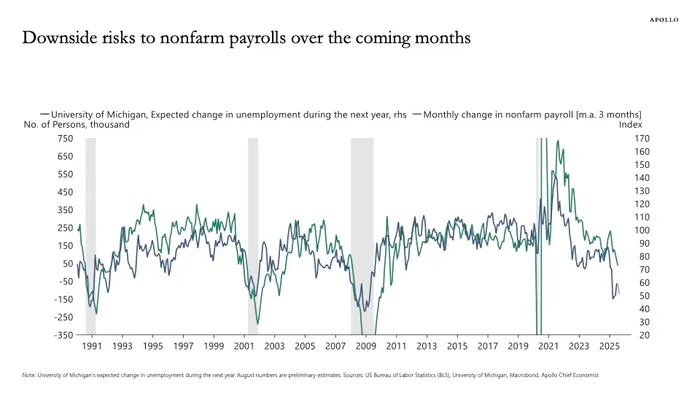
For investors, the day’s developments reinforce two themes. First, megacap technology companies remain the market’s ballast, benefiting from regulatory clarity and AI optimism. Second, the broader economy is sending signals of fatigue, with commodities and labor indicators flashing caution.
Salesforce’s results will test whether enthusiasm for AI can withstand the reality of slower adoption curves. As Zino cautioned, “Salesforce will figure this out and be a beneficiary, but there is going to be some disruption in their core platform.”
For now, Wall Street is willing to give tech giants the benefit of the doubt—even as the rest of the market braces for a slower climb.

Expert analysis on U.S. markets and macro trends, delivering clear perspectives behind major market moves.
Latest Articles
Stay ahead of the market.
Get curated U.S. market news, insights and key dates delivered to your inbox.




Comments
No comments yet