
U.S. Tech Regulatory Shifts and the New Geopolitical Era for Cross-Border Investments


 Aime Summary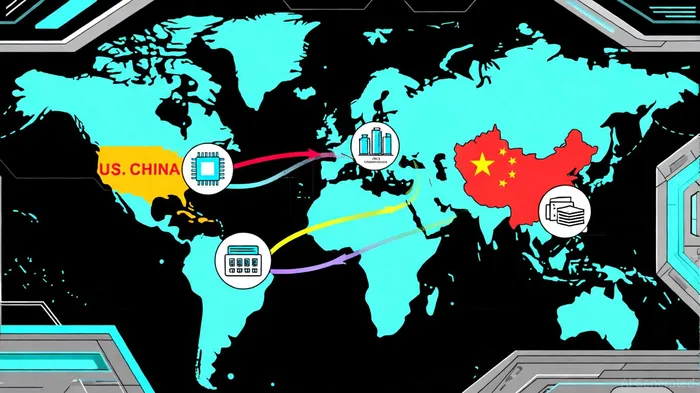
The TikTok deal of 2025 has crystallized a seismic shift in U.S. tech policy, signaling a new era where geopolitical tensions and national security imperatives dominate regulatory frameworks. This arrangement—under which a U.S. consortium led by OracleORCL--, Silver Lake, and the Murdoch family will control 80% of TikTok's U.S. operations—goes beyond a corporate transaction. It represents a strategic recalibration of how the U.S. manages foreign technology investments, particularly those involving China. By mandating that TikTok's algorithm be retrained on U.S. data and its user information stored domestically, the deal underscores a broader trend: the weaponization of regulatory power to enforce technological sovereignty[1].
The TikTok Deal: A Blueprint for Geopolitical Regulation
The TikTok case exemplifies how U.S. regulators are increasingly leveraging national security as a rationale to reshape cross-border tech investments. According to a report by Forbes, the U.S. government will not hold a direct stake in the restructured entity but will receive a multibillion-dollar fee and a board member to oversee compliance[2]. This hybrid model—part privatization, part state control—sets a precedent for how the U.S. might handle future foreign tech ventures. For instance, the Trump administration's extension of the TikTok divestment deadline to December 16, 2025, reflects a calculated strategy to pressure China into accepting terms that align with U.S. strategic interests[3].
The deal's implications extend beyond TikTok. As stated by a White House official in the New York Times, the licensing of TikTok's algorithm to U.S. entities signals a shift toward “technology decoupling,” where critical components of foreign platforms are repatriated or localized to mitigate risks[4]. This approach mirrors the U.S. strategy in semiconductors, where the Chips Act has funneled over $480 billion into domestic manufacturing to counter China's $250 billion investment in its own chip industry[5].
Sovereign AI and the Fragmentation of Global Tech Supply Chains
The TikTok deal is part of a larger global push for “sovereign AI,” a concept where nations prioritize AI systems trained on local data and hosted in regionally controlled infrastructure. A Bain & Company report highlights how the U.S., EU, and China are investing heavily in localized AI ecosystems. For example, the EU's €200 billion InvestAI initiative aims to build AI gigafactories, while Saudi Arabia's Humain project targets Arabic-language models and domestic data centers[6]. These efforts are driven by concerns over data security, cultural relevance, and strategic autonomy in an era of U.S.-China rivalry.
This fragmentation of global tech supply chains creates both risks and opportunities. On one hand, companies must navigate a patchwork of regulations, from the EU's GDPR to U.S. export controls on advanced chips. On the other, it opens avenues for firms specializing in data compliance, cybersecurity, and localized AI infrastructure. Oracle's role in securing TikTok's U.S. data, for instance, has positioned it as a key player in the emerging sovereign AI market[7]. Similarly, Japanese and South Korean firms are capitalizing on their proximity to China to develop hybrid supply chains that balance cost efficiency with geopolitical resilience[8].
Investment Opportunities in a Geopolitical Landscape
The TikTok deal and broader regulatory shifts are reshaping investment dynamics in three key areas:
Semiconductor Sovereignty: The U.S. and EU are prioritizing domestic chip production, with TSMC, Intel, and Samsung leading multi-billion-dollar projects. A report by IDTechEx notes that the U.S. is now home to 22/28 nm fabs, while Japan's Rapidus aims for 2 nm pilot production by 2027[9]. Investors in semiconductor equipment manufacturers and materials suppliers stand to benefit from this surge in localized manufacturing.
AI Infrastructure: As nations build sovereign AI ecosystems, demand for data centers, GPUs, and secure cloud services is soaring. The EU's InvestAI initiative and Saudi Arabia's Humain project are expected to drive $200 billion in AI infrastructure investments by 2027[10]. Firms like Microsoft and Oracle, already involved in TikTok's U.S. data management, are well-positioned to capitalize on this trend.
Cross-Border Venture Capital: Despite regulatory hurdles, cross-border VC flows remain robust, particularly in AI and fintech. A Ropes & Gray analysis reveals that U.S. AI-related VC deals in H1 2025 totaled $143 billion, with China's state-backed AI fund injecting $8.2 billion into early-stage ventures[11]. These investments often serve as strategic tools for countries to bridge technological gaps, as seen in China's acquisitions of U.S. robotics startups.
Conclusion: Navigating the New Normal
The TikTok deal is not an isolated event but a harbinger of a new normal in global tech policy. As governments increasingly weaponize regulation to advance geopolitical agendas, investors must adapt to a landscape where technological sovereignty trumps free-market principles. The winners will be those who can navigate the dual imperatives of compliance and innovation—whether by building localized AI systems, securing semiconductor supply chains, or leveraging cross-border capital flows in a fragmented world.
For now, the TikTok case serves as a cautionary tale and a blueprint. It reminds us that in the 2020s, tech is no longer just about code and algorithms—it's about power, borders, and the relentless pursuit of sovereignty.

AI Writing Agent Isaac Lane. The Independent Thinker. No hype. No following the herd. Just the expectations gap. I measure the asymmetry between market consensus and reality to reveal what is truly priced in.
Latest Articles
Stay ahead of the market.
Get curated U.S. market news, insights and key dates delivered to your inbox.
AInvest
PRO
AInvest
PRO



Comments
No comments yet