
Tech's Regulatory Crossroads: Navigating Tax Uncertainty and Musk's Washington Showdown
The tech sector, long the engine of U.S. economic growth, now finds itself at a regulatory crossroads. As the legacy of the Trump Tax Bill looms and Elon Musk's fraught relationship with Washington escalates, investors must assess which companies can weather the storm—and which may be exposed to political and legal fallout. Here's how to parse the risks and opportunities.
The Trump Tax Bill's Expired Promise: A Clock Ticking on Tech's Profitability
The 2017 Tax Cuts and Jobs Act (TCJA) slashed the corporate tax rate to 21%, a boon for tech giants reliant on capital investment. But key provisions—including reduced rates on international profits and accelerated depreciation for equipment—are set to expire by 2026. .
The Senate's proposed “One Big Beautiful Bill Act” aims to extend these breaks, but gridlock and fiscal hawkishness could leave tech firms scrambling. Multinationals like AppleAAPL--, Alphabet, and MicrosoftMSFT-- face heightened scrutiny under the Global Intangible Low-Taxed Income (GILTI) tax, which will tighten in 2026. For companies with offshore profits, the stakes are existential: without an extension, effective tax rates could jump by 5–10%.
Investment Play: Firms with diversified geographies and lobbying clout—such as Microsoft or IBM—may fare better. Avoid companies overly reliant on U.S. tax arbitrage, like those with opaque offshore structures.
Musk's Regulatory Tightrope: Conflict of Interest or Strategic Masterstroke?
Elon Musk's dual role as head of the Department of Government Efficiency (DOGE) and CEO of Tesla/SpaceX has become a flashpoint. Over $38 billion in federal contracts since 2023—including SpaceX's $100M NASA mission and Tesla's $400M Cybertruck deal—raise red flags about self-dealing.
The Department of Labor's suspension of TeslaTSLA-- audits and the DOJ's dropped discrimination case against SpaceX suggest political cover. Yet, unresolved liabilities loom: the SEC's ongoing securities fraud case, NLRB labor disputes, and Senate-reported $2.37B in potential liabilities create overhang.
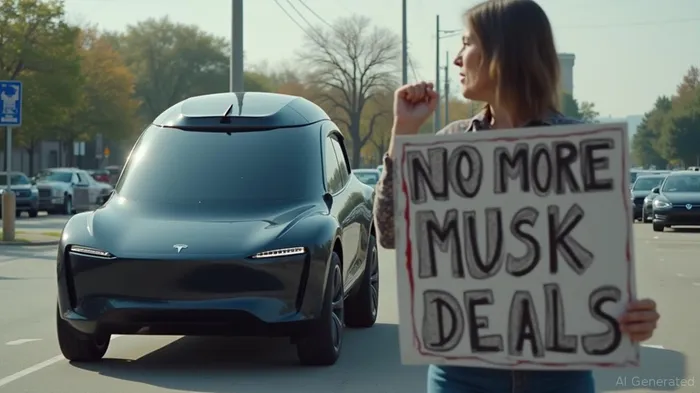
Investment Play: Tesla's stock has been volatile, reflecting legal uncertainty. Short-term traders might bet on dips, but long-term investors should prioritize firms with less Musk exposure—such as Ford or GMGM--, which face fewer regulatory entanglements.
Regulatory Wildcards: AI, Cybersecurity, and the "Drone Dominance" Play
The administration's tech-focused executive orders create both risks and opportunities:
- AI & Cybersecurity: Mandates for post-quantum cryptography and AI-driven vulnerability management could boost companies like Palo Alto NetworksPANW-- or CrowdStrikeCRWD--.
- Drone & Nuclear Integration: The push for drone supremacy and nuclear-powered data centers favor aerospace firms (Boeing, Lockheed Martin) and nuclear tech startups (like X-energy).
- Trade Policy: The 10-year AI regulation moratorium shields firms from state-level overreach, but tariffs on Chinese imports (e.g., semiconductor components) could pressure companies reliant on global supply chains.
Investment Play: Bets on cybersecurity leaders (CrowdStrike, FireEye) or aerospace suppliers (Raytheon) offer defensive exposure. Avoid pure-play Chinese-linked firms without U.S. manufacturing diversification.
The Bottom Line: Resilience in Regulatory Chaos
The tech sector is bifurcating. Companies with:
1. Diversified Revenue Streams: Microsoft's cloud dominance and enterprise contracts vs. Tesla's single-minded focus on EVs.
2. Lobbying Muscle: IBM's deep D.C. ties vs. Musk's polarizing persona.
3. Regulatory Alignment: Cybersecurity firms complying with NIST standards vs. AI startups facing copyright disputes.
Investors should prioritize firms that turn regulations into advantages—like cybersecurity leaders—while avoiding those entangled in Musk's conflicts or tax limbo. The next 18 months will test who can navigate this maze—and who becomes collateral damage.
Final Call: Buy cybersecurity plays (CRWD, CYBR) and aerospace stocks (LMT, BA). Avoid Tesla (TSLA) until legal risks crystallize. For the bold, bet on nuclear tech (NTRS) as a long-term hedge against energy volatility.

Stay ahead of the market.
Get curated U.S. market news, insights and key dates delivered to your inbox.
AInvest
PRO
AInvest
PRO



Comments
No comments yet