
Tech Giants' AI Power Play: OpenAI, Salesforce and Google Ramp Up Investments in the Race for Supremacy
The artificial intelligence boom is reshaping global economies, with tech behemoths pouring billions into infrastructure and innovation to stay ahead. From custom chip designs devouring city-scale electricity to massive data centers anchoring new AI hubs, these moves underscore the financial stakes involved.
OpenAI's latest partnership with BroadcomAVGO--, Salesforce's bold commitment to San Francisco, and Google's ambitious foray into India highlight how companies are betting big on AI's transformative potential, even as concerns mount over energy demands and competitive pressures.
OpenAI's Massive Chip Deal Signals Escalating Power Needs

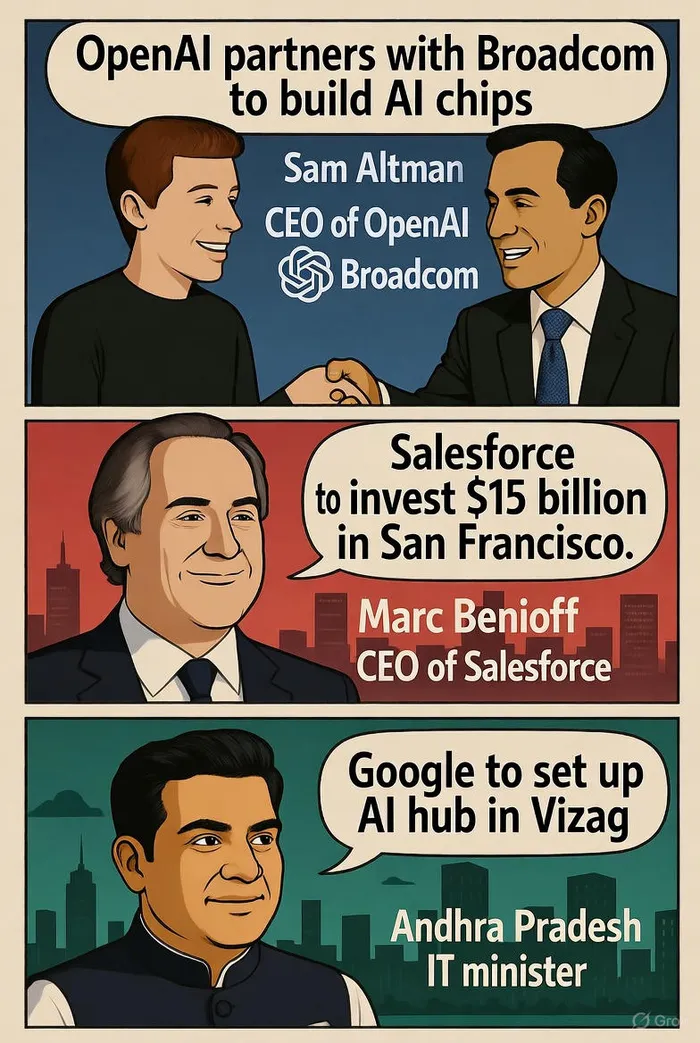
In a move that captures the sheer scale of AI's appetite for computing power, OpenAI has inked a deal with Broadcom to develop 10 gigawatts of custom AI chips and systems. This partnership, announced recently, positions OpenAI to build out infrastructure capable of supporting its exploding user base, with ChatGPT now boasting 800 million weekly users. An executive's comment on X even suggested that the new Sora video generation app is outpacing ChatGPT's early growth trajectory, hinting at even greater demands ahead.
The 10-gigawatt figure is staggering—equivalent to the electricity consumption of about 8 million U.S. households, according to Reuters calculations. Sam Altman, OpenAI's co-founder and CEO, framed the collaboration as essential for unlocking AI's full potential, stating in a press release that it's a "critical step in building the infrastructure needed to deliver real benefits for people and businesses." Deployment is slated for the second half of 2026, giving OpenAI time to integrate lessons from its frontier models directly into hardware for enhanced capabilities.
This isn't OpenAI's first rodeo in securing silicon; prior deals with Nvidia and AMD reflect a strategy to diversify suppliers amid a chip shortage. But the Broadcom tie-up elevates OpenAI's role in hardware design, allowing it to embed software insights into custom accelerators. The market reacted swiftly, with Broadcom shares jumping 12% on the announcement day, a clear vote of confidence from investors. Yet, the environmental footprint looms large: A 2024 Department of Energy report projects data centers could gobble up 6.7% to 12% of U.S. electricity by 2028, up from 4.4% in 2023. Altman himself noted that a single ChatGPT query uses energy akin to a lightbulb running for minutes, and Sora 2's video generation likely amplifies that intensity manifold.
From a financial analyst's lens, this deal exemplifies the capital-intensive nature of AI leadership. OpenAI's push for custom chips could reduce long-term dependency on third-party providers, potentially trimming costs and boosting margins. However, the power requirements raise red flags for sustainability-focused investors, who may scrutinize how these investments align with broader ESG goals.
Salesforce Doubles Down on AI with $15 Billion San Francisco Pledge
Shifting coasts, Salesforce is making waves with a $15 billion investment over five years in its San Francisco hometown, aimed at turbocharging AI adoption. As the cloud software pioneer founded in 1999, Salesforce is weaving AI deeper into its ecosystem, including Slack, to fend off rivals like ServiceNow, Oracle, and Microsoft in the cutthroat enterprise space.
CEO Marc Benioff described the commitment as a reflection of the company's "deep commitment to our hometown—advancing AI innovation, creating jobs and helping companies and our communities thrive." The funds will fuel a new AI incubator hub on the San Francisco campus, designed to nurture startups and facilitate the rollout of AI agents—autonomous tools that handle tasks for users. This comes hot on the heels of Salesforce's global launch of Agentforce 360, an AI platform poised to streamline business operations.
The timing aligns with Dreamforce, the company's flagship conference set for October 14-16, expected to attract 50,000 attendees and inject $130 million into the local economy. Globally, Salesforce employs over 76,000 people and recently announced a $1 billion expansion in Mexico, where it has operated since 2006. Analysts like Morningstar's Dan Romanoff see this as a savvy play to secure AI talent amid shortages, noting that maintaining leadership in emerging tech demands a robust innovation pipeline.
Stock-wise, Salesforce shares rose 2.8% on the news, though they've shed about 28% year-to-date amid broader market jitters. The company also upped its share buyback program by $20 billion in September, signaling confidence despite forecasting third-quarter revenue below estimates. Financially, this investment could yield dividends by positioning Salesforce as an AI enabler for enterprises, potentially driving subscription growth. But in a crowded field, the real test will be whether these agents deliver tangible ROI for clients, justifying the hefty outlay in a post-pandemic economy still grappling with efficiency demands.
Google's India Bet: Building an AI Powerhouse in Vizag
Venturing eastward, Google's agreement with the Andhra Pradesh government to establish a 1-gigawatt hyperscale data center in Visakhapatnam marks a pivotal step in India's AI ambitions. Signed in Delhi with high-profile attendees including Union Finance Minister Nirmala Sitharaman and Chief Minister N. Chandrababu Naidu, the deal anchors "AI City Vizag" with a near $10 billion investment over time.
State Industries Minister Nara Lokesh hailed it as a "transformative project for the future of Andhra Pradesh," emphasizing its role in making Vizag India's digital powerhouse. The hub will integrate Google's full AI stack, combining infrastructure, data capacity, clean energy, and fiber optics to accelerate AI-driven changes nationwide. Connected to Google's global network via subsea and terrestrial systems, it's designed for resilience and sustainability.
Economic projections are optimistic: State assessments forecast an average annual GSDP boost of ₹10,518 crore from 2028-2032, supporting 188,220 jobs yearly, plus ₹9,553 crore in annual productivity spillovers from GoogleGOOGL-- Cloud—totaling ₹47,720 crore over five years. The project cleared hurdles swiftly through the State Investment Promotion Board, with single-window clearances and plug-and-play infrastructure facilitated by local economic bodies.
Google's team, led by Cloud CEO Thomas Kurian, VP of Global Infrastructure Bikash Koley, and APAC President Karan Bajwa, underscores the strategic heft. This is among Google's largest Asian endeavors, aligning with India's push for digital self-reliance. Chief Minister Naidu's subsequent meeting with Prime Minister Narendra Modi to invite him to events like the CII Partnership Summit 2025 in Vizag signals broader national buy-in.
Analytically, this investment highlights emerging markets as fertile ground for AI expansion, where lower costs and government incentives can amplify returns. For Google, it secures a foothold in a high-growth region, potentially offsetting maturing markets elsewhere. Investors should watch for ripple effects on Alphabet's stock, as such deals enhance cloud revenue streams. However, challenges like energy integration and talent poaching could temper gains, especially if global AI hype cools.
The Broader Financial Implications of AI's Advance
These developments—OpenAI's power-intensive chip push, Salesforce's urban AI revival, and Google's Indian data fortress—paint a picture of an industry in hyperdrive. Collectively, they represent tens of billions in commitments, fueling stock surges and economic multipliers while stoking debates on energy sustainability.
From a portfolio perspective, AI remains a high-reward sector, but volatility lurks: Salesforce's year-to-date dip contrasts Broadcom's pop, reminding us of execution risks. As data centers proliferate, utilities and renewable stocks may emerge as indirect beneficiaries. Yet, with AI's power draw rivaling nations, regulators could impose curbs, impacting valuations.
In the end, these bets aren't just about tech; they're financial wagers on AI's ability to redefine productivity. Investors eyeing the next wave should monitor how these giants navigate the power crunch and competitive fray, as the winners could dominate for decades.

Expert analysis on U.S. markets and macro trends, delivering clear perspectives behind major market moves.
Latest Articles
Stay ahead of the market.
Get curated U.S. market news, insights and key dates delivered to your inbox.
AInvest
PRO
AInvest
PRO



Comments
No comments yet