



_e5e776571765985700355.jpg?width=240&height=135&format=webp)
_30b223131765892038605.jpg?width=240&height=135&format=webp)
AInvest Newsletter
Daily stocks & crypto headlines, free to your inbox
 Aime Summary
An astonishing coincidence: today’s Nasdaq trajectory looks strikingly similar to the run-up to the internet bubble after 1995.
Even the fundamentals appear comparable. The Federal Reserve executed sharp rate hikes in 1994, just as it did in 2022. In the 1990s, the internet was the disruptive technology; today, artificial intelligence plays that role.
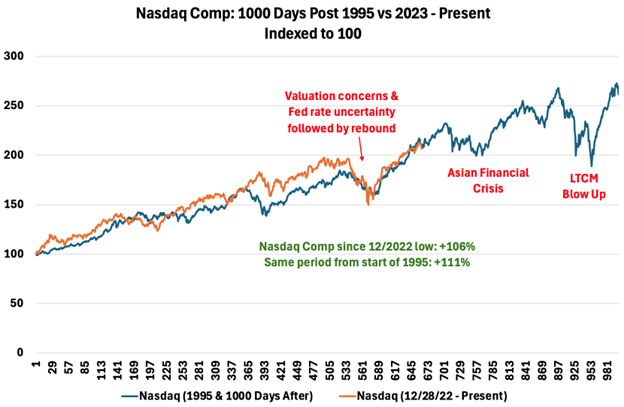
Given these parallels, many investors worry that lofty U.S. equity valuations, combined with such chart similarities, may signal a replay of the dot-com collapse.
Yet DataTrek argues that the technology giants of 2025 are far superior to those of 1999—making today’s higher valuations more justifiable.
Comparing the Titans
In 1999, the five major tech giants included
, , and IBM—companies that have since lost their dominance, but at the time rivaled today’s “Magnificent Seven” in prestige.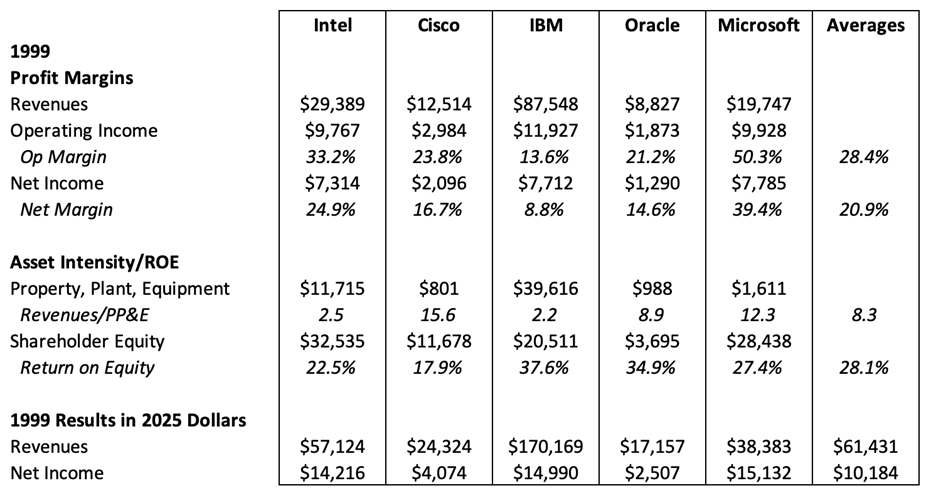
Now, stripping
and out of the seven, today’s “Big Five” show clear superiority across profitability measures.
Even after adjusting for inflation, the 2025 giants generate revenues 4.6 times larger than their 1999 counterparts, while net income is 9.1 times higher.
Profitability is stronger as well: average net margins stand at 34.2% in 2025 versus 20.9% in 1999, a 64% increase. Return on equity (ROE) shows an even starker contrast: 66.5% vs. 28.1%.
Nvidia vs. Intel: Then and Now
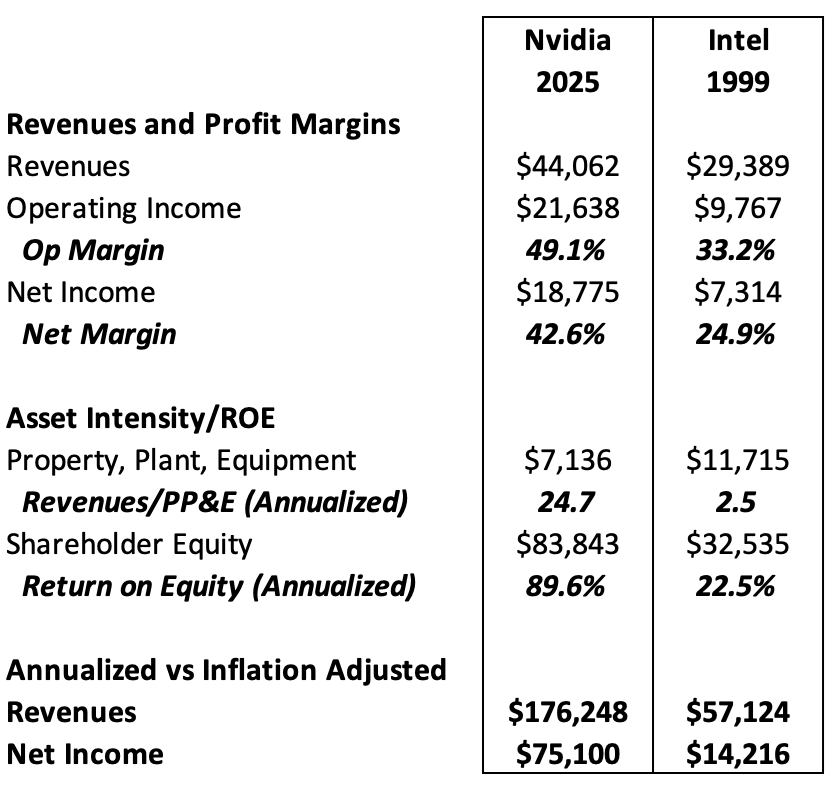
Consider the comparison between
, today’s semiconductor king, and Intel, the CPU giant of 1999.Nvidia is far more successful. Its net margin exceeds Intel’s by 71%, and its ROE is over 400% higher. Adjusted for inflation, Nvidia’s revenues and profits are multiple times larger than Intel’s peak levels.
Why Valuations Deserve a Premium
Investors are willing to pay a premium for companies delivering superior capital returns. Higher profitability supports higher multiples.
At the peak of the 1990s internet bubble, the S&P 500 forward P/E exceeded 23x. With stronger earnings power today, U.S. equities may have room for valuations to rise even further.
Each wave of disruptive technology spawns better business models. By 2045, it is likely that the next generation of tech giants will surpass today’s “Magnificent Seven.”
Yes, U.S. equities may look expensive now, but if tech companies keep advancing at this extraordinary pace, valuations could climb higher still. That is precisely the case for long-term equity ownership.

Expert analysis on U.S. markets and macro trends, delivering clear perspectives behind major market moves.
Daily stocks & crypto headlines, free to your inbox





Comments
No comments yet