
Tech-Driven Market Volatility: Assessing the AI Bubble Risk


 Aime Summary
Divergent Performances: PalantirPLTR-- vs. C3.ai
The AI sector's bifurcation is stark. Palantir Technologies, a leader in enterprise and defense AI, reported $1.18 billion in Q3 2025 revenue-a 62.8% year-over-year surge-while expanding its partnership with NVIDIA to enhance AI deployment capabilities. Its profitability, with a 40.3% net margin and $399 million in EBITDA, underscores its resilience amid sector-wide jitters. In contrast, C3.ai has faced a 45% stock decline over the past year, compounded by a 19% revenue drop to $70.3 million in its most recent quarter and a $117 million net loss. Leadership transitions and operational reorganization have further destabilized the company, with analysts projecting continued unprofitability through 2028.
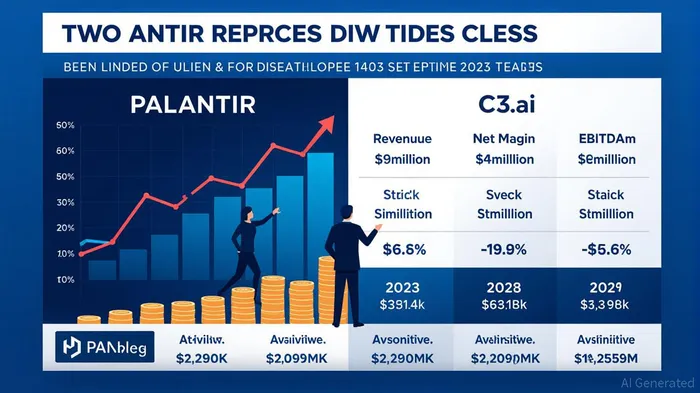 This divergence highlights a key risk for investors: not all AI stocks are created equal. While Palantir's strategic partnerships and monetization capabilities position it as a durable player, C3.ai's struggles reflect the sector's inherent fragility, particularly for firms lacking clear revenue models or operational discipline.
Nvidia's Earnings: A Crucible for AI Sentiment
Nvidia's Q3 FY26 earnings report, released on November 19, 2025, became a pivotal barometer for the AI sector. Analysts projected revenue between $54.8 billion and $55.4 billion, with the data center division expected to grow by 52% to 61% year-over-year. The market's reaction to this report-and Nvidia's forward guidance-was critical in determining whether investor confidence in AI would persist or prompt a reassessment of valuations according to market analysis.
Nvidia's performance underscores the sector's duality: its dominance in AI hardware and software ecosystems has fueled optimism, but its forward guidance also serves as a litmus test for broader market sentiment. A shortfall in Q4 projections could signal waning demand or overvaluation, particularly for AI enablers reliant on speculative growth.
The Correction: Profit-Taking or Warning?
In early November 2025, the Nasdaq Composite recorded its steepest weekly decline since April, with AI-focused stocks shedding over $800 billion in market value. Analysts described this pullback as a "healthy reset" after an extended AI-driven rally, emphasizing that the sell-off reflected profit-taking rather than fundamental weakness. However, some market observers warned that the correction could escalate into a deeper downturn if earnings fail to justify current valuations.
The correction has also intensified scrutiny of AI companies with high capital intensity and uncertain monetization. For instance, OpenAI's infrastructure investments, which far exceed its current revenues, have raised concerns about sustainability. Meanwhile, firms like Microsoft (MSFT) remain favored for their embedded AI features across Azure and Office 365, demonstrating a clearer path to monetization.
Risk Management in a Shifting Landscape
The mixed signals from the AI sector demand a nuanced approach to risk management. While companies like Palantir and Meta Platforms-whose AI-powered advertising tools drove a 22% increase in return on ad spend-showcase the sector's long-term potential according to market forecasts, others like C3.ai illustrate the perils of operational missteps and overvaluation.
Investors must prioritize firms with proven monetization, sustainable margins, and strategic partnerships. For example, Palantir's collaboration with NVIDIA and its focus on government contracts provide a buffer against market volatility according to industry analysis. Conversely, speculative bets on companies lacking clear revenue streams or operational stability-such as C3.ai-carry significant downside risk according to financial analysts.
Conclusion: Opportunity or Caution?
The recent correction in tech-heavy indices presents a dual-edged scenario. For disciplined investors, it offers a chance to capitalize on undervalued AI enablers with strong fundamentals, such as Palantir or Microsoft. However, the correction also serves as a warning: the AI sector's rapid growth has been fueled by speculative fervor, and not all participants will survive the inevitable recalibration.
As David Solomon, CEO of Goldman Sachs, has cautioned, equity markets could face 10-20% drawdowns over the next 12 to 24 months due to elevated valuations and tightening liquidity. In this environment, risk management hinges on discerning which AI stocks are built to endure-and which are merely riding the hype.

Delivering real-time insights and analysis on emerging financial trends and market movements.
Latest Articles
Stay ahead of the market.
Get curated U.S. market news, insights and key dates delivered to your inbox.




Comments
No comments yet