
The Tech Correction: Is It a Buying Opportunity or a Warning Sign?


 Aime Summary
A Correction Driven by Macro and Regulatory Headwinds
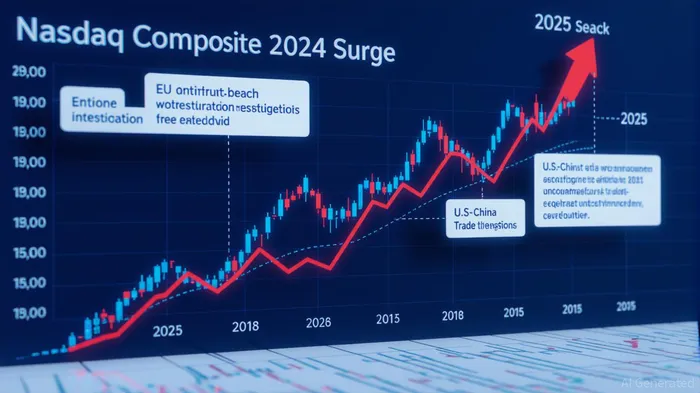
The recent slump in tech stocks is not a standalone event but a convergence of multiple pressures. Trade tensions, regulatory overreach, and competitive threats have eroded investor confidence. For instance, the European Commission's antitrust probe into alleged collusion between Deutsche Börse and Nasdaq over derivatives trading has cast a shadow on market integrity, raising concerns about systemic risks in global financial infrastructure, according to a financefeeds report. Meanwhile, the U.S. Federal Reserve's tightening cycle and a strong dollar have disproportionately impacted tech firms reliant on international revenue, compounding the sector's woes, as noted in a Capital.com analysis.
Structural challenges are equally pronounced. The rise of cost-competitive alternatives, such as China's DeepSeek GPUs, has disrupted Nvidia's dominance in AI hardware, triggering a 20% drop in its stock price and dragging down the broader US Tech 100 index, according to the Capital.com analysis. These dynamics suggest a market grappling with both cyclical volatility and deeper, long-term shifts in supply chains and innovation leadership.
Sector Rotation: Winners and Losers in a Shifting Landscape
The correction has accelerated sector rotation, with capital fleeing overvalued tech stocks and flowing into industries better positioned to weather macroeconomic headwinds. The travel sector, for example, has surged on the back of strong earnings from companies like Expedia Group, which reported $4.41 billion in Q3 2025 revenue amid a post-pandemic rebound, according to a markets.financialcontent.com article. Conversely, logistics and warehousing firms like Cheetah Net Supply Chain Service Inc. have struggled, posting a $1.3 million net loss due to trade war-driven declines in shipment volumes, according to a Yahoo Finance report.
This reallocation of capital reflects a broader recalibration of risk. Investors are increasingly favoring sectors with tangible assets and resilient cash flows, such as real estate and industrials, over speculative tech plays. For instance, Gladstone Land Corporation's shift to participation-based leases tied to crop sales has boosted variable income, illustrating how structural adaptations can unlock value in a high-interest-rate environment, as noted in a Seeking Alpha article. Similarly, Prospect Capital's pivot to first-lien loans-now 71.1% of its portfolio-highlights a strategic move to prioritize security in a volatile market, according to a Seeking Alpha article.
Cyclical Rebalancing or Structural Shift?
The debate hinges on whether the correction is a temporary overcorrection or a permanent realignment of market leadership. Goldman Sachs' Peter Oppenheimer has warned of a potential 30% further decline in a bearish scenario, citing event-driven volatility and geopolitical risks, as noted in the Capital.com analysis. Conversely, Morningstar's Michael Miller argues that the Nasdaq's underlying fundamentals-strong earnings from the "Magnificent 7" and robust asset inflows-remain intact, per the same Capital.com analysis.
The October 2025 rebound, driven by Amazon's 10% stock surge and Apple's strong earnings, offers a glimmer of hope. Amazon's AWS division, which grew revenue by 20% year on year, exemplifies how innovation in cloud computing can sustain growth even amid macroeconomic headwinds, as reported in a StreetInsider article. However, this resilience may not offset the broader structural challenges facing the sector, such as regulatory fragmentation and the rise of non-U.S. tech ecosystems.
Conclusion: A Tactical Entry Point with Caveats
For long-term investors, the correction presents a nuanced opportunity. While the Nasdaq's valuation appears attractive relative to its historical multiples, the risks of regulatory intervention and geopolitical fragmentation cannot be ignored. A disciplined approach-focusing on companies with durable competitive advantages, such as Amazon and Apple, while hedging against sector-specific risks-may offer the best path forward.
However, the correction also serves as a warning sign. The shift in capital toward sectors like travel and industrials underscores a market prioritizing stability over speculation. As the EU's antitrust probe and U.S.-China trade tensions evolve, investors must remain vigilant to structural shifts that could redefine market leadership in the years ahead.

Delivering real-time insights and analysis on emerging financial trends and market movements.
Latest Articles
Stay ahead of the market.
Get curated U.S. market news, insights and key dates delivered to your inbox.




Comments
No comments yet