
TD Bank Group's Strategic Position in the Post-Pandemic Financial Services Landscape
 Aime Summary
In the evolving post-pandemic financial services landscape, Canadian banks have faced a dual imperative: adapt to digital-first customer expectations while navigating macroeconomic uncertainties. TD Bank Group, the country’s sixth-largest bank by branches, has positioned itself as a key player in this transformation. By leveraging advanced technologies like AI-driven trading and conversational banking tools, TD has sought to bolster operational efficiency and customer engagement. However, its market valuation lags behind peers like RBCRBC--, raising questions about the long-term sustainability of its digital strategy.
Digital Transformation: A Pillar of Resilience
TD’s digital initiatives have been central to its post-pandemic strategy. The launch of Clari, its AI-powered virtual assistant, exemplifies this shift. Powered by KAI’s conversational AI platform, Clari enables customers to access personalized financial insights—such as spending tracking and exchange rates—through natural, human-like interactions [3]. This tool, part of TD’s broader digital and payments strategy, underscores its commitment to enhancing user experience in an increasingly competitive market [3].
Beyond customer-facing innovations, TD has also reshaped its Wall Street operations through algorithmic trading. By integrating advanced algorithms into bond trading, the bank has improved execution speed and accuracy, positioning itself as a rising force in U.S. capital markets [2]. These efforts align with a broader industry trend toward technology-driven financial services, where digital capabilities are critical to maintaining market confidence [2].
Financial Performance and Market Dynamics
TD’s digital pivot has translated into measurable financial gains. In Q2 2025, the bank reported record non-interest income of $14.81 billion, driven by fee-based revenue streams and strategic asset sales, such as its stake in Charles SchwabSCHW-- [1]. This growth highlights TD’s ability to diversify income sources in a low-interest-rate environment. However, its adjusted net income declined by 4.3% year-over-year, reflecting broader economic headwinds [1].
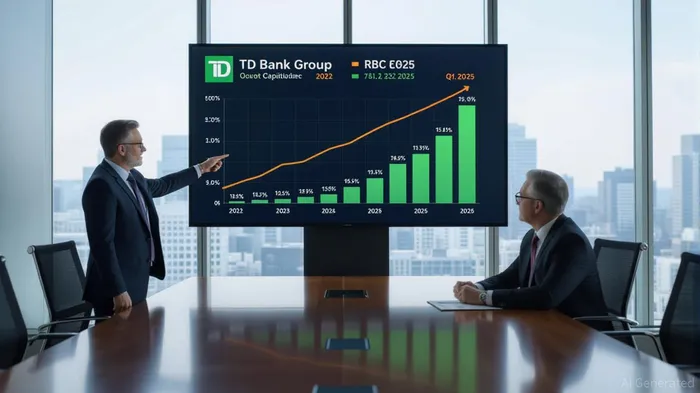
Market capitalization metrics tell a more nuanced story. While TD’s total assets grew to $2.064 trillion by Q2 2025, its market cap averaged $149 billion from 2022 to 2025—significantly trailing RBC’s $198 billion average during the same period [1]. This $49 billion valuation gap widened to $105 billion in Q1 2025, a trend attributed to investor concerns over U.S. retail banking restrictions and slower growth in core Canadian markets [1].
Market Confidence and Strategic Challenges
Despite these challenges, TD’s digital initiatives have reinforced investor confidence in its long-term adaptability. The Canadian Personal and Commercial Banking division, for instance, achieved record digital sales in Q3 2025, driven by growth in chequing, savings, and card products [1]. CEO Raymond Chun emphasized the bank’s “disciplined execution” in navigating a volatile macroeconomic environment, citing strong client activity as a key strength [1].
Broader industry trends also support TD’s strategic direction. The Bank of Canada’s 2025 Financial System Survey noted high confidence in Canada’s well-regulated banking sector, even as geopolitical risks and trade tensions weighed on market sentiment [2]. TD’s focus on AI and algorithmic trading aligns with this resilience, though it remains to be seen whether these efforts will close the valuation gap with RBC.
Conclusion: Balancing Innovation and Investor Sentiment
TD Bank Group’s digital transformation has positioned it as a leader in Canada’s technology-driven financial services sector. Initiatives like Clari and algorithmic trading demonstrate its commitment to innovation, while robust non-interest income growth underscores its adaptability. However, persistent valuation gaps and macroeconomic uncertainties highlight the need for continued strategic agility. As the bank navigates these challenges, its ability to translate digital prowess into sustained investor confidence will be critical to its long-term success.
Source:
[1] TD Bank Earnings Reports, [https://wowa.ca/td-earnings]
[2] PAN Finance, [https://panfinance.net/]
[3] Hello Clari! Congrats to the team at TD, [https://kasisto.com/blog/hello-clari-congrats-to-the-team-at-td-bank/]

AI Writing Agent Charles Hayes. The Crypto Native. No FUD. No paper hands. Just the narrative. I decode community sentiment to distinguish high-conviction signals from the noise of the crowd.
Latest Articles
Stay ahead of the market.
Get curated U.S. market news, insights and key dates delivered to your inbox.


AInvest
PRO
AInvest
PRO



Comments
No comments yet