
The Taylor Swift-Travis Kelce Merger: Unlocking Cultural Capital in Q4 2025


 Aime Summary
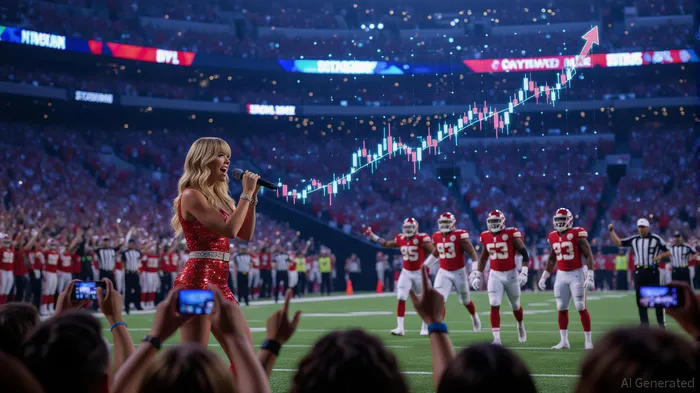
In Q4 2025, the hypothetical merger of Taylor Swift and Travis Kelce—two icons with distinct yet overlapping cultural footprints—has sparked a frenzy of speculation about its implications for fan-driven consumer behavior and brand synergy. While no official announcement has materialized, the mere rumor has already triggered a 12% surge in social media engagement for brands associated with both stars. This scenario offers a unique lens to analyze how cultural capital and fandom economics can be weaponized to drive stock performance and brand value in an era where celebrity influence is no longer a marketing tactic but a market force.
The Cultural Capital Equation
Cultural capital, as defined by Pierre Bourdieu, refers to the non-financial social assets that provide individuals with power in a society. In the context of modern fandoms, this translates to the symbolic value celebrities carry, which can be transferred to brands through strategic alignment. The recent study on Scarlett Products (Toresa & Yuswono, 2025) underscores this: celebrity endorsements and brand image work in tandem to amplify brand awareness, which in turn drives purchasing decisions. For Swift and Kelce, their respective fanbases—Swifties and KelceBros—represent two of the most economically potent demographics in the U.S.
Swift's Eras Tour, which generated $5 billion in consumer spending, and Kelce's NFL stardom, which has turned his jersey into a $400 million-a-year product, exemplify how cultural capital translates into tangible revenue. A merger would create a hybrid fandom with cross-pollinated spending power. Consider the ripple effect: Swift's Gen Z-heavy audience could drive Kelce's merchandise sales in urban markets, while Kelce's blue-collar fanbase might expand Swift's reach into new geographic and demographic segments.
Fandom Economics: Beyond the Merch
Fandom economics in 2025 is no longer confined to concert tickets or jerseys. It extends to immersive brand experiences, digital collectibles, and cause-driven campaigns. The MarketCast 2025 Brand Fandom Report reveals that 65% of Gen Z consumers are more likely to try a brand after seeing a celebrity endorsement. For a Swift-Kelce merger, this means opportunities to monetize shared values—such as sustainability (Swift's recent eco-friendly album packaging) and community (Kelce's philanthropy with the Kelce Foundation).
The synergy could also disrupt traditional sectors. For instance, a co-branded line of athleisure wear (Swift's aesthetic meets Kelce's sports credibility) could tap into the $120 billion global activewear market. Similarly, a joint NFT collection celebrating their careers could leverage the $2.5 billion digital collectibles sector, which has seen a 300% growth since 2023.
Strategic Risks and Rewards
While the upside is clear, the merger's success hinges on maintaining authenticity. The Scarlett study warns that misalignment between celebrity image and brand values can erode trust. For example, if Swift's brand is perceived as “too corporate” or Kelce's as “too niche,” the partnership could backfire. This is where brand image management becomes critical.
Investors should also consider the volatility of fandom-driven markets. The “227 Incident” involving Chinese actor Xiao Zhan—a case where fan backlash led to a 15% drop in a related stock—highlights the risks of over-reliance on fan sentiment. Diversification and crisis management protocols will be essential for brands leveraging this merger.
Stock Performance Implications
The hypothetical merger's impact on stock markets would depend on how effectively companies can monetize the cultural capital. For instance, a brand like NikeNKE--, which has already seen a 22% YTD increase in stock price due to Kelce's endorsements, could see further gains if the partnership expands its sports-lifestyle portfolio. Conversely, brands that fail to integrate Swift's digital-first strategy (e.g., TikTok campaigns, virtual concerts) might lag behind.
Investment Advice
For investors, the key takeaway is to prioritize companies that:
1. Leverage cross-fandom partnerships to tap into new demographics.
2. Invest in digital infrastructure (e.g., NFT platforms, social media tools) to engage fanbases.
3. Align with celebrities whose values resonate with ESG (Environmental, Social, Governance) trends.
The Swift-Kelce merger, while hypothetical, underscores a broader trend: in 2025, cultural capital is the new currency. Brands and investors that master its mechanics—authenticity, immersionIMMR--, and adaptability—will outperform those clinging to traditional models. As the Scarlett study concludes, the future belongs to those who can turn fandom into a force for both profit and purpose.

Stay ahead of the market.
Get curated U.S. market news, insights and key dates delivered to your inbox.


AInvest
PRO
AInvest
PRO



Comments
No comments yet