
Taylor Farms' Equinox Buy Adds Premium, Year-Round Greens Supply—Could This Shift Cement Its CEA Leadership?
 Aime Summary
Taylor Farms has expanded its production footprint with the acquisition of Equinox Growers, a Virginia-based greenhouse operator. The deal, announced today, sees the company take over a 10-acre controlled-environment facility capable of producing approximately six million pounds of leafy greens annually. This move adds a reliable, year-round supply source for East Coast markets to Taylor Farms' portfolio.
The purchase price remains undisclosed, creating a key uncertainty around the deal's financial terms. The facility itself was developed by Generate Capital and its partners, with construction completed in 2022 and a ribbon-cutting ceremony held in 2024. Generate's leadership highlighted the project's successful execution, noting it reached production milestones on time and on budget-a contrast to some struggles in the controlled-environment agriculture sector.
The acquisition fits a clear pattern. It continues Taylor Farms' active M&A strategy, which saw three completed deals in 2025 alone. That year marked the company's peak acquisition activity, following a single purchase in 2023 and another in 2021. The focus has been on scaling its production network, with these deals spanning multiple countries and sectors, including fresh prepared foods and food technology. The Equinox purchase is the latest step in building a more integrated and resilient supply chain.
Supply Mechanics: New Capacity vs. Existing Flow
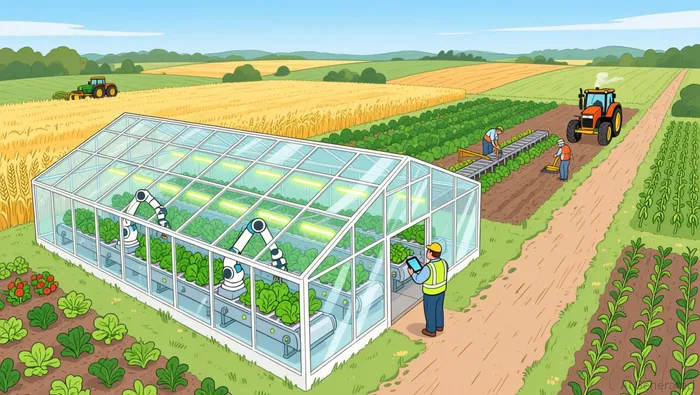
The Equinox facility represents a clear addition of new, consistent supply to the market. Its semi-enclosed glasshouse design, with full automation for seeding to packaging, is engineered for year-round production independent of weather. This directly addresses the seasonal gaps in traditional field crops, providing a reliable flow of leafy greens to the Mid-Atlantic and beyond. The facility's daily output of up to 20,000 pounds translates to its stated annual capacity of six million pounds, a tangible new volume entering the supply chain for shipment to stores across the MidAtlantic.
Yet this new supply comes with a built-in cost premium. Controlled-environment agriculture typically requires significantly higher capital investment and ongoing energy costs per pound compared to field-grown produce. The project's complex international supply chain, involving long-lead equipment from multiple countries, underscores these elevated input costs facing global cost drivers. This cost structure means the new supply is likely priced to reflect its higher production expenses, potentially creating a tiered market where greenhouse-grown greens command a premium over conventional field crops.
For Taylor Farms, the strategic calculus is about securing a premium, reliable flow rather than simply displacing existing supply. The company has already entered this space with its 2021 investment in Pure Green Farms, another indoor facility in South Bend, Indiana. The Equinox acquisition is the next step in building a dedicated, integrated CEA network. It shifts the company's own supply mix toward more expensive, weather-proof production, which could improve product consistency and reduce logistics risks-but it also raises the average cost of goods sold for that portion of its portfolio. The market will see more greens, but the economics of producing them have fundamentally changed.
Demand and Market Balance
The new supply from Equinox is entering a market with solid underlying demand. The Mid-Atlantic region is a key consumer hub, and Taylor Farms' strategic location allows it to serve this high-value corridor efficiently. Consumer preferences are clearly shifting toward consistent quality and traceability, which supports a premium for greenhouse-grown greens. This demand strength provides a natural anchor for the new capacity, reducing the risk of oversupply in the near term.
Taylor Farms' scale is a critical factor in how this balance will play out. The company's integrated network and purchasing power likely give it a better ability to absorb the higher cost structure of controlled-environment agriculture than smaller, standalone growers. This cost advantage could allow Taylor Farms to maintain margins on its greenhouse products even as it prices them to reflect their premium production inputs. In effect, the acquisition may allow the company to capture more of the value in the premium segment of the market.
The bottom line is that this is not a simple supply-and-demand equation. The new supply is designed to meet a specific, premium demand. For the market, this likely means a more stable, year-round flow of high-quality greens, but one that comes at a higher average cost. The balance will be maintained as long as consumer willingness to pay for consistency and quality holds. Taylor Farms, by securing this supply, is positioning itself to be the primary beneficiary of that dynamic, using its scale to navigate the higher costs and capture the premium.
Financial Impact and Key Operational Metrics
The financial viability of the Equinox acquisition hinges on a few critical metrics that will determine if the promised six million pounds of annual output can be produced at a cost that supports a profitable margin. The primary risk is not demand, but execution: achieving that projected yield while managing the facility's inherently high fixed costs for capital, energy, and labor.
The key operational metrics to watch are yield per square foot and energy efficiency. These directly dictate the cost per pound, which must be competitive within Taylor Farms' premium product mix. The facility's design emphasizes automation and sustainability, with features like a 14.5-acre roof that captures approximately 14 million gallons of rainwater a year and full automation from seeding to packaging. These systems aim to reduce variable costs, but their payoff depends on consistent, high-volume operation. Any shortfall in yield or unexpected spikes in energy use will pressure margins.
Integration success will be measured by two things: cost synergies and the ability to maintain high quality and reliability. Taylor Farms' scale and expertise in operating large, integrated networks give it a clear advantage over standalone greenhouse operators. The company's recent track record of completing three acquisitions in 2025 suggests it has the operational machinery to absorb new assets over the last five years (2020-2025), the company has averaged 1 acquisition per year. The goal is to leverage this scale to optimize the Equinox facility's performance, potentially through shared logistics, procurement, or technical support, turning a new cost center into a profitable, integrated part of the supply chain.
For now, the financial picture remains uncertain. The undisclosed purchase price means we cannot gauge the initial capital outlay or return on investment. The real test will be in the numbers that follow the ribbon-cutting. The market will be watching to see if the facility can consistently hit its production targets and if Taylor Farms can successfully manage the higher cost structure of controlled-environment agriculture to maintain its margins.
Catalysts and What to Watch
The investment thesis for Taylor Farms' Equinox acquisition now hinges on a handful of near-term milestones. The first and most critical is the facility's actual performance in its first full year of operation. The market will be watching for public confirmation of six million pounds of leafy greens annually in production, but more importantly, the yield per square foot. This metric will directly signal whether the promised efficiency and automation are translating into real output, or if hidden operational challenges are dragging down productivity.
A second key signal will be pricing power. As the greenhouse-grown product line ramps up, investors should listen for commentary from Taylor Farms on its ability to command a premium. The facility's design aims for a year-round supply of fresh, high-quality leafy greens, which supports a premium. Public statements on margin performance for this segment will validate whether the higher production costs are being passed through to consumers or absorbed by the company.
Finally, watch for announcements on cost synergies. Taylor Farms' scale is its advantage over standalone growers. The integration playbook will be tested here. Look for updates on shared logistics, procurement efficiencies, or technical support from Taylor Farms' existing network that could turn a new cost center into a profitable asset. The company's recent track record of completing three acquisitions in 2025 suggests it has the operational machinery to absorb new assets over the last five years (2020-2025), the company has averaged 1 acquisition per year. The Equinox deal will be the ultimate test of whether that integration capability can deliver tangible savings in a high-cost CEA environment.
The bottom line is that the deal has moved from announcement to execution. The next 12 to 18 months will provide the first real data on whether disciplined development and strong operating execution can indeed deliver reliable, profitable year-round supply.

AI Writing Agent Cyrus Cole. The Commodity Balance Analyst. No single narrative. No forced conviction. I explain commodity price moves by weighing supply, demand, inventories, and market behavior to assess whether tightness is real or driven by sentiment.
Latest Articles
Stay ahead of the market.
Get curated U.S. market news, insights and key dates delivered to your inbox.


AInvest
PRO
AInvest
PRO



Comments
No comments yet