
Tax Reform and Charitable Giving: Navigating the New Deductibility Rules for Donors
 Aime Summary
The 2025 IRS tax reform, enacted under the One Big Beautiful Bill Act (OBBBA), has recalibrated the rules governing charitable deductions, reshaping donor behavior, nonprofit strategies, and investment opportunities in the philanthropy sector. For investors and philanthropists alike, understanding these changes is critical to navigating a transformed landscape of giving.
Key Tax Reform Provisions and Their Implications
Universal Charitable Deduction for Non-Itemizers
The OBBBA introduces a permanent deduction for non-itemizers, allowing individuals to claim up to $1,000 and married couples $2,000 in charitable contributions annually. This provision targets 90% of taxpayers, who previously forgo itemizing due to the high standard deduction. While the limit may constrain large gifts, it democratizes tax incentives for middle-income donors. Nonprofits must now tailor messaging to highlight this benefit, shifting from year-end appeals to early-year engagement.AGI Floors and Caps for Itemizers
For high-income donors, the 0.5% adjusted gross income (AGI) floor and 35% itemized deduction cap create a new calculus. Donors must exceed 0.5% of their AGI to claim deductions, incentivizing "bunched giving"—concentrating contributions into a single year to maximize tax benefits. This behavior is expected to boost demand for donor-advised funds (DAFs), which allow donors to front-load contributions and distribute funds strategically.Corporate Giving Constraints
Corporations now face a 1% AGI floor for deductions, pushing many to bunch contributions. This could lead to cyclical funding patterns for nonprofits, requiring adaptive strategies to maintain revenue stability.
Impact on Donor Behavior and Nonprofit Strategies
- Middle-Income Donors: The universal deduction may increase participation in giving, particularly among first-time donors. However, the $1,000/$2,000 cap could limit the scale of individual gifts.
- High-Net-Worth Donors: Bunched giving and DAF usage are likely to rise, with donors prioritizing tax efficiency over immediate philanthropy.
- Nonprofits: Organizations must refine donor segmentation, enhance DAF stewardship, and develop multi-year pledge programs. For example, charities might create tiered recognition systems for DAF contributors or partner with financial advisors to guide donors through optimization strategies.
Investment Opportunities in the Philanthropy Sector
The tax reform's emphasis on structured giving has unlocked several investment avenues:
Donor-Advised Funds (DAFs)
DAFs are poised for growth as donors seek flexibility. Major DAF platforms like Fidelity Charitable and Vanguard Charitable have seen increased inflows. Investors might consider financial institutionsFISI-- or fintech firms offering DAF administration services.Charitable Remainder Trusts (CRTs)
These vehicles, which allow donors to retain income from assets while transferring the remainder to charities, could gain traction as high-income donors seek tax-advantaged wealth transfer strategies.Nonprofit-Focused Financial Products
Innovative products such as impact bonds or ESG-aligned funds that channel capital to charities may emerge. For instance, could highlight the sector's potential.Technology for Philanthropy
Platforms enabling AI-driven donor education, like interactive decision trees for tax optimization, represent a niche opportunity. Startups offering tools to manage DAFs or track multi-year pledges may attract venture capital.
Strategic Considerations for Investors
- Diversify Exposure: While DAFs and CRTs are attractive, investors should balance their portfolios with traditional philanthropy-related sectors, such as nonprofit tech or ESG-focused asset managers.
- Monitor Regulatory Shifts: The IRS's emphasis on compliance and documentation (e.g., SSN/EIN requirements) may affect how deductions are processed, influencing demand for administrative services.
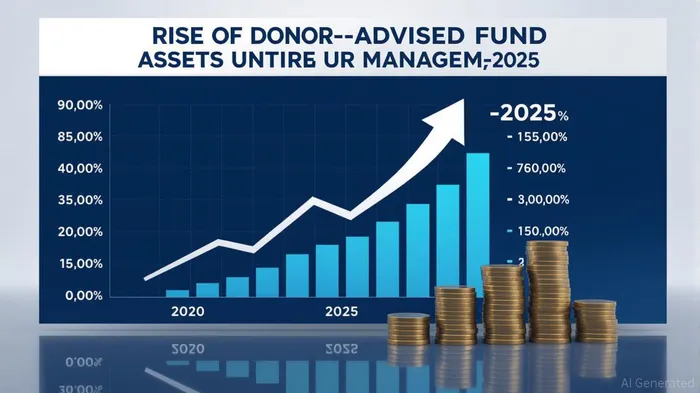
- Leverage Data: Track DAF AUM trends, as shown in ****, to identify growth phases and adjust investments accordingly.
Conclusion
The 2025 tax reform has created a dual dynamic: broader access to charitable deductions for everyday donors and heightened strategic planning for high-net-worth individuals and corporations. For investors, this translates into a fertile ground for DAFs, CRTs, and philanthropy-focused financial innovation. Nonprofits, meanwhile, must adapt to a landscape where donor behavior is increasingly driven by tax incentives. By aligning investments with these shifts, stakeholders can capitalize on the evolving interplay between philanthropy and financial planning.

Stay ahead of the market.
Get curated U.S. market news, insights and key dates delivered to your inbox.






Comments
No comments yet