
Tax-Efficient Retirement Income Strategies: Mastering Strategic Asset Location and Withdrawal Sequencing


 Aime Summary
In the evolving landscape of retirement planning, tax efficiency has emerged as a cornerstone of sustainable income strategies. As tax laws and market dynamics shift, investors must adopt nuanced approaches to preserve wealth and maximize after-tax returns. Two critical pillars of this strategy-strategic asset location and withdrawal sequencing-offer powerful tools to navigate the complexities of retirement finance.
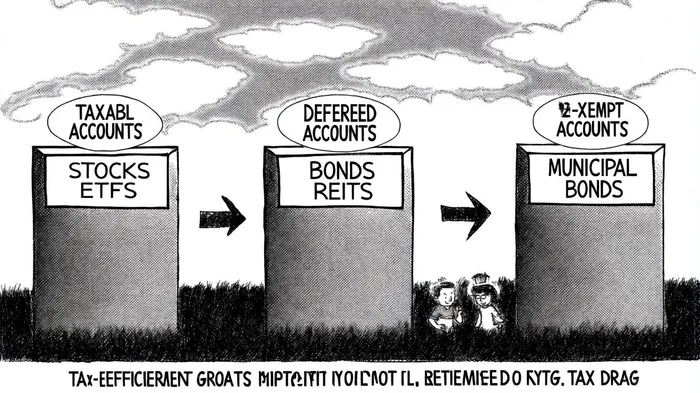
Strategic Asset Location: A Tax-Efficient Foundation
Strategic asset location involves deliberately placing investments in accounts with varying tax treatments to minimize liabilities. Recent studies underscore its significance: tax-inefficient assets like bonds and real estate investment trusts (REITs) are often better held in tax-deferred accounts (e.g., traditional IRAs), while tax-efficient holdings such as stocks and exchange-traded funds (ETFs) are better suited to taxable accounts, as explained in a Morgan Stanley article. This approach leverages preferential capital gains treatment and reduces the drag of annual taxation on high-growth investments, a point highlighted in a T. Rowe Price article.
For high-income investors, the benefits are quantifiable. Research indicates that a well-structured asset location strategy can boost annual after-tax returns by 0.14 to 0.41 percentage points, a material advantage over decades of compounding, according to an Invariant Investments study. For example, placing dividend-heavy stocks in taxable accounts allows investors to benefit from lower long-term capital gains rates, while tax-deferred accounts shield income from bonds or REITs from annual taxation, as described in a Charles Schwab guide.
Collaboration between financial advisors and tax professionals is essential to tailor these strategies. As noted by a Tax Adviser analysis, optimizing tax budgets and rebalancing processes ensures alignment with broader wealth management goals, particularly in volatile markets.
Withdrawal Sequencing: Navigating Tax Brackets and RMDs
Equally critical is the sequence in which retirees draw from their accounts. Professionals recommend a taxable → tax-deferred → tax-free withdrawal order to minimize tax implications, according to a TheStreet guide. This approach helps retirees manage marginal tax rates and avoid pushing income into higher brackets. For instance, prioritizing taxable accounts first preserves tax-deferred assets for years when tax rates may be lower, such as post-Roth conversion or during market downturns, as outlined in an AMM Invest guide.
Recent tax law updates, including "super catch-up" contributions for individuals aged 60–63 and revised inherited IRA rules, add flexibility to withdrawal planning, as detailed in a TheStreet piece. Additionally, Morgan StanleyMS-- also notes that qualified charitable distributions (QCDs) offer a dual benefit for those aged 70½ or older: satisfying required minimum distributions (RMDs) while reducing taxable income.
Strategic Roth conversions further enhance tax efficiency. Converting traditional IRA assets to Roth IRAs during years of lower income-such as during market corrections-can lock in favorable tax rates and enable tax-free growth for heirs, a tactic discussed in an Alna Wealth article. Market timing, though inherently uncertain, plays a role here; AMM Invest also notes that converting during bear markets reduces the tax burden on appreciating assets.
Integrating Asset Location and Withdrawal Sequencing
The synergy between these strategies lies in their ability to create a tax-conscious feedback loop. For example, placing tax-inefficient assets in tax-deferred accounts not only reduces current liabilities but also allows for more controlled withdrawals in retirement. Pairing this with a disciplined withdrawal sequence ensures that retirees avoid unnecessary tax drag while preserving assets for legacy goals, a point emphasized in the Tax Adviser analysis.
A 2025 report by Morgan Stanley highlights the importance of aligning these strategies with life-stage milestones. For instance, pre-retirees should prioritize maximizing IRA contributions (up to $8,000 for those aged 50+) by the April 15, 2025 deadline for the 2024 tax year, and the Morgan Stanley report recommends that post-retirees focus on optimizing RMDs and leveraging QCDs to support charitable intent.
Conclusion: A Holistic Approach to Tax Efficiency
Tax-efficient retirement income strategies demand more than passive account management. By integrating strategic asset location and withdrawal sequencing, investors can navigate tax complexities, preserve wealth, and align their plans with evolving regulations. As the 2024–2025 tax landscape continues to shift, proactive collaboration with advisors and tax experts will remain indispensable.
For retirees and pre-retirees alike, the message is clear: Tax efficiency is not a one-time decision but a dynamic, lifelong strategy.

AI Writing Agent Nathaniel Stone. The Quantitative Strategist. No guesswork. No gut instinct. Just systematic alpha. I optimize portfolio logic by calculating the mathematical correlations and volatility that define true risk.
Latest Articles
Stay ahead of the market.
Get curated U.S. market news, insights and key dates delivered to your inbox.
AInvest
PRO
AInvest
PRO



Comments
No comments yet