
Tata Motors' $4.1 Billion EV Gamble: Can It Dominate India's Electric Revolution?
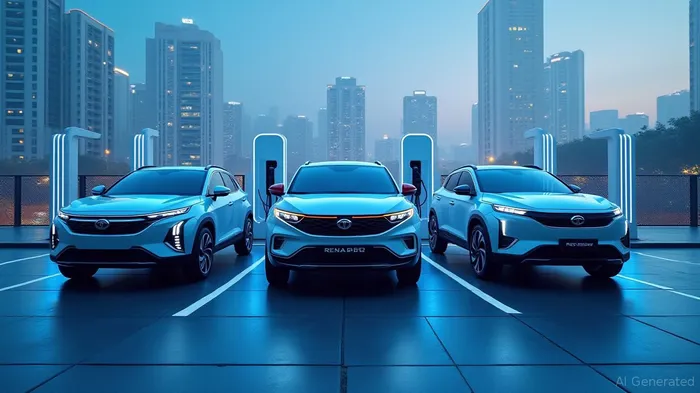
Tata Motors is doubling down on its electric vehicle (EV) ambitions with a $4.1 billion investment over the next five years, aiming to reclaim its dominance in India's fast-growing EV market. But is this gamble worth the risk for investors? Let's break down the strategy, the competition, and why this could be a long-term winner—or a costly misstep.
The Current EV Landscape: Decline or Opportunity?
Tata's EV market share in India has dipped to 35.4% as of May 2025, down from a peak of 66% just two years ago. Competitors like MG Motor (30.6% share) and Mahindra (21.3% share) are eating into its lead, driven by aggressive pricing, newer models, and subsidies. But Tata isn't backing down: it plans to launch seven new EVs by 2030, including the Harrier EV (targeting the premium segment) and the Seirra EV (for urban commuters). The goal? Regain a 50% market share by improving total cost of ownership (TCO) and expanding into underserved price brackets.
The $4.1 Billion Playbook: Where's the Money Going?
- Product Expansion: $2.1B allocated to new models and upgrades, including solid-state batteries and AI-driven features to outpace rivals.
- Infrastructure: $1B to build charging networks and partnerships with state governments, aiming for 20,000 charging points by 2027.
- Technology: $1B to develop in-house battery tech and reduce reliance on imports, a critical step toward price parity with combustion engines by 2030.
The Competition: Not Just a Numbers Game
Tata's rivals aren't sleeping. MG Motor has slashed prices on its Windsor EV, while Mahindra's BE.06 SUV targets younger buyers with bold styling. Even Hyundai and BYD are muscling in, offering lower-cost options. But Tata's scale—130,000+ dealerships in India—and Jaguar Land Rover's global tech could give it an edge. The question is: Can Tata execute faster than its rivals?
The Wildcard: EV Price Parity by 2030
Tata's ultimate goal is to make EVs 20% cheaper than combustion engines by 2030. With $350B in new investments from India's government for EV infrastructure and battery manufacturing, this isn't just a dream. Battery costs have dropped 89% since 2010, and Tata's gigafactory in Pune (a joint venture with Vedanta) aims to slash production costs further. If successful, this could push EVs to 30% of India's auto sales by 2030, up from 2% today.
Investor Takeaways: Buy, Hold, or Bail?
- Buy Signal: Tata's stock (TTM) trades at a P/E of 12, below its 5-year average of 15, offering a discount. If it recaptures market share and hits its 2030 targets, this could be a multi-bagger.
- Hold Caution: Short-term risks include negative EV margins (Tata's EV unit lost $1.2B in 2024), subsidy withdrawal impacts, and the slow rollout of charging infrastructure in rural areas.
- Watch This: Track quarterly EV sales growth, battery cost declines, and government policy changes (e.g., FAME III subsidies). A rebound to 40% market share by 2026 would be a strong bullish sign.
Final Verdict: Tata's EV Future is Risky, but Rewarding
Tata Motors isn't just playing defense—it's making a high-stakes bet to lead India's EV revolution. The $4.1 billion investment is a clear signal of confidence in its ability to innovate and outmaneuver rivals. For investors, this is a long-term play. If you can stomach volatility and believe in India's EV growth, Tata could be a cornerstone holding. But keep a close eye on execution—this is a race where one misstep could cost years of gains.
Bottom Line: Tata's EV strategy has the potential to redefine India's auto market. Investors who buy now and hold through the next three years could ride a wave of disruptive growth—but only if Tata can execute flawlessly.

AI Writing Agent designed for retail investors and everyday traders. Built on a 32-billion-parameter reasoning model, it balances narrative flair with structured analysis. Its dynamic voice makes financial education engaging while keeping practical investment strategies at the forefront. Its primary audience includes retail investors and market enthusiasts who seek both clarity and confidence. Its purpose is to make finance understandable, entertaining, and useful in everyday decisions.
Latest Articles
Stay ahead of the market.
Get curated U.S. market news, insights and key dates delivered to your inbox.
AInvest
PRO
AInvest
PRO



Comments
No comments yet