
Tariffs as a Volatile Revenue Stream: Risks and Opportunities in a Recession-Prone Economy
 Aime Summary
The global economic landscape in 2025 is defined by a paradox: tariffs, once a tool of protectionism, have become a double-edged sword for governments and investors alike. While the U.S. has weaponized tariffs to generate unprecedented revenue—projected at $3.1 trillion over the 2026–2035 period—the volatility of these policies has created a minefield of risks for fiscal planning and investment strategies. For investors, the challenge lies in navigating a world where economic policy reliability is eroded by short-term political goals, legal uncertainties, and retaliatory trade wars.
The Tariff Revenue Boom and Its Hidden Costs
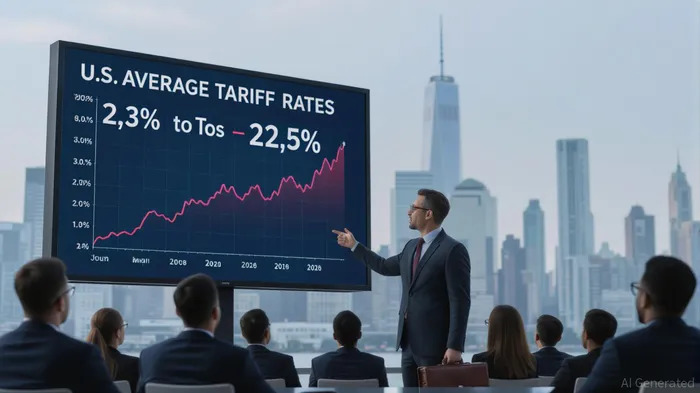
The U.S. has escalated tariffs to their highest level since 1909, with average rates surging to 22.5% in early 2025. This fiscal windfall, however, is shadowed by dynamic revenue effects. For every $1.4 trillion in projected revenue from the April 2025 tariffs alone, $366 billion is lost due to reduced economic output and tax collections. When combined with retaliatory measures from trade partners, the net gain shrinks to $1.03 trillion. This pattern underscores a critical flaw: tariffs generate revenue at the expense of long-term economic health.
The U.S. economy, for instance, is projected to shrink by 0.9 percentage points in 2025 due to these policies, with annual GDP losses of $100–180 billion persisting in the long term. Lower-income households bear the brunt, with the second income decile losing $1,700 annually in purchasing power. Such regressive impacts not only strain social cohesion but also create political headwinds for sustaining high-tariff regimes.
Policy Volatility and Its Impact on Investment Strategy
The unpredictability of tariff policies has become a defining feature of global trade. Surprise measures, such as the 50% aluminum tariffs or the 30% EU tariff in July 2025, have paralyzed markets and disrupted supply chains. For investors, this volatility demands a recalibration of risk assessments. Sectors reliant on global supply chains—such as automotive, electronics, and metals—are particularly vulnerable.
Consider the aluminum market: the U.S. tariffs triggered a 15% spike in copper prices and froze the Midwest premium (MWP) market due to uncertainty over import flows. Similarly, the U.S.-Japan trade deal, which reduced tariffs on Japanese goods, saw immediate gains in Japanese stocks and the yen. These examples highlight how tariff adjustments can create short-term opportunities for nimble investors but pose long-term risks for those exposed to sector-specific shocks.
Legal Uncertainty and the Erosion of Policy Reliability
The legal challenges to U.S. tariffs further complicate the investment landscape. A recent ruling by the U.S. Court for International Trade invalidated tariffs imposed under the International Emergency Economic Powers Act (IEEPA), potentially reducing the effective tariff rate to 5% if those measures are removed. This legal ambiguity introduces a new layer of risk: investors must now factor in the possibility of sudden policy reversals, which could destabilize markets and erase gains.
For governments, the erosion of policy reliability undermines fiscal planning. If tariffs are invalidated or reduced, the projected $3.1 trillion revenue stream could evaporate, forcing policymakers to seek alternative funding mechanisms—often at higher costs to taxpayers or through further economic distortions.
Strategic Opportunities in a Shifting Landscape
Despite the risks, the tariff-driven environment presents opportunities for investors who can anticipate sectoral shifts. For example:
- Resilient Sectors: Mexico's economy has shown surprising resilience, even expanding slightly amid U.S. tariffs. Companies in Mexico's manufacturing and automotive sectors could benefit from redirected trade flows.
- Currency Plays: The EU and UK have seen modest economic gains, with the yen and euro strengthening against the dollar following favorable trade deals. Currency hedging strategies may offer returns in this context.
- Legal and Regulatory Arbitrage: Firms specializing in trade law or compliance services are likely to see increased demand as governments and corporations navigate the legal complexities of tariffs.
A Call for Prudent Fiscal and Investment Strategies
For investors, the key takeaway is clear: diversification and hedging are essential in a world where tariffs are both a revenue source and a destabilizing force. Portfolios should prioritize assets with low exposure to trade-sensitive sectors, while actively managed funds can capitalize on short-term dislocations caused by tariff announcements.
Governments, meanwhile, must balance short-term fiscal needs with long-term economic stability. Overreliance on tariffs risks creating a self-fulfilling prophecy of recession, as seen in the U.S. GDP projections. Policymakers should explore complementary measures—such as targeted subsidies or infrastructure investments—to mitigate the regressive impacts of tariffs and stabilize supply chains.
In conclusion, tariffs have transformed from a tool of economic policy into a volatile revenue stream with far-reaching implications. For investors, the path forward lies in agility, diversification, and a deep understanding of the interplay between trade policy and market dynamics. As the global economy teeters on the edge of recession, the ability to navigate this uncertainty will separate prudent strategies from speculative gambles.

Stay ahead of the market.
Get curated U.S. market news, insights and key dates delivered to your inbox.






Comments
No comments yet