
Tariffs and Market Volatility: Navigating the New Trade Reality
The "TACO trade"—the assumption that President Trump would "chicken out" of aggressive tariff threats to avoid market turmoil—is unraveling. Recent tariff escalations and shifting geopolitical dynamics are forcing investors to confront a harsh reality: the era of complacency is over. With the expiration of a 90-day tariff moratorium and fresh threats of 30%-50% duties on critical sectors, equity markets face a pivotal test. How are investors adapting? And what does this mean for portfolios?
The TACO Trade Unravels: From Complacency to Caution
For years, investors bet that Trump's trade threats were bluffs, buoyed by the market's April rebound after his "Liberation Day" tariffs sent the S&P 500 plunging 20%. That logic now feels outdated. The latest tariff moves—targeting copper, pharmaceuticals, and key trade partners—signal a new phase where political posturing meets economic consequence.
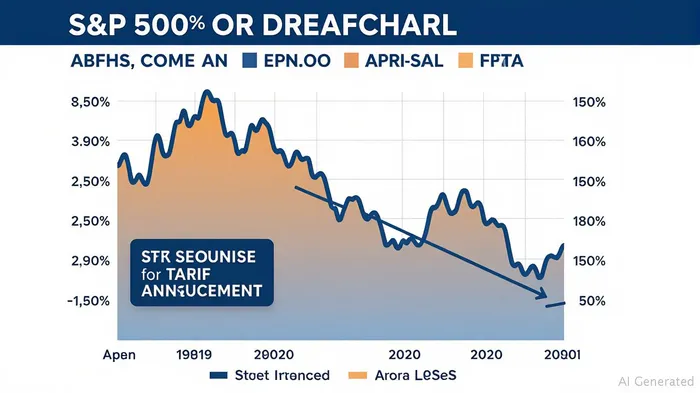
The market's muted reaction to recent threats has paradoxically emboldened policymakers. As Capital Economics notes, this creates a "dangerous circularity": no sell-off pressure allows tariffs to persist, even as their economic toll grows. The question now is whether investors will finally price in the risks—or if the game truly never ends.
Tariffs at the Sector Level: Winners and Losers
The impact of tariffs isn't uniform. Wealth Enhancement's Market Movers series identifies three critical battlegrounds:
- Consumer Goods: A Double-Edged Sword
Retailers like AmazonAMZN-- are thriving by doubling down on discount-driven sales (Prime Day's $21B haul, up 60% YoY). However, this masks deeper inflationary pressures. While discounters like WalmartWMT-- and Dollar TreeDLTR-- gain share, higher tariffs on imports could erode margins if retailers can't pass costs to consumers.
Industrials and Autos: Bracing for Impact
Multinationals in autos and manufacturing face rising costs as tariffs on steel, copper, and semiconductors disrupt supply chains. Analysts have downgraded stocks like Ford (F) and CaterpillarCAT-- (CAT), anticipating profit hits. The solution? Vertical integration or reshoring—neither comes cheap.Healthcare: A New Tariff Frontier
Proposed 200% tariffs on imported pharmaceuticals could spark a showdown with European drugmakers. U.S. firms like PfizerPFE-- (PFE) and MerckMRK-- (MRK) may benefit from reshoring, but the sector's volatility underscores the high stakes of tariff-driven reshaping.
Inflation and the Fed: A Delicate Balancing Act
The Fed's path is narrowing. While cooling inflation in housing and goods is positive, core services (wages, healthcare) remain stubbornly high. The June FOMC minutes hinted at two rate cuts by year-end—but that timeline hinges on tariffs not reigniting inflation.
Investors are already hedging: flows into short-duration bonds and dividend-paying stocks (e.g., utilities, consumer staples) have surged. This "quality over quantity" shift reflects a market prioritizing stability over growth—a stark contrast to the TACO trade's risk-on ethos.
Portfolio Strategies for the New Reality
Wealth Enhancement's analyses highlight three actionable steps to navigate this landscape:
Rotate into Defensive Equities
Focus on companies with pricing power and domestic revenue streams. Examples include consumer staples giants (Kroger (KR), Procter & Gamble (PG)) and healthcare leaders insulated from trade wars.Leverage Inflation Hedges
Short-term Treasuries and TIPS (Treasury Inflation-Protected Securities) offer ballast against uncertainty. Gold (GLD) could also shine if tariffs spark a flight to safety.Monitor Geopolitical Catalysts
The G20 trade talks (July 15-20) and August 1 tariff deadlines are critical inflection points. A breakthrough could spark a rally, while escalation might force further portfolio adjustments.
Conclusion: The End of Easy Money?
The TACO trade's decline marks a turning point. Investors can no longer rely on political retreats to offset tariff risks. The new reality demands discipline: diversification, liquidity, and a focus on companies that thrive in volatile environments. As Wealth Enhancement warns, the "game" may continue—but the stakes are rising.
For now, the playbook is clear: prioritize resilience, avoid overexposure to trade-sensitive sectors, and keep one eye on the G20 horizon. The next move is Trump's—but the market's patience is wearing thin.

Stay ahead of the market.
Get curated U.S. market news, insights and key dates delivered to your inbox.




Comments
No comments yet