
Tariffs and Inflation: Unpacking the Link Between Trade Policy and Rising Costs for Consumers
 Aime Summary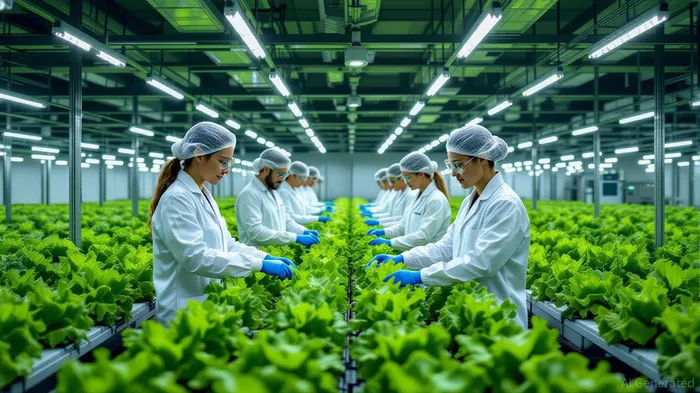
The U.S. food and agriculture sectors are grappling with a perfect storm of trade policies, supply chain bottlenecks, and inflationary pressures. Tariffs imposed in 2025 under the International Emergency Economic Powers Act (IEEPA) have created a cascade of challenges, from surging wholesale vegetable prices to volatile input costs. For investors, understanding the interplay between trade policy and sector-specific inflation is critical to navigating a landscape where resilience and innovation are reshaping the industry.
Tariffs and the Vegetable Supply Chain: A Perfect Storm
The U.S. imports over 33% of its fresh vegetables, a dependency that has become a vulnerability in the face of retaliatory tariffs. China's 10–15% tariffs on U.S. agricultural exports, coupled with Mexico's reciprocal measures, have disrupted key markets for soybeans, corn, and pork. Meanwhile, U.S. tariffs on Canadian potash—a critical fertilizer input—have driven up costs for DAP, MAP, and urea by 25%. These pressures are amplified for perishable goods like vegetables, which cannot be stockpiled before tariffs take effect.
Wholesale vegetable prices have spiked by 38.9% in July 2025, according to recent data. This surge is driven by a combination of factors:
- Logistical Delays: Tariff-related border inspections and port uncertainties have caused spoilage and increased demurrage fees.
- Labor Shortages: Immigration raids have reduced the availability of agricultural labor, pushing wages up by 12% and further inflating costs.
- Input Price Volatility: Fertilizer and machinery costs have risen by 15–20%, squeezing margins for farmers.
Long-Term Inflationary Pressures and Input Cost Volatility
While the USDA projects overall food price inflation at 2.9% for 2025, the agricultural sector faces unique headwinds. The ERS report notes that food-away-from-home prices are expected to rise 4.0%, outpacing food-at-home inflation. This divergence reflects the structural inefficiencies in supply chains, where restaurants bear higher costs for perishable ingredients and logistics.
Tariffs also indirectly fuel inflation by reducing competition and distorting global trade flows. For example, China's 10% tariff on U.S. farm equipment861136-- has hit companies like DeereDE-- & Co., while U.S. steel tariffs have increased the cost of manufacturing agricultural machinery. These cascading effects are pushing farmers to delay capital expenditures, further straining productivity.
Resilient Agribusiness Models: The Rise of Controlled Environment Agriculture
Amid these challenges, investment in resilient agribusiness models is gaining momentum. Controlled Environment Agriculture (CEA), including vertical farming and hydroponics, is emerging as a solution to mitigate supply chain risks. The CEA market, valued at $30 billion in 2023, is projected to grow to $120 billion by 2030, driven by $18 billion in annual tech investments.
Key players like Oishii and Local Bounti have demonstrated strong unit economics, with gross profit growth of 50–339% in 2024. These companies leverage AI-driven analytics, automation, and energy-efficient systems to produce high-margin crops like microgreens and herbs. Investors are increasingly favoring CEA operators with defensible margins and scalable infrastructure, as evidenced by Oishii's $150 million Series B round at a $615 million valuation.
Strategic Investment Opportunities
For investors, the path forward lies in balancing exposure to traditional agriculture with high-growth agtech. Here are three actionable strategies:
1. Diversify into CEA: Allocate capital to CEA platforms with strong operational discipline, such as Local Bounti (NASDAQ: LOCL) or Edible Garden. These companies are positioned to capitalize on the $120 billion CEA market.
2. Hedge Against Input Costs: Invest in firms developing sustainable alternatives to traditional fertilizers, such as Nutrien (NTR) or CF Industries (CF), which are adapting to higher potash prices.
3. Monitor Trade Policy Shifts: Closely track developments in U.S.-China trade negotiations and the potential for a permanent resolution to the 90-day tariff truce. A resolution could unlock $21 billion in U.S. soybean and corn exports.
Conclusion: Navigating a Shifting Landscape
The 2025 tariff regime has accelerated inflationary pressures in the food sector, particularly for perishable goods like vegetables. However, the crisis has also catalyzed innovation in resilient agribusiness models. As supply chains become increasingly localized and technology-driven, investors who prioritize adaptability and sustainability will be best positioned to thrive. The future of agriculture lies not in resisting trade disruptions but in building systems that turn volatility into opportunity.

Stay ahead of the market.
Get curated U.S. market news, insights and key dates delivered to your inbox.




Comments
No comments yet