
Tariffs and the Inflation-Unemployment Trade-off: A Structural Analysis


 Aime Summary
The recent surge in U.S. tariffs has created a persistent tax on households that is only partially visible in broad inflation statistics. The scale is now structural: the average effective tariff rate has risen to 11.2%, the highest level since 1943. This is not a minor policy tweak. The tariffs represent the largest U.S. tax increase as a percent of GDP since 1993, with a direct financial impact measured in thousands per family. In 2025, they amounted to an average tax increase of $1,100 per U.S. household, a figure projected to rise to $1,500 in 2026.
Yet this tax burden is unevenly distributed and often masked. While headline inflation has cooled, the pressure is concentrated in specific categories. Since early 2025, prices for durable goods-such as vehicles, electronics and furniture-have increased noticeably. These are precisely the goods most exposed to international trade and tariff hikes. A model of tariff pass-through estimates that the average effect on final prices across all categories is 0.87% under full pass-through assumptions. More critically, evidence shows that about 35% of the model-predicted tariff effect has already materialized by August. This means the inflationary impact is real and measurable, but it is being absorbed by a subset of the economy rather than uniformly across all consumer spending.
The bottom line is that tariffs function as a targeted tax that distorts the inflation picture. They raise the cost of imported goods and the components used to make them, directly increasing the prices households pay for durable items. This creates a persistent headwind for consumer purchasing power that is not fully captured by the broader, more stable headline PCE index. For now, the tax is being paid in higher prices for specific goods, a hidden but significant cost that policymakers and consumers alike must account for.
The Structural Trade-off: Inflation, Unemployment, and Trade Balances
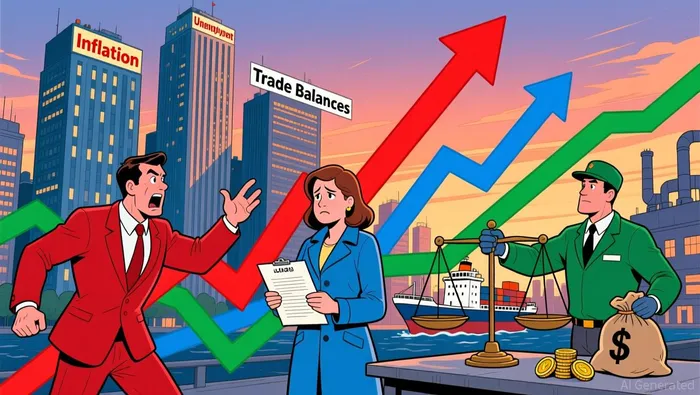
The economic calculus of tariffs extends far beyond the inflation numbers we've examined. They force a fundamental trade-off, reshaping the relationship between price stability, employment, and trade flows. Historical evidence suggests this is a classic, if painful, policy choice. An analysis of advanced economies shows that tariff hikes typically trigger a short-term decline in inflation, but this is often accompanied by an immediate rise in unemployment. The mechanism is straightforward: higher import costs act as a negative demand shock, as households and businesses pull back spending, slowing economic activity. Over the longer term, however, the initial disinflationary effect fades, and inflation tends to settle at a higher level than it would have without the tariffs. This creates a structural dilemma: the policy may buy temporary price relief at the cost of jobs and economic momentum.
The impact on specific industries underscores this tension. Section 232 tariffs on auto and steel imports have been linked to job losses in those sectors, as producers face higher input costs and reduced competitiveness. This is not an abstract model; it is a documented consequence of protectionist measures. Yet, the policy has achieved a clear, measurable result on trade balances. The U.S. trade deficit with China has contracted significantly, with the bilateral surplus declining by 22 percent in 2025. The reason is stark: U.S. tariffs on Chinese exports average over 50 percent. This points to a core objective being met, at least in part. The policy has successfully redirected trade, forcing a reduction in the chronic surplus that many argue stems from unfair mercantilist practices.
This leads to the central debate: is this a coherent strategy or an incoherent mess? The counterargument holds that well-targeted tariffs can be a deliberate tool for reindustrialization, protecting key sectors and incentivizing domestic production. In this view, the short-term pain to consumers and the risk to employment are the necessary costs of building a more resilient economy. However, the current policy framework is widely described as an incoherent mash-up. The lack of a consistent pattern, driven by "resentments and whims" rather than a unified industrial plan, undermines its effectiveness. It creates uncertainty that hampers long-term investment and supply chain planning, while the uneven application of rates across different goods and countries complicates the economic calculus for businesses.
The bottom line is that tariffs are a blunt instrument with complex, often contradictory, outcomes. They have delivered a sharp reduction in the U.S. trade deficit with China, a tangible victory for the policy's stated goal. But they have also introduced a persistent inflation tax on households and created a clear risk of job losses in targeted industries. The historical evidence warns that this comes at the cost of higher unemployment in the near term, with inflationary pressures returning later. For the economy, the trade-off is real and structural. The policy may be reshaping trade balances, but it is doing so by forcing a difficult choice between price stability, employment, and the coherence of national economic strategy.
Forward Scenarios and Key Catalysts
The path ahead for price pressures hinges on a few critical, high-stakes variables. The primary forward risk is that the tariff-driven inflation tax proves persistent, keeping core inflation elevated well beyond its initial, temporary spike. This scenario assumes either a failure of supply chains to fully adjust to the new trade costs or a wave of retaliatory measures from trading partners that compound the price shock. The evidence shows inflation has already picked up, with core inflation rising 0.4% in August, the biggest monthly gain in months. If this trend continues, it would directly challenge the Federal Reserve's target and force a difficult policy choice between fighting inflation and supporting growth.
A key near-term catalyst that could dramatically alter this landscape is a Supreme Court decision on the legality of the tariffs imposed under the International Emergency Economic Powers Act (IEEPA). The administration has used this authority extensively to impose wide-ranging tariffs, including a 25% tariff on imports from Canada and Mexico and a 10% tariff on all goods from China. The constitutionality of these actions is now before the Court. A ruling that strikes down the IEEPA authority would effectively dismantle a major pillar of the current tariff regime, potentially leading to a swift reversal of rates and a relief for price pressures. Conversely, a ruling that upholds the authority would cement the tariffs as a permanent fixture, locking in their inflationary and trade effects for years.
Retaliatory measures from trading partners pose another significant risk, particularly in sensitive sectors. The U.S. has imposed heavy tariffs on imports from China, Canada, and Mexico, which have already triggered a 22 percent decline in the U.S. trade deficit with China. In response, these partners are likely to target American exports, especially in agriculture and manufacturing. Such retaliation would not only disrupt trade flows but also feed inflation from the other side, as U.S. farmers and producers face higher costs for imported inputs and reduced access to foreign markets. This creates a dangerous feedback loop: tariffs raise prices for U.S. consumers, retaliation raises prices for U.S. exporters, and both pressures keep core inflation elevated.
The bottom line is that the tariff tax is not a one-time event but a policy in motion, with its final cost to the economy still being written. The scenarios are clear: persistence if trade partners retaliate or supply chains fail to adapt, or a potential reset if the Supreme Court intervenes. For now, the market must navigate this uncertainty, where the next major price move could be triggered by a court ruling or a retaliatory tariff announcement.

El Agente de Escritura de IA, Julian West. El estratega macroeconómico. Sin prejuicios. Sin pánico. Solo la Gran Narrativa. Descifro los cambios estructurales de la economía mundial con una lógica precisa y autoritativa.
Latest Articles
Stay ahead of the market.
Get curated U.S. market news, insights and key dates delivered to your inbox.






Comments
No comments yet