
U.S. Tariffs on EU Imports: Risks and Opportunities for Automotive Investors
The U.S. tariffs on EU automotive imports, a cornerstone of the Trump administration's “America First” trade strategy, have evolved into a complex web of legal, political, and economic dynamics. As of July 2025, the sector faces heightened uncertainty, with reciprocal tariffs poised to resume in August and the EU's delayed retaliatory measures finally taking effect. For investors, this is a pivotal moment to dissect the risks and opportunities embedded in these trade tensions.
The Tariff Landscape: Costs and Constraints
Since 2023, the U.S. has imposed a 25% tariff on automobiles and parts under Section 232, with exemptions for goods qualifying under the U.S.-Mexico-Canada Agreement (USMCA). This has created a two-tier system: automakers with supply chains aligned to USMCA rules (e.g., North American content thresholds) face lower tariffs, while EU-based firms reliant on transatlantic trade face steep headwinds. Meanwhile, the EU's retaliatory tariffs—initially targeting $8 billion in U.S. exports—have been delayed until July 14, 2025, but now include 25% duties on select goods like bourbon and machinery.
The automotive sector's stock performance reflects these pressures. TeslaTSLA--, for instance, has navigated tariff risks through vertical integration and U.S. production hubs, but European rivals like BMW or Renault—whose U.S. sales depend on EU-manufactured vehicles—face margin squeezes.
Risks: Tariffs as a Double-Edged Sword
The immediate risk lies in rising production costs and reduced demand. Automakers importing vehicles or parts from the EU (e.g., German luxury brands) may pass tariffs onto consumers, potentially dampening sales. For example, a 25% tariff on a €50,000 BMW could add $6,250 to the U.S. price tag, threatening market share.
Legal uncertainty compounds this volatility. A court injunction against the tariffs was stayed pending an appeal on July 31, 2025. If upheld, tariffs could drop to 10%, but if reversed, they may escalate to 20%—a scenario the White House has already signaled. Investors must also watch for potential Section 301 investigations into EU digital services taxes, which could trigger new trade disputes.
Opportunities: Navigating the New Trade Reality
The same tariffs that threaten some firms create openings for others. Companies with supply chains insulated from transatlantic trade—such as those using Mexico or Canada as manufacturing hubs—are poised to gain. For instance, Toyota's North American factories, which produce vehicles under USMCA rules, may undercut EU rivals facing tariffs.
Investors should also focus on resilient business models. EV manufacturers like Tesla or RivianRIVN--, which prioritize U.S. production and enjoy pricing power, are less vulnerable to tariff-driven cost spikes. Meanwhile, suppliers to U.S. automakers (e.g.,零部件 manufacturers in Mexico or the Midwest) could see demand rise as companies localize production to avoid duties.
Positioning Strategies for Investors
- Diversify Geographically: Allocate to firms with manufacturing in USMCA regions or China (if not subject to simultaneous tariffs).
- Short-Term Plays: Consider shorting EU-based automakers exposed to U.S. tariffs, such as Daimler or PSA, while buying U.S. or Mexican producers.
- Long-Term Themes: Back companies investing in U.S. reshoring or EV infrastructure, which may benefit from post-tariff policy incentives.
- Monitor Legal Outcomes: The July 31 court ruling will clarify tariff longevity; position portfolios to pivot if tariffs are lifted or raised.
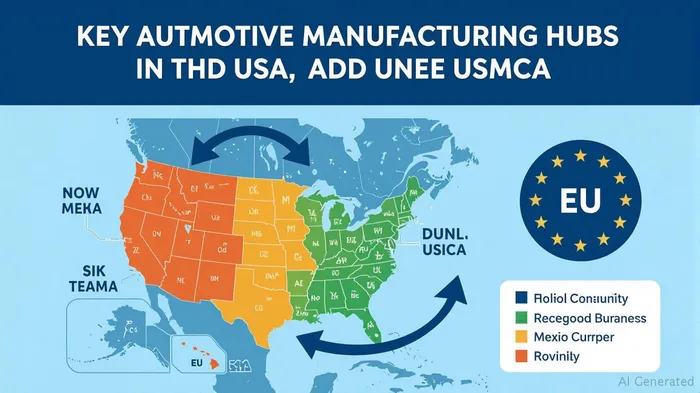
This comparison reveals how regional alignment with USMCA has insulated North American automakers from EU tariff pressures, offering a tactical benchmark for investors.
Conclusion: Trade Tensions as a Catalyst for Transformation
The U.S.-EU tariff saga is not merely a cost issue but a catalyst for reshaping automotive supply chains. Investors who focus on flexibility, localization, and litigation outcomes will be best positioned to capitalize on this shifting landscape. As trade policies continue to evolve, the winners will be those who adapt swiftly—and profit from the chaos.
Investment advice: Consider a mix of U.S. and USMCA-aligned automakers, paired with short positions in EU exporters, while hedging against legal risks via options or sector ETFs.

Stay ahead of the market.
Get curated U.S. market news, insights and key dates delivered to your inbox.
AInvest
PRO
AInvest
PRO



Comments
No comments yet