
US Tariffs Drive Record Revenue: Navigating Opportunities in Trade-Exposed Sectors
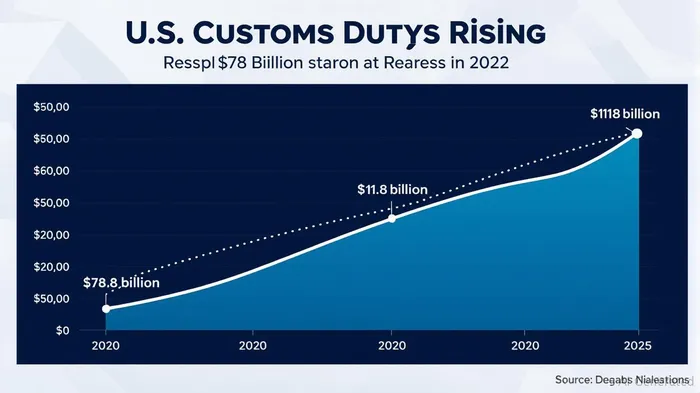
The U.S. government's tariff policies have generated unprecedented revenue, with customs duties hitting $82.13 billion in FY 2025—a figure that underscores the enduring nature of trade tensions. While tariffs have fueled inflation and disrupted global supply chains, they also create opportunities for investors to capitalize on sectors positioned to thrive in this environment. From logistics to materials, here's how to navigate the tariff-driven economy.
The New Normal: Tariffs Are Here to Stay
The Treasury's projections suggest tariffs will raise $2.6 trillion over the next decade, even after accounting for economic drag. This signals that trade tensions are not a temporary phase but a structural shift. Investors must adapt to a world where supply chains are reorganized, costs are reallocated, and certain industries gain competitive advantages.
Sector Spotlight: Logistics—The Winners of Disrupted Supply Chains
Tariffs have incentivized companies to shorten supply chains, favoring domestic and regional logistics. Firms like C.H. Robinson (CHRW) and XPO Logistics (XPO), which specialize in North American freight, are well-positioned to handle increased demand for last-mile delivery and customs brokerage. Meanwhile, railroads like Canadian National Railway (CNI) benefit from shippers avoiding tariff-heavy sea routes.
Actionable Play: Overweight logistics ETFs such as Global X U.S. Logistics ETF (USLO), which tracks companies in freight, warehousing, and transportation.
Materials: Protecting Domestic Manufacturing
With tariffs shielding domestic producers from foreign competition, U.S. materials firms enjoy pricing power. Nucor (NUE) and Allegheny Technologies (ATI), for instance, have benefited from 25% tariffs on imported steel. Investors should also monitor companies like E I du Pont de Nemours (DD), which supply chemicals critical to reshored manufacturing.
Actionable Play: Consider SPDR S&P Metals & Mining ETF (XME) for broad exposure, while selectively buying undervalued names in steel and industrial metals.
Consumer Goods: Pricing Power in Inflationary Environments
Tariffs have forced companies to raise prices or absorb costs, but firms with strong brands and customer loyalty can pass through increases. Procter & Gamble (PG) and Coca-Cola (KO), which dominate essential goods, have historically outperformed in inflationary periods. Similarly, L Brands (LB), which sources domestically, avoids the volatility of tariff-hit apparel imports.
Actionable Play: Focus on consumer staples stocks with pricing discipline and low exposure to imported inputs.
The Risks: Policy Volatility and Overrotation
While tariffs present opportunities, their impact is uneven. Sectors like construction and agriculture face long-term declines due to input cost pressures, while automakers struggle with layered tariffs (e.g., General Motors (GM) and Toyota (TM)). Investors must avoid overconcentration in trade-exposed industries and monitor geopolitical risks—such as sudden tariff rollbacks or retaliatory measures.
Conclusion: Position for Resilience
The tariff era has created a “winner-takes-most” dynamic. Logistics firms, domestic materials producers, and consumer goods giants with pricing power are the clear beneficiaries. Investors should rebalance portfolios toward these sectors while hedging against policy uncertainty through diversification.
Final Recommendation: Rotate into logistics and materials ETFs, pair with selective equity picks in consumer staples, and avoid sectors like autos and construction. Tariffs may be here for the long haul—invest accordingly.
Data sources: U.S. Customs and Border Protection, Federal Reserve Economic Data (FRED), Bloomberg.

Delivering real-time insights and analysis on emerging financial trends and market movements.
Latest Articles
Stay ahead of the market.
Get curated U.S. market news, insights and key dates delivered to your inbox.




Comments
No comments yet