
The Tariff Whipsaw: How Port of LA's Surge Reveals Supply Chain Shifts and Investment Opportunities
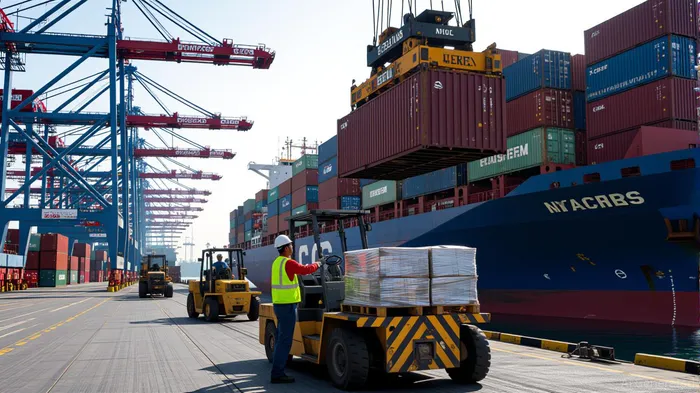
The Port of Los Angeles' record-breaking June 2025—processing 892,340 TEUs, a 32% jump from May—epitomizes the chaos of global trade policy volatility. Shippers, scrambling to avoid U.S. tariffs set to surge as high as 50% starting August 1, have triggered a “whipsaw” effect of frontloading cargo. This short-term surge masks deeper structural shifts: a permanent reshaping of supply chains, rising logistical costs, and a race to position inventories amid geopolitical uncertainty. For investors, the data offers a roadmap to capitalize on these trends.
The Tariff-Driven Surge and Its Limits
The June surge was fueled by an 8% year-over-year rise in loaded imports, with businesses rushing to stockpile goods before tariffs on China, Vietnam, and other trade partners took effect. July's projected 950,000 TEUs—supported by seven extra vessels—suggests a peak in this frontloading frenzy. However, the National Retail Federation warns that cargo volumes will drop by double digits from August to November as retailers confront overstocked warehouses and dwindling speculative orders. This volatility creates a critical dilemma: how to balance short-term inventory buffers against the risk of a post-tariff demand slump.
The stakes are highest for consumer goods and tech sectors. Retailers like WalmartWMT-- and TargetTGT--, already grappling with $40,000–$50,000 shipping costs per container (20x pre-tariff rates), face margin erosion as they pass costs to consumers. Meanwhile, tech firms reliant on Asian components—particularly semiconductors—risk supply chain bottlenecks if transshipment tariffs (e.g., 40% on goods partially made in China) complicate just-in-time manufacturing.
The Shift to Southeast Asia: Winners and Losers
The data reveals a long-term pivot: China's U.S. imports fell 28.3% year-over-year, while Vietnam's exports rose 7.7%. This divergence signals a structural shift in manufacturing hubs, favoring firms with Southeast Asian supply chains. Companies like CMA CGM, which expanded Southeast Asia routes, and logistics giants C.H. Robinson and J.B. Hunt—specializing in cross-border freight—are positioned to profit from reshaped trade routes.
Strategic Inventory Positioning: A Necessity, Not a Luxury
Firms are now treating inventory as a strategic asset. Proactive companies—such as Bogg, diversifying suppliers while managing transshipment costs—are mitigating risks. Yet smaller businesses, lacking scale to absorb tariff spikes, face existential threats. This divergence suggests two investment themes:
- Logistics and Storage:
- Ports and Infrastructure: The Port of Los Angeles' infrastructure upgrades, backed by federal funds, will underpin its role as a gateway.
3PL (Third-Party Logistics) Firms: Companies like C.H. Robinson, with expertise in global routing and customs compliance, are critical to navigating tariff complexity.
Tariff-Hedging Sectors:
- Southeast Asia Exposed: Firms with manufacturing or sourcing ties to Vietnam (e.g., apparel brands like PVH) or Thailand (e.g., automotive parts suppliers like PACCAR) benefit from lower tariffs and proximity to U.S. markets.
- Tech Component Alternatives: Semiconductor makers in Taiwan or Malaysia, less exposed to China's transshipment tariffs, could gain market share.
Risks and Opportunities in Q3-Q4
The coming months will test inventory strategies. A delayed holiday season—due to rushed pre-August orders—could pressure consumer goods stocks like Home DepotHD-- or Best Buy, which might see inventory corrections. Conversely, logistics firms and Southeast Asia-focused companies should thrive as supply chains stabilize.
Investment Recommendations
- Long:
- Logistics leaders (C.H. Robinson, J.B. Hunt) for their global network agility.
- Port operators (e.g., the Port of Los Angeles' infrastructure partners) benefiting from reshaped trade flows.
Southeast Asia-exposed manufacturers (e.g., PVHPVH--, PACCAR) and tech suppliers.
Short:
- Overstocked retailers (Walmart, Target) facing margin pressure and inventory write-downs.
Tech firms reliant on China-based components without alternative sourcing plans.
Monitor:
- Transshipment tariff impacts on industries like apparel and electronics.
- Red Sea rerouting delays (adding 14 days to transit) as a test of supply chain resilience.
Conclusion
The Port of Los Angeles' record volumes are a snapshot of a fractured global trade system. For investors, the lesson is clear: allocate capital to firms that can navigate tariff complexity, diversify suppliers, and dominate logistics. The winners will be those who treat inventory not as a cost, but as a strategic lever to outlast the tariff whipsaw—and position themselves for the post-volatility era.

Stay ahead of the market.
Get curated U.S. market news, insights and key dates delivered to your inbox.
AInvest
PRO
AInvest
PRO



Comments
No comments yet