
Tariff Turbulence: Navigating Trade Policy Uncertainty in U.S. Equity Markets
The second quarter of 2025 brought a seismic shift in U.S. trade policy, with tariff announcements and negotiations reshaping global supply chains and equity market dynamics. As President Trump's “Liberation Day” tariffs targeted imports from 14 countries—including Vietnam, Japan, and South Korea—the resulting uncertainty has left investors grappling with sector-specific vulnerabilities and valuation pressures. This article dissects the ripple effects of trade policy on equity markets and offers strategies to navigate the turbulence.
Trade Policy Uncertainty: The Catalyst for Market Volatility
The administration's aggressive tariff stance has created a “wait-and-see” environment for investors, with deadlines and renegotiations dominating headlines. The extension of the initial 90-day tariff pause to August 1—a tactic to maintain leverage—has prolonged uncertainty, particularly for sectors reliant on global supply chains.
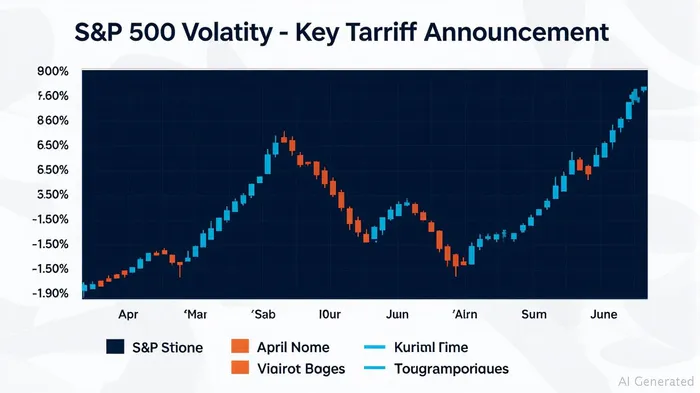
The S&P 500 and Nasdaq initially dipped after the April 2 tariffs were announced but rebounded to record highs by June, buoyed by hopes of resolution. However, the DAX index (+30% in euro terms) outperformed the S&P 500 (+1.5%) during the same period, signaling a broader shift in investor sentiment toward European markets.
Sector-Specific Vulnerabilities: Winners and Losers in the Tariff Landscape
1. Automotive & Manufacturing: Stranded in a Cost-Squeeze**
The automotive sector faces a perfect storm of rising input costs and delayed supply chain adjustments. While tariffs on copper and steel benefit domestic producers like Freeport-McMoRan (+2.5% stock rise), automakers are locked into multiyear contracts with foreign suppliers.
Tesla, already under scrutiny for CEO Elon Musk's political affiliations, saw sales drop 14% amid regulatory headwinds. Investors hedged risks via puts, highlighting the sector's exposure to policy shifts.
2. Healthcare: Navigating Regulatory Crossfires**
The threat of 200% tariffs on pharmaceuticals pressured drugmakers, but ModernaMRNA-- surged 8.8% after challenging restrictive vaccine policies. Meanwhile, the U.S.-Vietnam trade deal—which imposed a 20% tariff on generic drugs—created uneven opportunities:
- Winners: U.S. generic manufacturers like Teva and Mylan.
- Losers: Indian and Chinese pharma exporters facing transshipment penalties.
3. Utilities & Renewables: Collateral Damage from Tariff Wars**
The ban on tax credits for renewable energy projects sent solar stocks plummeting. SunRun fell 11.4%, while NextEra Energy emerged as a relative safe haven due to its diversified portfolio and regulated utility assets.
Geopolitical Risks: The Elephant in the Room
China's response to U.S. tariffs—accelerating tech self-reliance and diversifying trade routes—has intensified strategic competition. The U.S.-China trade deficit, while narrowing, now reflects a shift toward higher-value goods (e.g., semiconductors), complicating sector valuations.
The Dow Jones U.S. China Exposure Index has underperformed the S&P 500 by 8% year-to-date, underscoring investor caution toward firms with heavy China exposure.
Investment Strategies for the Tariff Era
1. Sector Rotation: Focus on Resilience**
- Avoid: Banks with legacy liabilities (e.g., JPMorgan) and tech giants facing antitrust scrutiny (e.g., Amazon).
- Focus On:
- Utilities: NextEra Energy's regulated assets and renewable projects offer stability.
- Genomic Medicine: Companies like IlluminaILMN-- and Thermo Fisher ScientificTMO-- benefit from global healthcare spending.
- Diversified Auto: ToyotaTM-- and BYD, with strong supply chain flexibility, outperform U.S. peers.
2. Leverage Volatility with Options**
Use puts on cyclical sectors (e.g., automotive) and calls on energy ETFs to capitalize on tariff-driven swings. For example, purchasing puts on TeslaTSLA-- stock could hedge against further regulatory risks.
3. Global Diversification**
Allocate to European equities (e.g., Daimler, Siemens) and emerging markets (+11% in Q2) to mitigate U.S. policy overhang.
Conclusion: The Tariff Tightrope
U.S. equity markets have proven resilient despite tariff-induced uncertainty, but investors must remain vigilant. The August 1 deadline looms large, with unresolved negotiations threatening renewed volatility. Prioritizing sectors with pricing power, geopolitical insulation, and supply chain agility will be critical. As trade policy remains a wildcard, portfolios should balance growth exposure with defensive hedges—because in the tariff era, preparation is the best strategy.

Stay ahead of the market.
Get curated U.S. market news, insights and key dates delivered to your inbox.
AInvest
PRO
AInvest
PRO



Comments
No comments yet