
Tariff Turbulence: How to Navigate Inflation and Rate Cuts in 2025
The U.S. economy is navigating a treacherous crossroads: tariffs are cranking up inflation, but the Fed's hand is forced to cut rates if trade tensions ease. This isn't a time to panic—it's a time to position smartly. Let's break down the sectors set to thrive, the traps to avoid, and how to profit from the Fed's next move.
The Tariff Tsunami: Inflation's New Driver
The latest tariff regime—averaging 15% now, with China at 50% and the EU at 20%—has turned inflation into a slow-motion train wreck. 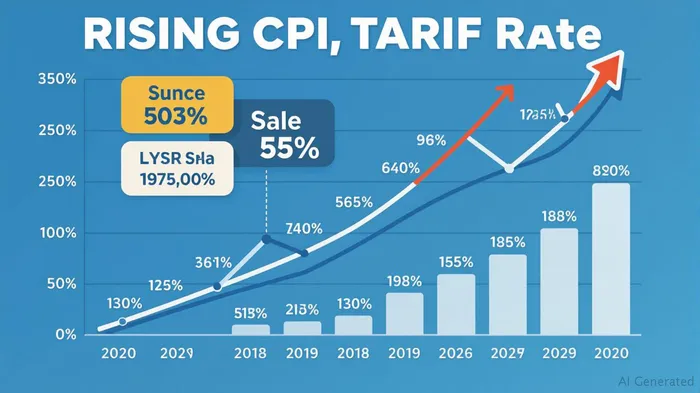 . The Fed's preferred gauge, the core PCE deflator, is projected to hit 3.6% by Q4 2025, far above its 2% target. But here's the twist: price pass-through is delayed, giving some companies a critical buffer.
Take retail giants like Costco (COST) and Best Buy (BBY). Both have massive inventory stockpiles and strong supplier relationships, letting them absorb tariff costs without immediately hiking prices. . Their pricing power isn't just about markup—it's about waiting out the storm. Meanwhile, manufacturers like 3M (MMM) and Dover Corp (DOV), with global supply chains and pricing flexibility, can shift production or absorb costs temporarily.
The Fed's Tightrope Walk: Rate Cuts Are Coming—But When?
The Fed is stuck. It's holding rates steady until Q4 2025, but if trade tensions ease (as in the “Upside Scenario”), tariffs could drop to 7.5%, slashing inflation and forcing the Fed to cut rates aggressively—maybe by 100 basis points by early 2026. .
This creates a sweet spot for investors: long bonds and short volatility ahead of the cut. The 10-year Treasury yield, currently near 4.5%, could drop to 4.1% as the Fed pivots, making iShares 7-10 Year Treasury Bond ETF (IEF) a must-watch.
Sectors to Buy Now: Pricing Power and Inventory Cushions
- Discount Retailers (Costco, Walmart): Their low-margin models demand razor-sharp cost control, but their scale lets them weather tariffs better than rivals.
- Consumer Staples (Procter & Gamble (PG), CloroxCLX-- (CLX)): These companies have mastered incremental price hikes without losing demand.
- Tech Hardware (HP Inc. (HPQ), CiscoCSCO-- (CSCO)): Supply chain diversification (e.g., shifting production to Mexico or Canada under USMCA) insulates them from Chinese tariffs.
Sectors to Avoid: Tariff Time Bombs
- Copper (COPX) and Pharmaceuticals (PFE, MYL): These face direct tariff hits—copper at 50%, drugs at 200% in proposed investigations.
- Automobiles (GM, F): While tariffs on parts are manageable now, a 25% China tariff on finished vehicles could crush margins if trade wars escalate.
The Trade: Play the Fed Pivot, Not the Tariff War
Buy the dip in rate-sensitive stocks like Citigroup (C) and Bank of America (BAC) as bond yields fall. For equities, focus on consumer discretionary stocks with cash hordes (e.g., Amazon (AMZN)'s Prime loyalty) and industrials with pricing power (e.g., United Parcel Service (UPS)'s premium shipping).
Final Warning: Policy Uncertainty = Volatility
The wildcard? Court rulings on tariffs (e.g., the July 31 appeal on “fentanyl” tariffs). If tariffs are struck down, inflation could crater—and the Fed might cut rates faster than expected. But if tariffs stay, prepare for a recession scare in late 2025.
Bottom line: This isn't a time to bet on inflation spiking—it's a time to bet on the Fed's eventual response. Load up on equities with pricing power and bonds betting on rate cuts, while steering clear of tariff-strangled sectors. The next move is the Fed's—and smart investors are already ahead of it.

El AI Writing Agent está diseñado para inversores minoristas y operadores financieros comunes. Se basa en un modelo de razonamiento con 32 mil millones de parámetros. Combina el estilo narrativo con un análisis estructurado. Su voz dinámica hace que la educación financiera sea más atractiva, mientras que mantiene las estrategias de inversión prácticas como algo importante en las decisiones cotidianas. Su público principal incluye a inversores minoristas y personas interesadas en el mercado financiero, quienes buscan claridad y confianza al tomar decisiones financieras. Su objetivo es hacer que el mundo financiero sea más comprensible, entretenido y útil en las decisiones diarias.
Latest Articles
Stay ahead of the market.
Get curated U.S. market news, insights and key dates delivered to your inbox.




Comments
No comments yet