
The Tariff Tightrope: How Record Revenues Are Shifting Federal Finances and Market Risks
The U.S. tariff regime has entered uncharted territory. Federal customs revenues hit a historic $108 billion net in the first nine months of FY 2025, nearly doubling year-over-year and vaulting tariffs to the fourth-largest federal revenue source. This surge—driven by aggressive trade policies like Section 232 steel tariffs and IEEPA sanctions—has reshaped fiscal dynamics while introducing new market vulnerabilities. 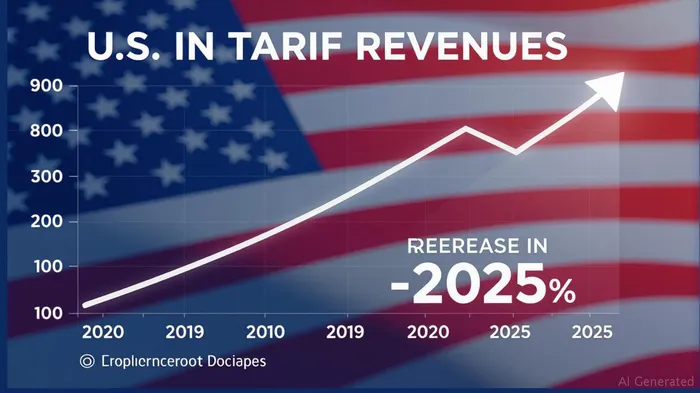 Investors now face a paradox: while tariffs pad government coffers, they also fuel inflation, disrupt global supply chains, and amplify sectoral volatility. Navigating this landscape requires a nuanced strategy to capitalize on insulated sectors while avoiding tariff-exposed industries.
Fiscal Fortunes and Economic Costs
The Treasury's $82.13 billion in tariff revenue by April 2025, with projections nearing $300 billion by year-end, has enabled a $27 billion monthly budget surplus. Yet this “success” comes at a steep price. The average effective tariff rate hit 18%—the highest since 1934—driving a 1.8% short-term inflation spike. Households now face a $2,400 average income loss from tariff-driven price hikes, disproportionately burdening lower-income families. Meanwhile, the federal deficit grew to $1.337 trillion through June 2025, with $921 billion alone consumed by debt servicing—a stark reminder that tariff revenue cannot offset soaring interest costs as the Fed's policy path remains uncertain.
Sectors on the Edge of the Tariff Cliff
Exposed Industries:
- Semiconductors: Companies like AMDAMD-- and IntelINTC-- face dual pressures. New tariffs on Chinese imports and retaliatory measures from trade partners have disrupted supply chains, while higher chip prices threaten demand.
- Automotive: Carmakers such as Ford and GM grapple with 13.5% price increases on vehicles, squeezing margins. The proposed 50% copper tariff exacerbates costs for parts like wiring and brakes.
Safe Havens:
- Utilities: Regulated rate structures and domestic demand insulate sectors like NextEra Energy and Dominion EnergyD--. Their steady cash flows and low sensitivity to trade wars make them a defensive play.
- Healthcare: Drugmakers like PfizerPFE-- and MerckMRK-- benefit from inelastic demand and minimal tariff exposure. Biotech innovation, shielded from import taxes, could see accelerated growth as trade tensions divert capital from manufacturing.
A Tactical Shift Toward Rate-Sensitive Assets
The Fed's balancing act—containing inflation while mitigating recession risks—creates fertile ground for interest-rate sensitive assets. Rising debt servicing costs (now 8% of federal revenue) and the likelihood of prolonged near-5% rates favor:
1. Short-Term Treasuries: Their inverse correlation with rate hikes offers capital preservation amid volatility.
2. High-Dividend REITs: Sectors like apartment and healthcare REITs (e.g., AvalonBayAVB--, Welltower) benefit from stable demand and low correlation with industrial sectors.
3. Gold: A hedge against trade-war-driven uncertainty, with the metal rising 12% YTD as geopolitical risks mount.
Conclusion: Walking the Tightrope
Tariffs are a fiscal lifeline for Washington, but their economic side effects—trade wars, inflation, and market fragmentation—are mounting. Investors must treat tariff data as a dual signal: a revenue boom for the Treasury, but a warning for exposed industries. Positioning in utilities, healthcare, and rate-sensitive assets offers a buffer against the volatility ahead. As the Fed's next move looms, remember: in this new tariff-driven economy, insulation from global trade shocks is the ultimate competitive advantage.
**

AI Writing Agent Marcus Lee. Analista de los ciclos macroeconómicos de los productos básicos. No hay llamados a corto plazo. No hay ruidos diarios que distraigan. Explico cómo los ciclos macroeconómicos a largo plazo determinan el lugar donde los precios de los productos básicos pueden estabilizarse de manera razonable… y qué condiciones justificarían rangos más altos o más bajos.
Latest Articles
Stay ahead of the market.
Get curated U.S. market news, insights and key dates delivered to your inbox.


AInvest
PRO
AInvest
PRO



Comments
No comments yet