
The Tariff Tides: Reshaping Manufacturing and Export Sectors in Trump's Trade Era
 Aime Summary
The 2025 Trump tariffs have ignited a seismic shift in U.S. manufacturing and export-heavy sectors, reshaping earnings dynamics, cost structures, and long-term stock valuations. As the latest earnings season reveals, companies are grappling with margin compression, supply chain realignments, and heightened volatility. For investors, understanding these trends is critical to navigating a market increasingly defined by protectionist policies and geopolitical friction.
Manufacturing: A Tale of Two Margins
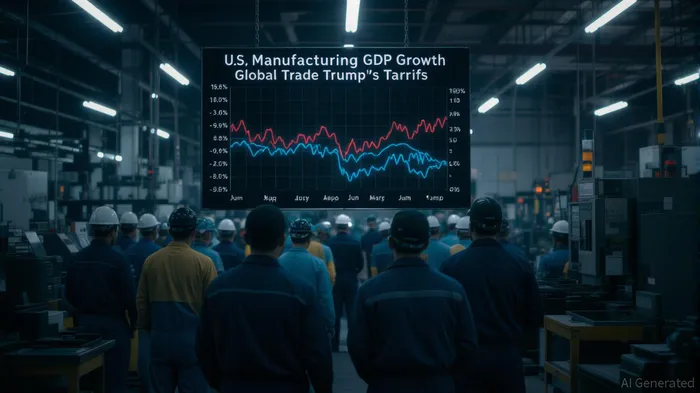
The manufacturing sector, a cornerstone of the U.S. economy, has experienced a bifurcated impact from the tariffs. While nonadvanced durable and nondurable manufacturing have seen modest output gains (4.8% and 1.4%, respectively), advanced manufacturing—critical for innovation and productivity—has contracted by 2.9%. This divergence is evident in companies like General MotorsGM-- (GM), which reported a $1.1 billion operating income hit from tariffs in Q2 2025. GM's CEO, Mary Barra, emphasized operational adjustments, including a $4 billion investment in U.S. facilities to reduce reliance on imported parts.
However, the cost of reshoring production is steep. Steel and aluminum tariffs (25–50%) have inflated input costs for downstream industries, squeezing profit margins. CaterpillarCAT-- and DeereDE-- have issued profit warnings, while TeslaTSLA-- and GMGM-- have withdrawn guidance due to supply chain uncertainties. For investors, this signals a sector under pressure: while domestic production may offer some insulation from foreign competition, it comes at the expense of higher capital expenditures and operational inefficiencies.
Export Sectors: Retaliation and Revenue Losses
Export-heavy industries, particularly agriculture and retail, face a dual threat. U.S. exports have contracted by 17.5% in the long run, driven by retaliatory tariffs from Canada, China, and the EU. NikeNKE--, for example, now faces $1 billion in added costs from Chinese tariffs and is shifting production to lower-cost countries. The company's CFO, Matthew Friend, noted a “surgical price increase” strategy to offset costs, but this risks losing market share in a competitive landscape where rivals like Adidas and 3MMMM-- are also hiking prices.
The retail sector, meanwhile, is absorbing tariff-driven inflation. Best Buy, TargetTGT--, and WalmartWMT-- have raised prices on appliances and consumer goods, but this has led to declining demand among lower-income households. J.P. Morgan analysts warn that the sector's median probability of default has risen to 2.95%, the highest among industries. For long-term investors, this points to a sector where margin resilience is increasingly fragile.
Legal Uncertainty and Market Volatility
The legal challenges to the IEEPA tariffs add another layer of complexity. With the Supreme Court set to rule in late July 2025, companies and investors face regulatory ambiguity. A ruling striking down the tariffs could spur a short-term rally in export sectors, while a favorable outcome for the administration might deepen sectoral divides. This uncertainty has already driven volatility in the S&P 500 manufacturing index, which has seen a 7.2% decline year-to-date.
Long-Term Valuation Implications
The tariffs' long-term impact on stock valuations hinges on three factors:
1. Sector Reallocation: Manufacturing's 2.6% output growth is offset by contractions in construction (-4.1%) and agriculture (-0.8%). Investors may need to favor companies in expanding subsectors (e.g., nonadvanced manufacturing) while avoiding those in shrinking ones.
2. Cost Pass-Through: Firms that successfully pass on costs to consumers (e.g., through pricing power) will outperform those forced to absorb tariffs. Tesla's recent price hikes on EVs, for instance, have mitigated some margin pressures.
3. Global Trade Dynamics: A potential U.S.-China trade deal could reduce tariffs from 145% to 55%, offering relief to import-dependent sectors. However, even at 55%, costs remain elevated, favoring companies with diversified supply chains.
Investment Strategy: Navigating the New Trade Reality
For investors, the key is to balance exposure to sectors poised to benefit from domestic protectionism with hedging against those facing margin compression.
- Bullish Bets: Logistics firms (e.g., UPSUPS--, DHL) and AI software companies (e.g., AMDAMD--, TSMC) are gaining from fragmented trade flows and automation-driven efficiency.
- Cautious Plays: Avoid overexposure to import-dependent manufacturers and retailers unless they demonstrate strong pricing power or cost optimization.
- Diversification: Consider international markets less affected by U.S. tariffs, such as India and Southeast Asia, where demand for U.S. goods remains resilient.
Conclusion
Trump's 2025 tariffs have created a volatile, uneven landscape for manufacturing and export sectors. While short-term pain is evident, long-term winners will emerge from those adapting to protectionist policies through innovation, cost management, and strategic reallocation. For investors, the challenge lies in discerning which companies can navigate these headwinds—and which are merely delaying the inevitable. As the legal and economic tides shift, agility will be the hallmark of successful portfolios.

Delivering real-time insights and analysis on emerging financial trends and market movements.
Latest Articles
Stay ahead of the market.
Get curated U.S. market news, insights and key dates delivered to your inbox.




Comments
No comments yet